Highlights of Old Montreal
Montreal is a city founded by French settlers.
In 1642, a French military fort called Fort Ville-Marie was built, serving as a base for the full-scale settlement of Montreal. Montreal developed as a center of Catholic missionary activity in North America and as a hub for the fur trade in beaver, otter, mink, and other furs.
In 1760, the British army, which had won the Seven Years’ War (the French and Indian War), took control of Montreal from the French army. In fact, most of the buildings seen in Old Montreal were built during or after the period of British rule.
Even under British rule, French culture and traditions, as well as freedom of religion, were respected.Notre-Dame Basilica of Montrealis a representative example of a building designed in the French architectural style under British rule.
Old Montreal preserves a unique historic streetscape influenced by both France and Britain.
Montreal's Notre-Dame Basilica

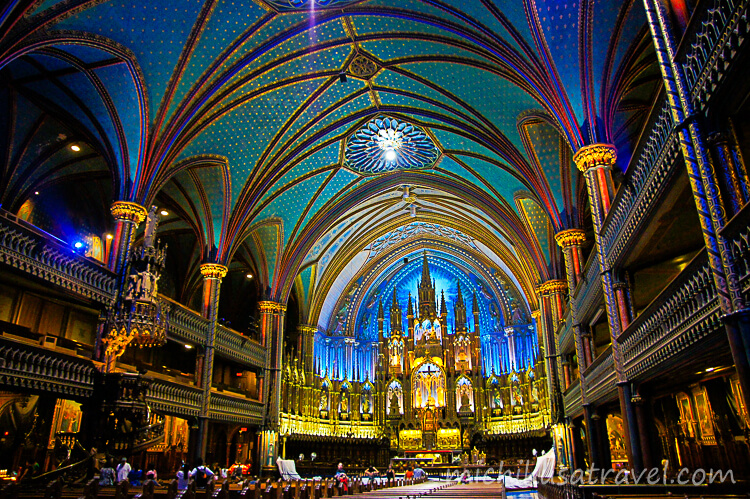
 Montreal's Notre-Dame Basilica is one of the oldest Gothic Revival buildings in North America. Highlights include its blue ceiling, which evokes the night sky, and its altar illuminated with dramatic lighting.
For information about the cathedral’s blue ceiling, altar, and tours, please see the article below.
Bank of Montreal Building
 The Bank of Montreal Building (Édifice de la Banque de Montréal) faces Place d'Armes, opposite Notre-Dame Basilica of Montreal. The Bank of Montreal is Canada’s oldest bank. The Bank of Montreal Building was the bank’s 2nd headquarters and is the oldest surviving bank building in Canada. It was designed in the Neoclassical style. Its Corinthian columns are a distinctive feature.
Montreal City Hall

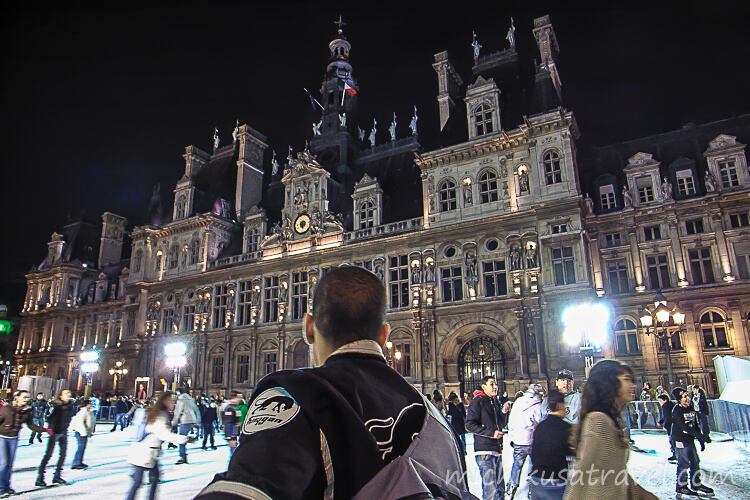
Montreal City Hall (Hôtel de Ville de Montréal) was designed by Henri-Maurice Perrault and others in the architectural style of the Second Empire. Representative buildings in this style include the Louvre Palace (the Louvre Museum) and the Palais Garnier (the Garnier Opera House) in Paris.
For information about Paris attractions, including the Louvre and the Palais Garnier, see the article below.
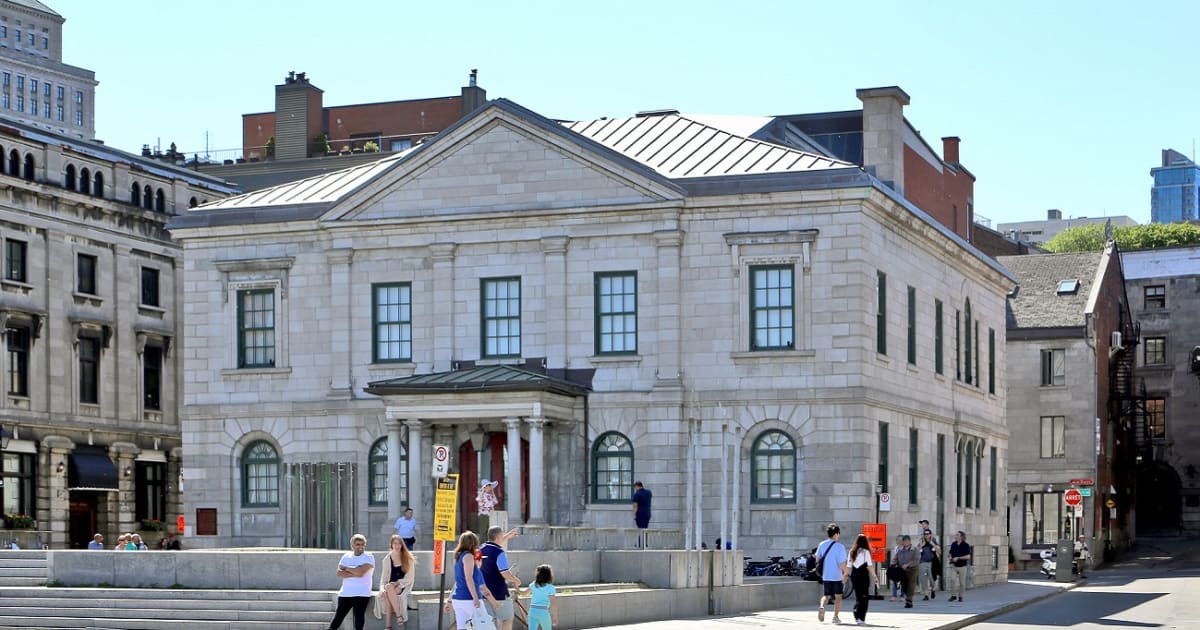
Lucien-Saulnier Building

The Lucien-Saulnier Building (Édifice Lucien-Saulnier) is Montreal's 2nd courthouse and the oldest surviving courthouse building. It was designed in the Neoclassical style by Henri-Maurice Perreault and others, who also worked on Montreal City Hall. Its Ionic columns are a defining feature.
Ernest Cormier Building

The Édifice Ernest-Cormier is Montreal's 3rd courthouse. Its distinctive design blends Neoclassical and Art Deco styles. Geometric patterns are arranged in continuous rows along the Doric columns.
Notre-Dame-de-Bon-Secours Chapel

The Chapelle Notre-Dame-de-Bon-Secours is one of the oldest churches in Montreal. The first chapel was built in 1665 under French rule. The building seen today was rebuilt in 1771. A statue of the Virgin Mary holding the infant Jesus is installed inside.
 Notre-Dame-de-Bon-Secours Chapel has a completely different appearance from the front and the back. Facing the Saint Lawrence River, a statue of the Virgin Mary with outstretched arms stands atop the high roof. Known as the “Star of the Sea (L'Étoile de la mer),” it watches over the safety of seafarers.

Bonsecours Market

Standing next to Notre-Dame-de-Bon-Secours Chapel is Bonsecours Market (Marché Bonsecours). It was built in 1847, when Montréal was the capital of the Province of Canada. The market is still in operation, housing boutiques, restaurants, and other businesses.


Calvet House

Maison Du Calvet was built in the 1770s by the wealthy merchant Pierre Calvet as both a residence and commercial premises. Its thick stone firewalls and steeply pitched roof convey the architectural style of the period to this day.

Essential Information about Old Montréal
The information below was checked against official sources on October 11, 2026. Please also check the latest information on the official website when planning your trip.
- 🔗 Official website
- The City of Montreal has published a plan to preserve and enhance Old Montreal.
 Un plan pour protéger et mettre en valeur le Vieux-MontréalLe Plan de protection et de mise en valeur du Vieux-Montréal propose des actions pour protéger, développer et mettr...montreal.ca
- 📍 Location
- Vieux-Montréal, Montréal, Québec
- 🕒 Hours
- The streets and squares of Old Montreal can be explored throughout the day. Visiting conditions and opening hours vary by building, including cathedrals, churches, and markets, so check the official information for each destination if you plan to go inside.
- 💶 Admission
- Exploring Old Montreal is free. Cathedrals, museums, and events may charge admission depending on the facility.
- ⏱️ Duration
- Allow about 2–3 hours to walk around Place d’Armes, Montreal City Hall, Notre-Dame-de-Bon-Secours Chapel, and Bonsecours Market.⚠️ The time required varies depending on whether you visit the interiors of the buildings and stop for a meal or a break along the way.
Getting to Old Montreal
To reach Old Montreal, take the metro's Orange Line to Place-d'Armes station or Champ-de-Mars station.
From Place-d'Armes station, walk east along Rue Saint-Sulpice for about 5 minutes to reachNotre-Dame Basilica of Montreal.

Subway and accessibility
Both Place-d'Armes and Champ-de-Mars stations have elevators accessible from street level. Before setting out, check the operating status of the elevators along your route and the accessible transfer routes. Due to delays in updates, online information may differ from conditions at the station.

The related guide “【モントリオール】観光スポット・グルメ・交通・モデルコースを解説” is currently available only in Japanese.
