About Japan's steam railways
Japan’s steam railway began with theopening of the railway between Shimbashi and Yokohama on October 14, 1872 (the 5th year of the Meiji era). The steam locomotives used at the beginning wereClass 150 (Locomotive No. 1)and other engines imported from Britain and elsewhere, so Japan’s railways began their journey with foreign-built locomotives. During the development of Hokkaido, the“Yoshitsune,” “Benkei,” and “Shizuka” nicknamedClass 7100 locomotives played an active role.
From 1902 (Meiji 35)the Class 230, the first mass-produced steam locomotive made in Japanbegan to be manufactured, and Japanese steam locomotives gradually entered an era of domestic production.Classes 8620, C51, and C57represented passenger locomotives,Classes 9600 and D51represented freight locomotives; various small locomotives for branch lines and station yards were also developed according to their uses.
During the war, demand for freight transport increased, and freight locomotives with substantial tractive powerD52and others saw active service. After the war, the situation reversed: as demand for freight transport declined, some freight locomotives became surplus, andthe boilers of the D51 and D52 locomotives were reusedfor passenger locomotivesC61 and C62which were manufactured.
As electrification and the shift to diesel power progressed from main lines to branch and local routes, steam locomotives gradually came to the end of their role. On 1975 (the 50th year of the Shōwa era), 12/14,C57 No. 135 hauled Japanese National Railways’ last scheduled passenger train on the Muroran Main Linebringing the history of scheduled passenger service by steam locomotive in Japan to a close.
Classification of Steam Locomotives
Steam locomotives are broadly classified into tender locomotives and tank locomotives.

A tender steam locomotive is designed with atender like the one shown in the photograph coupled behind the locomotive, where coal and water are loaded. It can carry large quantities of fuel and water, making it suitable for long-distance operation and use on main lines.
A tank steam locomotive is a type that carries coal and water on the locomotive itself. Since there is no need to couple a separate tender, the whole unit is compact and easy to handle, making it suitable for shunting work in station yards and short-distance operation on branch lines.
Steam locomotive wheel arrangement
The wheel arrangement (axle arrangement) of a steam locomotive indicates the order of its leading wheels, driving wheels, and trailing wheels. In the Japanese system, it is expressed by the number of axles: leading and trailing axles are represented by numbers, while driving axles are represented by letters. For example, “2C1” means 2 leading axles, 3 driving axles, and 1 trailing axle. The letters used in the Japanese National Railways’ class designations also correspond to this system: the “C” in C57 indicates 3 driving axles, while the “D” in D51 indicates 4 driving axles.
| number of driving axles | alphabet | representative classes |
|---|---|---|
| 2 | B | Class B20 |
| 3 | C | Class 8620 Class C51 Class C57 Class C58 Class C62 |
| 4 | D | Class 9600 Class D51 Class D52 |
| 5 | E | Class E10 |
Most Japanese steam locomotives have 3 or 4 driving axles, andthose with 3 driving axles (C), capable of relatively high speeds, were used mainly for passenger service, while those with 4 driving axles (D), offering relatively high tractive effort, were used mainly for freight service. However, the difference between passenger and freight locomotives is not determined solely by the number of driving axles; it is also characterized by the diameter of the driving wheels, the arrangement of the leading and trailing wheels, and the design of the boiler and firebox.
In the Whyte wheel arrangement system, used mainly in the United Kingdom and the United States, the arrangement is expressed by the number of wheels rather than axles, with leading, driving, and trailing wheels listed in that order and separated by hyphens. For example, the Japanese notation “2C1” represents 4 wheels on 2 leading axles, 6 wheels on 3 driving axles, and 2 wheels on 1 trailing axle, so it becomes “4-6-2” in the Whyte system.
Each axle arrangement (wheel arrangement) has a common name, such as “Pacific.”
| Japanese notation | Whyte notation | Common name |
|---|---|---|
| 1C | 2-6-0 | Mogul |
| 1C1 | 2-6-2 | Prairie |
| 2C1 | 4-6-2 | Pacific |
| 2C2 | 4-6-4 | Tender type: Hudson Tank type: Baltic |
| 1D | 2-8-0 | Consolidation |
| 1D1 | 2-8-2 | Mikado |
| 1D2 | 2-8-4 | Berkshire |
| 2D1 | 4-8-2 | Mountain |
| 2D2 | 4-8-4 | Northern |
Steam Locomotives in the Early Days
Japanese National Railways 150-class steam locomotive (locomotive 1)

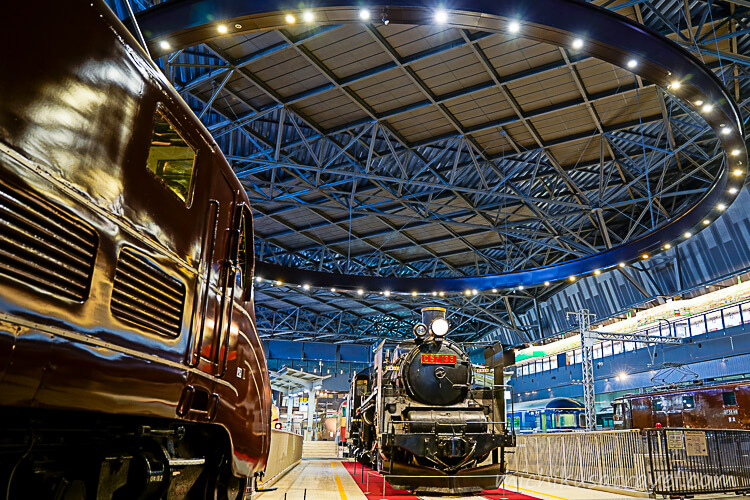
Japan’s railway opened between Shimbashi and Yokohama on October 14, 1872. Japanese National Railways Class 150 steam locomotive was manufactured in 1871 by the British Vulcan Foundry and imported for the opening of Japan’s railway asJapan’s first steam locomotiveIt is affectionately known as “Locomotive No. 1.” In 1997, it became the first railway vehicle to be designated an Important Cultural Property of Japan. It is exhibited at the Railway Museum.
For information on the Railway Museum’s highlights, opening hours, tickets, and more, please see the article below.

The JNR 150 Class steam locomotive (locomotive No. 1) was sold to the Shimabara Railway in Nagasaki Prefecture in 1911 (Meiji 44). After supporting the company during its early years, it was returned to the Ministry of Railways for preservation in 1930 (Showa 5). On its return, Shimabara Railway founder Mototaro Ueki expressed his feelings on a plaque with the words “immeasurable sorrow at parting.”
Japanese Government Railways 7100-class steam locomotive, locomotive 1 “Yoshitsune”
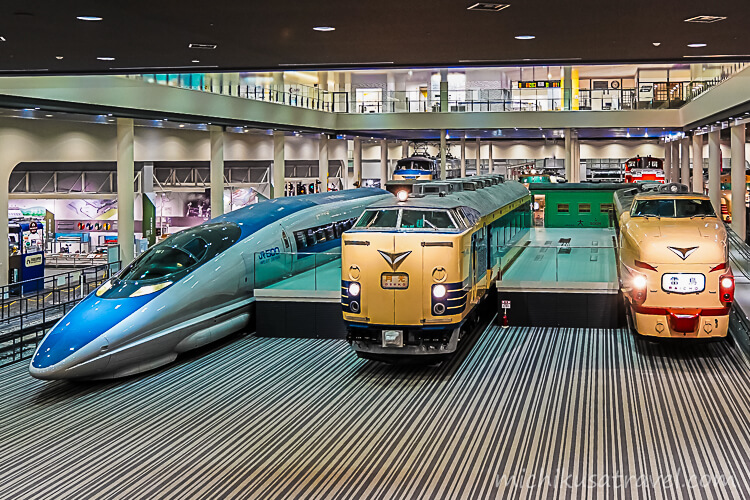
 The JNR Class 7100 steam locomotive is a tender locomotive manufactured by the US company H. K. Porter between 1880 and 1889. It was introduced for the opening of the government-operated Horonai Railway, Hokkaido’s first railway. This locomotive is No. 1 of the class and is known by the nickname “Yoshitsune.” It is on display at the Kyoto Railway Museum.
For information about the highlights, opening hours, tickets, and more about the Kyoto Railway Museum, see the article below.
Japanese National Railways class 7100 steam locomotive No. 2 “Benkei”

This is “Benkei,” the 2nd locomotive of Class 7100. At the front are a cowcatcher and a distinctive chimney called a diamond stack;a steam locomotive from the era of the American Westthese are its characteristic features. It is on display at the Railway Museum.

H. K. Porter was a locomotive manufacturer based in Pittsburgh, Pennsylvania. “369” indicates the production number, while “1880” indicates the year of manufacture.
Japanese National Railways Class 7100 steam locomotive No. 6, “Shizuka”

This is No. 6 of the Class 7100 locomotives, “Shizuka.” 8 Class 7100 locomotives were built, but only 3 remain today: “Yoshitsune,” “Benkei,” and “Shizuka.” The name “Shizuka” comes from Shizuka Gozen, Yoshitsune’s concubine. It is exhibited at the Otaru City General Museum Main Building.
For information on the highlights, opening hours, and admission fees of the Main Building of the Otaru City General Museum, see the article below.
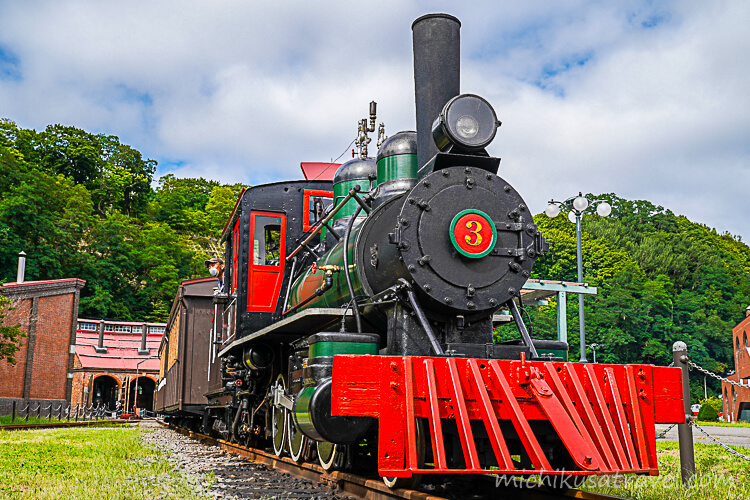
Japanese National Railways 1800-class steam locomotive

The JNR class 1800 (class 1801) was a small tank steam locomotive introduced in the early Meiji era to handle the steep gradient between Kyoto and Otsu over Osaka Pass. It was imported from the British firm Kitson in 1881.
JNR 1290-class steam locomotive “Zenkō”

The Japanese National Railways 1290-type steam locomotive “Zenkō” is a tank locomotive manufactured by the British company Manning Wardle in 1881 (14 year of the Meiji era). It is introduced as the first steam locomotive to run in Saitama Prefecture. The name “Zenkō” derives from the fact that the locomotive was unloaded and assembled near Zenkō-ji Temple in Kawaguchi, Saitama Prefecture.
JNR Class 5500 steam locomotive (5540)
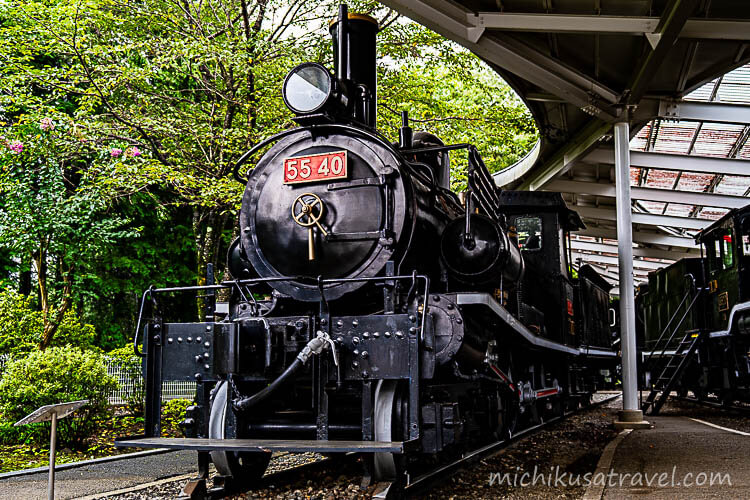 The JNR Class 5500 steam locomotives were imported from the British company Beyer, Peacock between 1893 and 1898 and were representative passenger steam locomotives of the Meiji era. In addition to the government railways, they were used by Nippon Railway and Sobu Railway, among others, and served especiallyas Nippon Railway's main locomotives. They are on display at Ome Railway Park.
For information on the attractions, opening hours, and admission fees at Ome Railway Park, please see the article below.
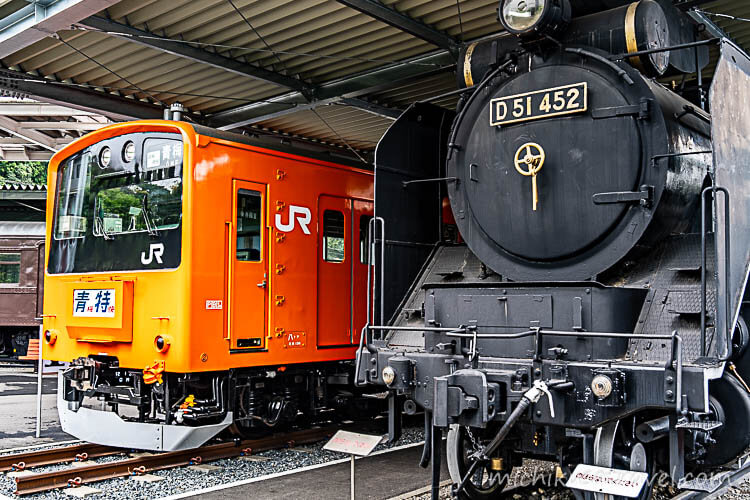
JNR 7150-class steam locomotive “Taishō-gō”

The JNR Class 7150 steam locomotive “Taishō” was built as a one-off at the Temiya Works in Hokkaido in 1895 andis the oldest surviving steam locomotive manufactured in Japan.
It was named “Daishō” to commemorate the victory in the First Sino-Japanese War, and after nationalization it came to be known as Class 7150. It uses parts from a JNR Class 7100 steam locomotive manufactured by the U.S. company H. K. Porter.
Japanese National Railways Class 230 Steam Locomotive (233)

The JNR Class 230 steam locomotive was produced in 41 units between 1902 (35th year of the Meiji era) and 1909 (42nd year of the Meiji era), making it the first mass-produced steam locomotive manufactured in Japan. No. 233 has been designated an Important Cultural Property of Japan. It is on display at the Kyoto Railway Museum.
JNR Class 2120 steam locomotive (2221)
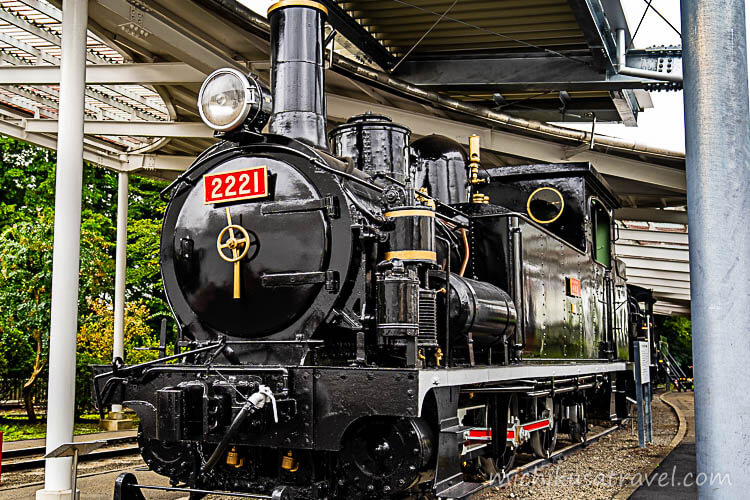
The Japanese National Railways Class 2120 steam locomotives were tank locomotives for freight service, imported mainly from Britain in the late Meiji period. Locomotive No. 2221, preserved at Ome Railway Park, was built in 1905 by the North British Locomotive Company in Britain.
A medium-sized locomotive with 3 driving axles, it was known, together with related classes such as the 2100 and 2400,「B6」by the popular nickname “B6.” “B6” was its class designation during the Railway Works Bureau era, derived from its being the sixth class of tank locomotive with 3 driving axles. After being used to increase transport capacity during the Russo-Japanese War, it remained in service for many years hauling freight trains and shunting in station yards.
Japanese National Railways 9850-Type Steam Locomotive (9856)

JNR Class 9850 steam locomotive (9856) was built by Henschel & Sohn in the Kingdom of Prussia (present-day Germany) and imported in 1912. This Mallet-type steam locomotive was used to haul heavy trains on steep sections of major lines, including between Yamakita and Numazu on the Tōkaidō Main Line and between Nagano and Naoetsu on the Shin’etsu Main Line.
This locomotive is the only surviving Mallet-type steam locomotive in Japan.
Japanese National Railways C-type tender steam locomotive, built domestically
Japanese-built C-type tender locomotives of the national railway (with 3 driving axles) weredeveloped mainly for passenger trains. The group covers a wide range of types, from those suited to high-speed operation on main lines to those used for both passenger and freight service on local lines, and represents the lineage of Japan's passenger steam locomotives. It includes many types that remain popular today, such as the C57, known for its elegant appearance, and the C62, Japan's largest passenger steam locomotive.
| Class | Wheel arrangement | Production start | Production end | Production quantity | Passenger | Freight | Notes |
|---|---|---|---|---|---|---|---|
| Class 8620 | 1C | 1914 | 1929 | 672 locomotives | ○ | △ | |
| Class C50 | 1C | 1929 | 1933 | 154 locomotives | ○ | △ | |
| Class C51 | 2C1 | 1919 | 1928 | 289 locomotives | ◎ Main line | ||
| Class C53 | 2C1 | 1928 | 1930 | 97 locomotives | ◎ Main line | Domestic production of imported Class C52 | |
| Class C54 | 2C1 | 1931 | 1931 | 17 locomotives | ○ | No surviving vehicles | |
| Class C55 | 2C1 | 1935 | 1937 | 62 locomotives | ○ | △ | |
| Class C56 | 1C | 1935 | 1939 | 160 locomotives | ○ | ○ | Nickname: “Pony” |
| Class C57 | 2C1 | 1937 | 1947 | 201 locomotives | ○ | △ | Nickname: “The Lady” |
| Class C58 | 1C1 | 1938 | 1947 | 431 locomotives | ○ | ○ | |
| Class C59 | 2C1 | 1941 | 1947 | 173 locomotives | ◎ Main line | ||
| Class C60 | 2C2 | 1953 | 1961 | 47 locomotives | ○ | ○ | Converted from Class C59 |
| Class C61 | 2C2 | 1948 | 1949 | 33 locomotives | ○ | △ | D51 boiler reused |
| Class C62 | 2C2 | 1948 | 1949 | 49 locomotives | ◎ Main line | D52 boiler reused |
Japanese Government Railways Class 8620 steam locomotive (8620)
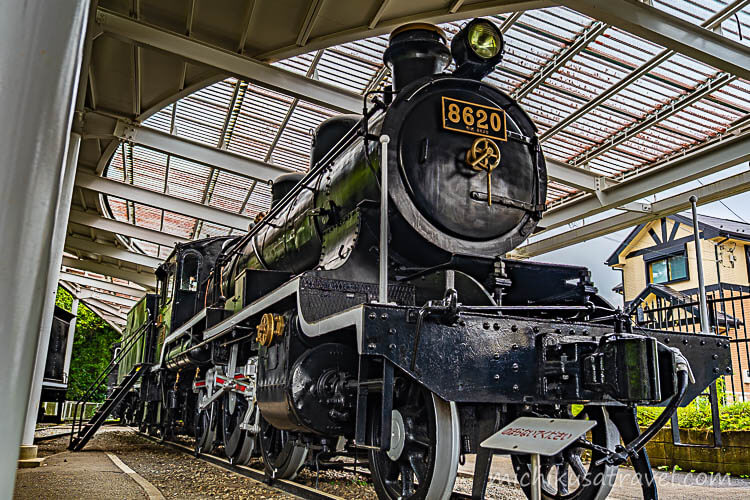
The JNR Class 8620 tender steam locomotive is a passenger locomotive manufactured from 1914 (the 3rd year of the Taishō era). It was used mainly for passenger trains on regional main and secondary lines, and in some cases for freight trains as well, and is known by the nickname“Hachiroku”The 8620 locomotive displayed at Ome Railway Park is the commemorative No. 1 locomotive of the 672 units manufactured in this class.
JNR Class C51 Steam Locomotive Number 239

The Japanese National Railways C51-class steam locomotive was a tender-type steam locomotive built for mainline passenger trains from 1919 to 1928. Following the 1928 revision of the locomotive classification regulations, it was renamed from Class 18900 to Class C51. Locomotive No. 239 was the dedicated locomotive for theImperial traincarrying the Emperor.
JNR Class C53 steam locomotive No. 45

The JNR Class C53 steam locomotive is a tender locomotive for mainline passenger trains, developed by American Locomotive (Alco)through analysis of the Class C52 and domestically produced in Japan. The Class C52 was JNR's last foreign-built steam locomotive, and only 6 were imported in 1926. No Class C52 locomotive survives, but the Class C53 conveys its legacy.
JNR Class C55 steam locomotive No. 1

Japanese National Railways Class C55 steam locomotives were built from 1935 to 1937 as tender locomotives for passenger trains. They appeared during the same period as the global trend toward streamlined steam locomotives, including Britain’s Mallard, and 21 Class C55 locomotives, Nos. 20 to 40, were fitted withstreamlined bodywork. This locomotive is No. 1, the first numbered locomotive of the class. Unfortunately, none of the locomotives from No. 20 to No. 40 survive.
Japanese National Railways C56-class steam locomotive No. 160

The Japanese National Railways C56 steam locomotive is a small, lightweight tender locomotive manufactured from 1935 to 1939. Because of the way it raced through highland areas such as the Koumi Line, it was nicknamed the Pony (Highland Pony). This is locomotive No. 160, the last-numbered unit of the class. It is preserved in working order at the Kyoto Railway Museum.
JNR C57-class steam locomotive number 1

The Japanese National Railways C57 steam locomotive is a tender locomotive manufactured from 1937 to 1947. Because of its elegant appearance, it is known as the“Lady”This is No. 1 of the series, the first unit produced. It is preserved in working order at the Kyoto Railway Museum and is also used as the “SL Yamaguchi.”
Japanese National Railways C57-class steam locomotive135

C57 No. 135 is known for hauling the last regularly scheduled passenger train pulled by a JNR steam locomotive on the Muroran Main Line in Hokkaido on December 14, 1975. It is on display at the Railway Museum.
JNR C57 steam locomotive No. 139

This is locomotive C57 No. 139, which hauled imperial trains 18 times. It is on display at The SCMAGLEV and Railway Park.
JNR Class C58 steam locomotive No. 1

The JNR Class C58 steam locomotive was manufactured from 1938 to 1947 as a tender steam locomotive for both passenger and freight service. Its maximum operating speed is 85 kilometers per hour, close to that of Class 8620 (95 kilometers per hour), while its tractive effort (cylinder tractive force) is 12,570 kilograms, close to that of Class 9600 (13,702 kilograms). This locomotive is number 1, the first locomotive of the series.
JNR Class C59 Steam Locomotive Number 164

The Japanese National Railways C 59-class steam locomotive is a tender locomotive for mainline passenger trains, manufactured from 1941 to 1947. It was designed as the successor to the C 53 class to haul passenger trains on the Tokaido and Sanyo Main Lines. While the C 53 class was complex in terms of construction and maintenance because it used 3 cylinders, the C 59 class adopted 2 cylinders, improving maintainability.
Japanese National Railways C60 steam locomotive No. 1

The JNR C60 steam locomotive was manufactured from 1953 to 1961 by rebuildingC59 locomotivesas tender steam locomotives. In 1953, electrification was completed between Tokyo and Nagoya on the Tokaido Main Line, followed by the entire Tokaido Main Line in 1956. The C59 locomotives handed their role over to electric locomotives such as the JNR EF58. The C60 class was developed to make effective use of surplus C59 locomotives; reducing the axle load enabled it to operate on secondary and regional main lines. No. 1, the first locomotive of the class, is on display in Nishi Park in Sendai.
JNR Class C61 Steam Locomotive No. 2

The Japanese National Railways C61 steam locomotive is a tender locomotive for train service, manufactured from 1947 to 1949. After World War II, demand for freight transport declined, leaving freight locomotives such as the D51 and D52 surplus. The C61 wasmanufactured by reusing boilers from D51 locomotives. Locomotive No. 2 is preserved in working order at the Kyoto Railway Museum.
JNR Class C62 steam locomotive No. 1

Japanese National Railways Class C62 steam locomotives were built from 1948 to 1949 as tender locomotives for main-line passenger trains. While Class C61 reused boilers from Class D51, Class C62 reused boilers from Class D52. This locomotive is No. 1, the first numbered locomotive of the class.
The C62 class is known as the steam locomotive from Leiji Matsumoto’s Galaxy Express 999. In the original work and theatrical film, it bears the number plate “C62 48,” while the television anime version uses “C62 50.” Production of the C62 class ended with locomotive number 49 (C62 49), so “C62 50” is a fictional number.
Japanese National Railways C62-class steam locomotive No. 17

In 1954, C62 No. 17 set the Japanese speed record for a steam locomotive and the world speed record for a narrow-gauge steam locomotive129 kilometers per hourIt is on display at SCMaglev and Railway Park.
Incidentally, the world's highest speed for a steam locomotive, including standard-gauge locomotives, is 203 kilometers per hour, recorded by Mallard in 1938. Mallard is on display at the National Railway Museum in the United Kingdom.
For information about the National Railway Museum of the United Kingdom’s highlights, opening hours, admission fees, and more, please see the article below.
JNR Class C63 Steam Locomotive No. 1 (Model)

The Japanese National Railways C-series63 steam locomotive is a legendary steam locomotive that was designed but never built. It was designed in 1956 as a tender steam locomotive for both passenger and freight service, but the plan was canceled as Japan shifted toward electrification and diesel power, and production remained only a dream. The Kyoto Railway Museum displays a model of the Japanese National Railways C-series63 steam locomotive, locomotive1.
Domestic JNR tender steam locomotive, Class D
The domestically built D-type tender steam locomotives of Japanese National Railways, with 4 driving axles, are a group of classes developed primarily for freight trains.Developed primarily for freight trains. The group ranges from types suited to main-line freight trains requiring substantial tractive effort to those also used to haul passenger and mixed trains, and represents the lineage of Japan’s freight steam locomotives. It includes many classes still well known today, such as the D51, Japan’s most-produced steam locomotive, and the D52, the heaviest in Japan.
| Class | Wheel arrangement | Production began | Production ended | Number produced | Passenger | Freight | Notes |
|---|---|---|---|---|---|---|---|
| Class 9600 | 1D | 1913 | 1926 | 770 locomotives | ○ | nickname “Mountain Old Man” | |
| Class D50 | 1D1 | 1923 | 1931 | 380 locomotives | ○ | ||
| Class D51 | 1D1 | 1935 | 1945 | 1115 locomotives | △ | ○ | the most produced in Japan |
| Class D52 | 1D1 | 1943 | 1946 | 285 locomotives | △ | ○ | the heaviest in Japan |
| Class D60 | 1D2 | 1951 | 1956 | 78 locomotives | ○ | rebuilt from Class D50 | |
| Class D61 | 1D2 | 1959 | 1961 | 6 locomotives | ○ | rebuilt from Class D51 | |
| Class D62 | 1D2 | 1950 | 1951 | 20 locomotives | ○ | rebuilt from Class D52 no surviving vehicles |
JNR Class 9600 steam locomotive (9608)
 The JNR Class 9600 steam locomotive was created by the Railway Administration, predecessor to the JNR, during the Taishō era and becameJapan's first mass-produced freight steam locomotive. It has nicknames such as “Kyūroku” and “Yamaoyaji.” It became the foundation of Japan's freight steam locomotives, leading to later models such as the D51.
JNR Class D50 steam locomotive No. 140

The Japanese National Railways D50-class tender steam locomotives for freight service were manufactured from 1923 to 1931.successor to the 9600 classThey were introduced as main-line freight locomotives with greater tractive effort, and following the 1928 revision of the classification rules, they were redesignated from the 9900 class to the D50 class.
JNR Class D51 Steam Locomotive No. 1

The JNR D51 tender steam locomotive was manufactured from 1935 to 1945.Degoichiis widely known by this nickname and is regarded as virtually synonymous with steam locomotives in Japan. A total of 1184 locomotives of this type were built, and this is the commemorative No. 1 locomotive.
Japanese National Railways Class D52 steam locomotive number 468

The Japanese National Railways D52 tender locomotive was manufactured from 1943 to 1946. With greater tractive effort than the D51 type, it is Japan’s largest steam locomotive for freight service. It was introduced to meet the increased transportation demand during World War II.
Domestically Built Japanese National Railways Tank Steam Locomotive
Tank steam locomotives are characterized by a design without a tender, carrying coal and water on the locomotive itself. Their short overall length made them highly maneuverable, and they were used for shunting, branch-line operations, and lines with axle-load restrictions. Japanese National Railways used a wide variety of tank locomotive types, mainly smaller engines designed for specific purposes.
| Type | Axle arrangement | Production start | Production end | Number built | Remarks |
|---|---|---|---|---|---|
| Ke90 class | B | 1918 | 1918 | 2 locomotives | For special narrow-gauge lines |
| Ke100 class | B | 1919 | 1919 | 6 locomotives | For special narrow-gauge lines No surviving locomotives |
| 1070 class | 2B1 | 1925 | 1928 | 49 locomotives | Converted from imported 6200/6270 classes |
| B20 class | B | 1944 | 1947 | 15 locomotives | For shunting operations |
| C10 class | 1C2 | 1930 | 1930 | 23 locomotives | |
| C11 class | 1C2 | 1932 | 1947 | 381 locomotives | |
| C12 class | 1C1 | 1932 | 1947 | 282 locomotives | |
| E10 class | 1E2 | 1948 | 1948 | 5 locomotives | JNR's last newly built steam locomotive |
Japanese National Railways Ke90 steam locomotive

The JNR Class Ke90 steam locomotive is a tank steam locomotive for light railways, of which only 2 were built in 1918. Originally used as Type A of the Tono Railway on a light railway line with a 762 mm gauge, it became part of the Railway Ministry in 1926 and was renamed Class Ke90. The Shin-Tajimi–Hiromi section of this line later became part of the present-day JR Taita Line via the former JNR Taita Line. The Tono Railway of that time was a different company from the present-day Tono Railway Co., Ltd.
Both 2 cars still exist, with 1 car on display at the SCMAGLEV and Railway Park. The remaining 1 car, Class Ke91, is on display along the Horidome Poppo Road in Hamamatsu.
Japanese National Railways steam locomotive 1070 (1080)

The Japanese National Railways Class 1070 steam locomotive was created by converting Class 6200 and Class 6270 tank locomotives between 1925 (Taisho 14) and 1928 (Showa 3). Class 6200 was a tender steam locomotive manufactured by British Neilson, while Class 6270 was manufactured by British Dübs. The wheel arrangement was also changed from 2B by adding 1 trailing axles, becoming 2B1.
JNR Class B20 steam locomotive No. 10

The JNR B20 steam locomotive is a small tank locomotive manufactured from 1944 to 1947. It was used as a shunting locomotive to move rolling stock within station and railway-depot grounds. In 2002, it was restored to operating condition to commemorate the 30th anniversary of the Umekoji Steam Locomotive Museum's opening, and it remains in active service as a shunting locomotive at the Umekoji locomotive depot.
JNR C11 steam locomotive No. 1
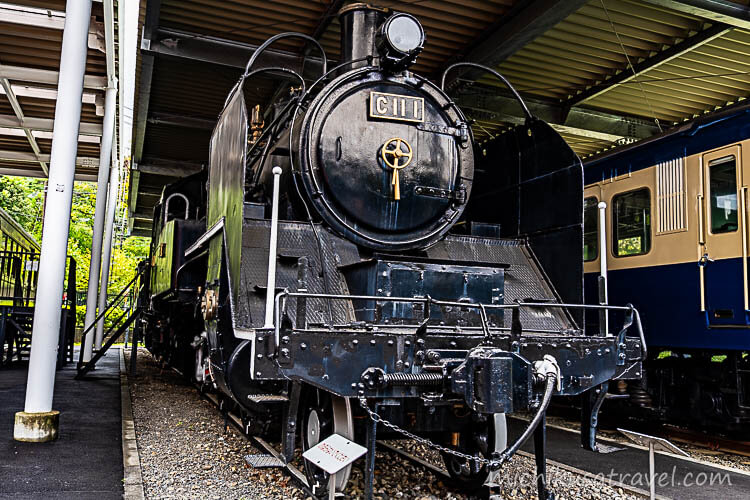
JNR Class C11 steam locomotives were manufactured from 1932 for short-distance operation. Because they carried coal and water on the locomotive itself, no tender was attached, making them easy to operate in either direction. They were widely used for passenger and freight trains on suburban and local lines, as well as for shunting within station yards. The historic first locomotive of the C11 class is on display at Ome Railway Park.
Japanese National Railways C12-class steam locomotive No. 6

The JNR C12 steam locomotive is a small tank steam locomotive for passenger and freight service, manufactured from 1932 to 1947. It was developed and manufactured in parallel with the C11 class, and the two were used according to their intended purposes. The C56 class tender steam locomotive was also developed based on the C12.
Japanese National Railways Class E10 Steam Locomotive No. 2
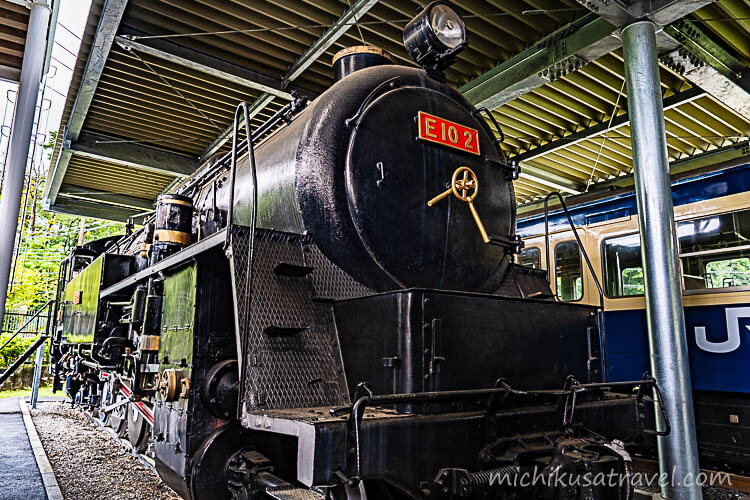 The JNR E10-class steam locomotive was built in only 5 units in 1948 (Shōwa 23) and wasthe largest tank-type steam locomotive operated by JNR. It was built to push trains from behind over the steep Itaya Pass on the Ōu Main Line and has 5 driving axles. It was also the last newly built steam locomotive produced by JNR.
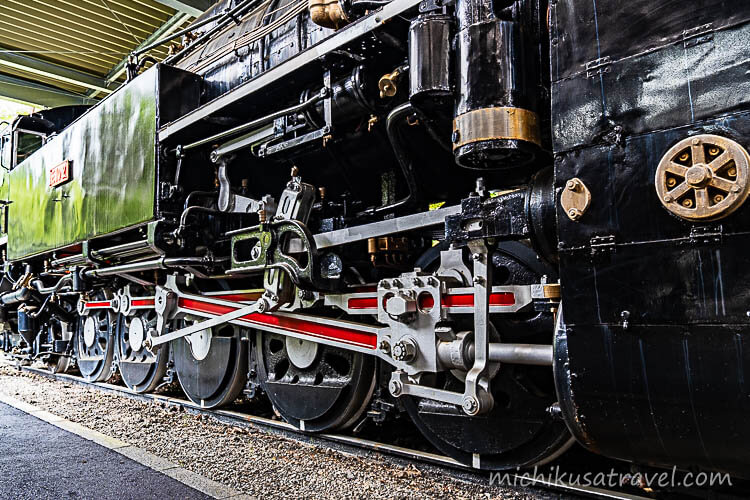 The E10-class was designed to be coupled at the rear of a train and run in reverse, so the cab was installed facing the opposite direction from usual to provide a clear view behind. From the side, you can see its large body without an attached tender and 5 sets of driving wheels.