Highlights of SCMAGLEV and Railway Park

SCMAGLEV and Railway Park is a railway museum in Kinjo-futo, Minato Ward, Nagoya. It opened in 2011 and is managed and operated by Central Japan Railway Company (JR Central).
The only surviving steam railcarHoji No. 6014 steam railcarand one of the oldest surviving domestically built buses,JNR Bus No. 1are designated Important Cultural Properties of Japan.
Many other valuable railway vehicles are also on display, including the JNR Class 52 (MoHa 52) train, representative of prewar express trains, as well as test vehicles for the Shinkansen and the superconducting maglev.
Alongside the JR East Railway Museum in Saitama and the JR West Railway Museum in Kyotoit is considered one of Japan’s three major railway museums.
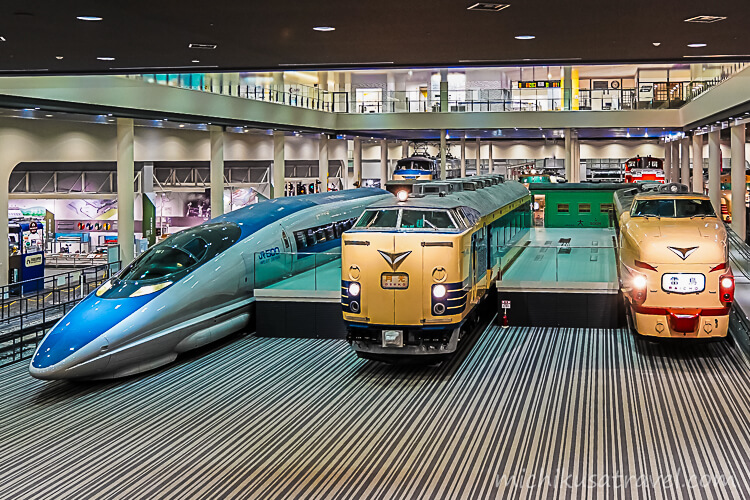
 Immediately after entering, visitors are greeted by the signature exhibits that serve as the face of SCMaglev and Railway Park. From left to right are the JNR Class C62 steam locomotive, the Shinkansen Class 955 train (300X), and the superconducting maglev MLX01-1. A large screen explains the history of railway speed development in Japan.
Japanese National Railways C62 steam locomotive

The Japanese National Railways C62 steam locomotive is a tender locomotive built from 1948 to 1949. It is known as the steam locomotive from Leiji Matsumoto’s “Galaxy Express 999.”
This is locomotive No. 17, which in 1954 set Japan's speed record for steam locomotives and the world speed record for narrow-gauge steam locomotives129 kilometers per hour . Incidentally, the world speed record for steam locomotives, including standard-gauge locomotives, is 203 kilometers per hour, set by Mallard in 1938. Mallard is on display at the National Railway Museum in the United Kingdom.
For more information about the National Railway Museum in the United Kingdom, where Mallard is on display, see the article below.
Shinkansen 0 series electric train

The 0 Series Shinkansen was Japan's first commercial Shinkansen train, introduced with the opening of the Tokaido Shinkansen in 1964. Its rounded nose earned it the affectionate nickname “dango nose,” and it is known as a railway vehicle symbolizing Japan's period of rapid economic growth.
When it entered service, it recorded the world's fastest operating speed (the maximum speed in commercial service)210 kilometers per hour and connected Tokyo and Shin-Osaka in about 4 hours. In 1986, its maximum operating speed was raised to 220 kilometers per hour, and it supported Japan's high-speed railways for a remarkable 44 years until its retirement in 2008.
Shinkansen Class 100 electric train

The 100 Series Shinkansen train began commercial service in 1985 as the successor to the 0 Series. In addition to its sharply streamlined nose, it introduced the world's first 2-level cars for high-speed rail, greatly improving comfort with features such as private Green Car compartments and reclining swivel seats at every Standard Car seat.
The 100 series has a maximum operating speed of 220 kilometers per hour, while the 100N series (V formation), introduced from 1989, achieved on the Sanyo Shinkansen section230 kilometers per hourin commercial service. The 100N series is on display at the Kyoto Railway Museum.
For information about the Kyoto Railway Museum’s exhibits, including the 100N series, see the article below.
Shinkansen 300 series train

The 300 Series Shinkansen train began service in 1992as the first “Nozomi”and dramatically improved the speed performance of railway vehicles.With a service speed of 270 kilometers per hourit connected Tokyo and Shin-Osaka in as little as 2 hours and 30 minutes.
Shinkansen 700 series electric train

The Shinkansen 700 Series train began commercial service in 1999 as a new standard model following the 300 and 500 Series. It was developed to comprehensively improve not only high-speed performance but also ride comfort, quietness, and energy efficiency. Its distinctive nose, shaped like a platypus, reduces noise as the train passes through tunnels. The maximum operating speed is 270 kilometers per hour on the Tokaido Shinkansen and 285 kilometers per hour on the Sanyo Shinkansen.
N700 Series Shinkansen train

The N700 Series Shinkansen train entered commercial service in 2007 as the successor to the 700 Series. It further improved speed, comfort, and environmental performance, achieving a commercial operating speed of285 kilometers per hour on the Tokaido Shinkansen and 300 kilometers per hour on the Sanyo Shinkansen.
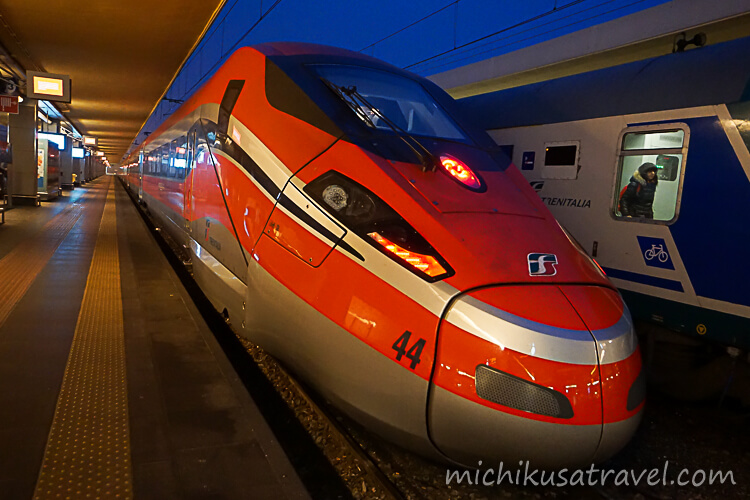
Another notable feature is that it was the firstbody-tilting systemto be adopted for a Japanese Shinkansen train. This made it possible to reduce speed less even on the curving Tokaido Shinkansen, shortening travel times and improving ride comfort. Italy’s Pendolino is well known as a train with a body-tilting system.
For information about Italy’s railways, including the Pendolino trains, see the article below.
Shinkansen 955 series train (300X)

The Shinkansen 955 train (300X) is an experimental Shinkansen train developed by JR Central for high-speed testing. Manufactured in 1994, it underwent running tests to collect and verify various data on high-speed performance, noise, body structure, pantographs, bogies, and other features. In 1996, on the Tokaido Shinkansen line between Maibara and Kyoto, it recordeda speed of 443 kilometers per hour.
Superconducting maglev MLX01-1

The superconducting maglev MLX01-1 is a test vehicle for superconducting maglev trains developed by JR Central. It was manufactured in 1995. It runs while levitating by using the magnetic force generated between the superconducting magnets mounted on the vehicle and coils installed on the ground. In 2003, it achieved, on the Yamanashi Maglev Test Line,581 kilometers per hoursetting the world's highest railway speed record at the time.
Shinkansen 923 series electric train, 0 subseries (T4 formation)

The Series 923 Shinkansen train, basic type 0 (T4 formation), is a comprehensive electric railway inspection train that measures the condition of the electrical, track and signalling equipment on the Tokaido and Sanyo Shinkansen while running on regular service lines. Developed as a service vehicle based on the 700 Series, it is calledDoctor Yellowbecause of its body color.
The Shinkansen 922 series train, subseries 20 (T3 formation), which was displayed in the main building until 2025, has been moved to Train Park Hakusan (Hakusan, Ishikawa Prefecture), where it is now on permanent display.
Japanese National Railways Ke90 steam locomotive

The JNR Class Ke90 steam locomotive is a tank steam locomotive for light railways, of which only 2 were built in 1918. Originally used as Type A of the Tono Railway on a light railway line with a 762 mm gauge, it became part of the Railway Ministry in 1926 and was renamed Class Ke90. The Shin-Tajimi–Hiromi section of this line later became part of the present-day JR Taita Line via the former JNR Taita Line. The Tono Railway of that time was a different company from the present-day Tono Railway Co., Ltd.
Both 2 cars still exist, with 1 car on display at the SCMAGLEV and Railway Park. The remaining 1 car, Class Ke91, is on display along the Horidome Poppo Road in Hamamatsu.
JNR C57 steam locomotive No. 139
 The JNR Class C57 steam locomotive is a passenger tender locomotive manufactured from 1937 (the 12th year of the Showa era) to 1947 (the 22nd year of the Showa era). Because of its elegant appearance, it is called the“Lady”. This locomotive is No. 139, which hauled the imperial train 18 times.
Steam railcar Hoji 6014 (KiHa 6401)

The Hoji 6014 steam railcar was manufactured in 1913 (the 2nd year of the Taishō era) as aKudō-style steam railcar. This self-propelled vehicle enabled single-car operation by incorporating a power mechanism similar to that of a steam locomotive on one side of the passenger car; it was developed by Heijirō Kudō in 1909 (the 42nd year of the Meiji era). Hoji 6014 is an example of a Japanese-made steam railcar using this system and was used for short-distance transport on non-electrified lines. It was later renamed KiHa 6401 and operated until 1943 (the 18th year of the Shōwa era). It is designated as an Important Cultural Property of Japan.
JNR ED18 electric locomotive

The Japanese National Railways ED18 electric locomotive was imported from the United Kingdom by the Railway Ministry in 1923 in preparation for the electrification of the Tokaido Main Line, then later modified for use on the Iida Line. After being retired, it was restored to operating condition and returned to service as the locomotive hauling theTrokko Familyand other trains on the Iida Line.
JNR MoHa 12 train (KuMoHa 12 train)

The JNR MoHa 12 (KuMoHa 12) electric railcar originated as a vehicle built as the Railway Ministry’s first steel electric railcar, the MoHa 30. It was later converted into the service vehicle KuMoYa 22 and remodeled again for passenger use in 1987. Electric trains of the Japanese National Railways (JNR) were calledkokuden in the Tokyo metropolitan area and Keihanshin. The nicknamegeta-den was also used in the sense of “a train you can easily board wearing geta”. “Ganso Geta-den-go” is the nickname of an event train operated on the Iida Line in 1987. The vehicle continued to be used on the Iida Line afterward.

The logo of Japanese National Railways (JNR) also appears on the cover of the ceiling-mounted fan.
Japanese National Railways Class 52 electric train (MoHa 52 type)

The Japanese National Railways Class 52 train (MoHa 52 type) was built from 1936 to 1937 as an express train for the Keihanshin area on the Tokaido and Sanyo Main Lines (today’s JR Kyoto and JR Kobe lines). Meaning “streamlined train,” it was nicknamedRyūden. It was one of the representative express-train types of the prewar era and a pioneer of rapid trains in the Keihanshin area, leading to today’s “Shin-kaisoku” services.
 Rows of stylish, flat, round lamps with decorative metal fittings line the ceiling.
Japanese National Railways 117 series train (KuHa 117 type)
 The Japanese National Railways Class 117 electric train (KuHa 117 type) entered service in 1980 as an express train in the Keihanshin region and becamethe first train dedicated exclusively to the “Shin-Kaisoku” service. The “Shin-Kaisoku” service began in 1970 with Class 113 and was taken over by Class 153 in 1972, but Class 117 was newly built to replace the aging Class 153. From 1982, it was also introduced in the Tōkai region for rapid services and became popular under the nicknameTōkai Liner.
JNR OYa 31 passenger coach
 The JNR Oya 31 passenger car was made by modifying an existing passenger car into astructure gauge measuring carA total of 7 cars were rebuilt between 1949 and 1961. Contact sensors mounted around the body measured, while the car was in motion, whether ground facilities such as platforms and overhead-line poles remained within the prescribed area known as the “structure gauge.”
Japanese National Railways Bus No. 1
 The Japanese National Railways No. 1 bus was manufactured in 1930 (the 5th year of the Shōwa era) by Tokyo Gas and Electric Engineering Company and isone of the oldest surviving buses made in Japan. It was operated by the Japanese National Railways' Automotive Bureau on the Okazaki–Tajimi and Kōzōji–Seto Kinenbashi routes. It is designated as an Important Cultural Property of Japan.
Railway simulator

The N700 Shinkansen Simulator lets you experience driving a Tokaido Shinkansen N700-series train using a full-size cab and a large screen. There are also simulators for conventional train operation and train conductors, allowing you to perform station safety checks, open and close doors, and make onboard announcements.
Railway Diorama

N700 and N700S trains are stopped at the Shinkansen platforms of JR Nagoya Station, overlooked by JR Central Towers and JR Gate Tower.

This shows ballast replacement work being carried out at night using a work vehicle called an NBS (New Ballast Scraper).
Superconducting SCMAGLEV Exhibition Room

You can learn how superconducting maglev works using models, experimental equipment, and other exhibits. In the mini theater, you can experience the world at 500 kilometers per hour through seat vibrations as well as video.
Basic information about SCMaglev and Railway Park
The information below was checked against official sources on September 16, 2026. Please also check the latest information on the official website when planning your trip.
- 🔗 Official website
- Information about the exhibits, opening days, admission tickets, and simulators is available on the official SCMaglev and Railway Park website.
リニア・鉄道館|JR東海JR東海 リニア・鉄道館 〜夢と想い出のミュージアム〜 3月14日、名古屋に誕生。語り継ぐ、夢と想い出が、ここにある。museum.jr-central.co.jp
- 📍 Location
- 3-2-2 Kinjōfutō, Minato-ku, Nagoya, Aichi Prefecture
- 🕒 Opening hours
- Open from 10:00 to 17:30, with last admission at 17:00.
- 🚫 Closed days
- Every Tuesday (the following day when Tuesday is a public holiday) and from December 28 to January 1. During Golden Week, the Obon period, and the beginning of the year, it may also open on Tuesdays.⚠️ Temporary closures may occur due to weather, so check the opening calendar.
- 💶 Admission
- The standard admission fee is 1,200 yen. Prices for each ticket type, online admission tickets, and simulator tickets are explained in detail in the section “SCMaglev and Railway Park Tickets.”
- ⏱️ Recommended visit time
- Allow approximately 2–3 hours to see the actual vehicles and main exhibits.⚠️ If you use the simulators, railway diorama, or video exhibits, allow extra time, including waiting time.

Tickets for SCMAGLEV and Railway Park
- 💶 Admission Fees
-
- Adults:¥1,200
- Elementary, junior high, and high school students:¥500
- Preschool children (aged 3 and over):¥200
- General groups of 20 or more:Adults ¥1,000, elementary, junior high, and high school students ¥400, preschool children ¥100
- Persons with a disability certificate and 1 accompanying person:¥500 each (¥200 each for high school students and younger)
- 🎫 Admission Tickets and Simulators
- Dated online admission tickets are available for purchase. The Shinkansen simulator “N700” and the conventional railway “Conductor” simulator cost ¥500 each for 1 session of approximately 15 minutes, while the conventional railway “Driving” simulator costs ¥100 for 1 session of approximately 10 minutes. Simulator tickets are sold on a first-come, first-served basis, and sales end once the available number of tickets has been reached. For the Shinkansen simulator “N700” and the conventional railway “Conductor” simulator, only 1 ticket for either simulator may be purchased per 1 person or 1 group.
Prices and sales conditions may change. Please check the latest information on the official website before purchasing.
Getting to SCMaglev and Railway Park
The nearest station to the SCMAGLEV and Railway Park is Kinjō-futō Station. From Kinjō-futō Station, it is about a 1-minute walk north to the museum entrance.
It takes approximately 24 minutes from Nagoya Station to Kinjō-futō Station on the Aonami Line (the Nishi-Nagoya Port Line of the Nagoya Rinkai Rapid Railway).
By car
SCMAGLEV and Railway Park has no dedicated parking lot. If you come by car, use the nearby Nagoya City Kinjō-futō Parking Lot, but as it is expected to be crowded, visitors are advised to use public transportation whenever possible. There is no discount on the parking fee.