Highlights of the National Museum of Scotland
The National Museum of Scotland is a museum in Edinburgh, the capital of Scotland. Along with Glasgow's Kelvingrove Art Gallery and Museum, it isone of Scotland's most popular tourist and cultural attractions.
For information about the exhibits and visiting Kelvingrove Art Gallery and Museum, please see the article below.
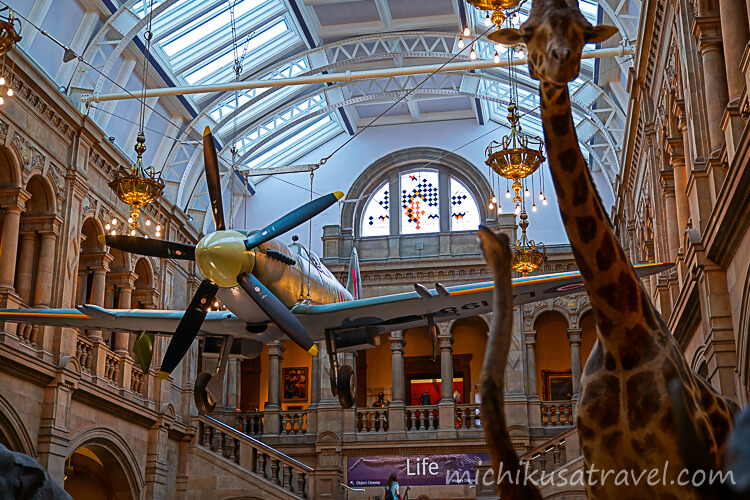
In Japan, the term “national museum” may sound a little formal, but this museum offers a wide variety of exhibits and thoughtfully designed displays, making it an inviting place that anyone can enter and enjoy.

The museum offers much more than Scotland's history and culture, with natural history, science and technology, and collections from around the world. Exhibits from different fields are brought together in one building, allowing you to choose what to see based on your interests.
Science and Technology Exhibition

Exhibition area dedicated to science and technology.

A Piper PA-38 Tomahawk chases a Beagle A.61 Terrier.

This is a Formula 1 car from Red Bull Racing, which is based in the United Kingdom. Red Bull Racing entered F1 in 2005, but this car is the model known as the “RB2,” introduced the following year.
Wylam Dilly

The Wylam Dilly is the 2nd-oldest surviving steam locomotive. Incidentally, the oldest surviving steam locomotive is Puffing Billy, which is housed at the Science Museum in London. Both were built by William Hedley between 1813 and 1815.


Steam locomotives use heat from burning coal to boil water, which serves as their power source, but early steam locomotives were distinctive in appearance because they stored water in wooden barrels.

The LNER A4-class steam locomotive No. 60031 “Golden Plover” is crossing the Forth Bridge.
The structure of the Forth Bridge and how it looks from the site are introduced in detail in the article below.

The LNER A4 steam locomotive is known for its streamlined body, but the most famous is No. 4468 “Mallard,” which set the world speed record for a steam locomotive. Mallard is preserved and displayed at the National Railway Museum in the United Kingdom.
For information about the preserved railway vehicles and visiting the National Railway Museum in the United Kingdom, please see the article below.

This is Nikon’s semiconductor lithography equipment. It is also called a stepper. The Dutch company ASML currently dominates this field, but before 2000 Nikon had the largest market share.

It looks like an arcade game controller. The “NSR” model designation is still used in Nikon semiconductor lithography equipment.
Natural World Exhibition

By contrast, this is the exhibition area devoted to the natural world (Natural World).

Geoffroy's cats (Geoffroy's cat) are shown mating.

Female dunnocks (Dunnock) mate with multiple males. The male stimulates the female's reproductive organ with his beak (more precisely, the cloaca, which also serves as the anus), removes another male's semen, and then mates with her.

Opossums give birth to more than 10 young at a time, and for the first 2–3 months they live with their babies clinging to their nipples.

A banded mongoose is trying to crack an ostrich egg by throwing a small stone between its legs.

This is an adorable pair of Pallas's cats.
The Grand Gallery and the Cultures of the World

The charm of the National Museum of Scotland lies in its anything-goes atmosphere, where Buddha statues stand next to a rocket.

This is an automaton clock called the Millennium clock tower.

It is said to symbolize the era of socialism and fascism in which Lenin, Stalin, and Hitler lived.

The museum’s main hall, called the Grand Gallery.

It is said to be a sacred Kannon statue brought from Chōshō-ji Temple in Ichikawa, Chiba Prefecture.

This is a statue of Buddha from Khajuraho, India.

This is a Thunderbird mask worn by Indigenous peoples in Canada during ceremonies. Thunderbird is a legendary being revered by Indigenous peoples of the Americas.

This is an old British postbox. It is cute that it wears a crown, but the vertical mail slot is interesting too.
Basic Information about the National Museum of Scotland
The information below was checked against official sources on October 11, 2026. Please also check the latest information on the official website when planning your trip.
- 🔗 Official website
- You can check the opening hours, closure days, admission fees, location, and museum facilities.
リンク先を開く(nms.ac.uk)www.nms.ac.uk
- 📍 Location
- Chambers Street, Edinburgh, EH1 1JF
- 🕒 Opening hours
-
- Regular Every day 10:00–17:00
- December 26 and January 1 12:00~17:00
⚠️ The hours for special exhibitions and museum facilities may differ from the museum's opening hours.
- 🚫 Closed
- December 25
- 💶 Admission fees
-
- Permanent exhibitions Free
- Some special exhibitions Paid
⚠️ Prices for special exhibitions vary by exhibition, so check the exhibition information.
- ⏱️ Recommended time
- Allow 2–3 hours to select and see the main exhibitions, or about half a day to explore a broader range of areas such as science and technology, natural history, and world cultures.⚠️ The time required varies depending on the floors and number of exhibitions visited, whether you see special exhibitions, and how crowded the museum is.

Getting to the National Museum of Scotland
It is about a 10-minute walk from Edinburgh Waverley station to the National Museum of Scotland. Head south from the station, then go west along Chambers Street. Both the Main Entrance and the Tower Entrance are on the Chambers Street side.
Entrance and accessibility
From the Tower Entrance, you can access the main parts of the museum without steps and without passing through the busy entrance hall. All entrances have automatic doors, and every floor is accessible by elevator.
Wheelchairs for use during your visit are available to borrow free of charge. Advance reservations are not possible, so please check availability at the information desk when you arrive.

For attractions, transport and suggested itineraries, see “Edinburgh: A Guide to Attractions, Food, Transport and Suggested Itineraries”.