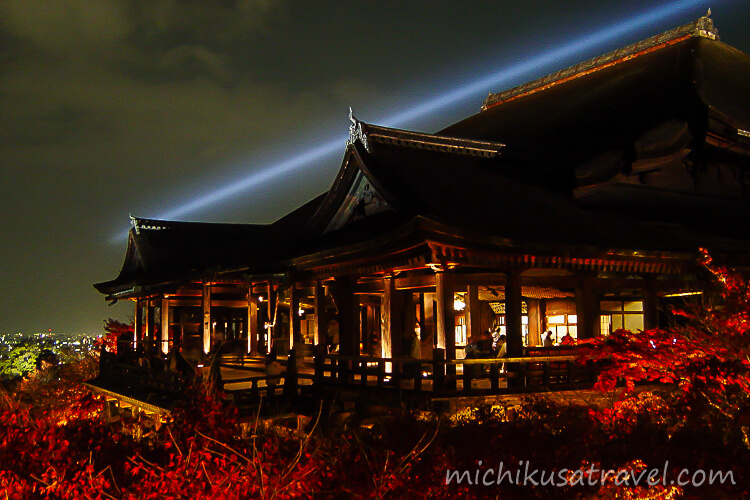
Highlights of Heian Jingū Shrine
Heian-jingū Shrine was founded in 1100 to commemorate the relocation of the capital to Heian-kyō in 1895. Dedicated to Emperors Kanmu and Kōmei, it features vermilion-lacquered shrine buildings that recreate Heian-kyō’s main administrative and ceremonial complex at approximately 8 of its original scale 5, along with the Shin’en Garden, designated a national Place of Scenic Beauty.
Shrine buildings recreating Ōtenmon Gate and the Chōdō-in complex

Standing at the front of the shrine grounds, Ōtenmon is a sacred gate modeled on the Ōtenmon of the Chōdō-in complex in Heian-kyō. Passing through the gate reveals a spacious precinct surrounded by the Daigokuden in front, the Sōryūrō and Byakkorō towers on either side, and covered corridors.

In spring, weeping cherry blossoms adorn the vermilion shrine buildings, creating a vivid contrast with the blue-green roof tiles.
Heian Shrine Garden and Taihei-kaku Pavilion
Behind the shrine buildings stretches a shin’en garden of approximately 3 tens of thousands of square meters, created by Ogawa Jihei VII. It consists of four gardens — southern, western, central, and eastern — each offering a different seasonal landscape, including beni-shidare weeping cherries, irises, water lilies, and autumn foliage.
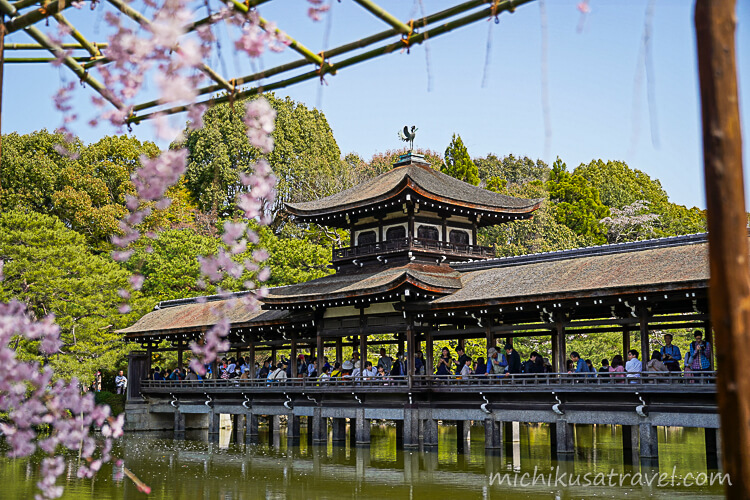
Taiheikaku is a covered bridge spanning Seiho Pond in the East Garden, offering views of the pond and garden. Some of the stone used in its bridge piers came from the Sanjo and Gojo Bridges built by Toyotomi Hideyoshi.
Great Torii Gate

A grand torii gate approximately 24m tall stands on Jingu-michi, which runs north to south through Okazaki Park. Its vermilion form is a landmark visible from afar.

Viewed from close below, its thick pillars and massive upper crossbeam stretch across the sky, conveying the gate’s immense scale.

The Kyoto City KYOCERA Museum of Art stands east of the great torii, making it easy to visit together with the cultural facilities in Okazaki Park.
Jidai Matsuri
Every year on 10 22, the Jidai Matsuri, the festival of Heian-jingū, is held. A procession traveling back through history from the Meiji Restoration to the founding of Heian-kyō proceeds from the Kyoto Imperial Palace to Heian-jingū, presenting the attire and customs of each era. On this day, the reception hours for visiting the shrine and gardens differ from normal.
Basic Information about Heian Shrine
The information below was checked against official sources on September 30, 2026. Please also check the latest information on the official website when planning your trip.
- 🔗 Official website
- Check visiting hours, garden admission hours and fees, and changes due to ceremonies.
https://www.heianjingu.or.jp/visit/worship/www.heianjingu.or.jp
- 📍 Location
- Okazaki Nishi-Tennocho, Sakyo Ward, Kyoto, Kyoto Prefecture 97
- 🕐 Visiting hours
- Shrine grounds
- 3 month 1–9 month 30: 6:00–18:00
- 10 month 1–10 month 31: 6:00–17:30
- 11 month 1–the end of 2: 6:00–17:00
Garden
- 3 month 1–9 month 30: 8:30–18:00 (admission ends 17:30)
- 10 month 1–10 month 31: 8:30–17:30 (admission ends 17:00)
- 11 month 1–the end of 2: 8:30–17:00 (admission ends 16:30)
⚠️ On 10 22, garden admission hours change because of the Jidai Festival.
- 💴 Admission
-
- Shrine grounds: free
- Garden: adults 600 yen, junior high school students and younger 300 yen, preschool children free
- ⏱ Suggested time
- Allow about 30 minutes to visit the shrine buildings, or about 1 to 1 hours and 30 minutes including the garden. ⚠️ Visiting time varies depending on crowd levels and how much of the garden you see.

Getting to Heian-jingū Shrine
Subway
It is about a 10-minute walk from Higashiyama Station on the Kyoto City Subway Tozai Line. Head north along Jingumichi from Sanjo-dori and proceed through the grand torii.
Bus
It is about a 3-minute walk from the Kyoto City Bus stop “Okazaki-koen Bijutsukan・Heian-jingu-mae.”
By car
Heian Shrine has no parking for visitors. Use public transportation or a paid parking lot near Okazaki Park.
For attractions, transport and suggested itineraries, see “Kyoto: A guide to attractions, food, transportation, and suggested itineraries”.