Highlights of Kasuga Taisha
Kasuga Taisha is a Shinto shrine situated at the western foot of Mount Kasugayama in Nara. Regarded as a sacred place since ancient times, it has attracted the deep devotion of the imperial court and aristocracy as the shrine enshrining the Fujiwara clan’s guardian deity. It is said to have been founded in 768, in the 2nd year of the Jingō Keiun era. Under the modern shrine ranking system, it was a kanpei-taisha, the highest rank.
Kasuga Taisha is the head shrine of about 3 thousand Kasuga Shrines throughout Japanthe Kasuga ShrinesIts enshrined deities are the four deities Takemikazuchi-no-Mikoto, Futsunushi-no-Mikoto, Ame-no-Koyane-no-Mikoto, and Himegami, collectively known as Kasuga-no-Kami.
where the four principal deities are enshrinedthe main sanctuary buildings(from the First to the Fourth Sanctuary) are designated as National Treasures. The grounds also featurea path lined with stone lanterns and corridors lined with hanging lanternsalong with other highlights unique to Kasuga-taisha.
In addition, Kasuga-taisha’s National Treasure Hall housesthe Kinji raden kenukigata tachi sword—a national treasure—along with many other swords, suits of armor, and similar objects. Since many of these works of art and craftsmanship were created and dedicated during the Heian period, Kasuga-taishais also known as the Shōsōin of the Heian period.
Kasuga Grand Shrine is registered as a UNESCO World Cultural Heritage site as one of the components of the “Historic Monuments of Ancient Nara.”
Ichino Torii

The First Torii stands on Sanjo Street. It is 6.75 meters tall and, along with the grand torii of Itsukushima Shrine and Kehi Jingu, is considered one of thethree greatest wooden torii in Japan. It is designated an Important Cultural Property of Japan.
Second Torii

An approach path extends from the First Torii and from the Daibutsuden intersection on Ōmiya Street to the Second Torii. Across the expansive shrine grounds,approximately two thousand stone lanterns line the path.

According to legend, Takemikazuchi-no-Mikoto, the principal deity enshrined at Kasuga Taisha, descended from Kashima in Hitachi Province to Mount Mikasa riding a white deer. Since then, deer have been cherished as “sacred deer,” messengers of the gods.

The sight of deer in the grounds of Kasuga Taisha creates a mystical atmosphere.

Enomoto Shrine

Enomoto Shrine existed as the guardian shrine of Kasuga even before the founding of Kasuga Taisha. Today, it stands southwest of the main shrine of Kasuga Taisha. Visitors can worship there beside the corridor leading to the main shrine, where it conveys the history of Kasuga's layered religious traditions.
Central Gate of the Main Shrine

The central gate of Kasuga Taisha’s main shrine, together with the corridors extending to both sides, has been designated an Important Cultural Property of Japan. Behind the central gate, the main sanctuaries from the first to the fourth stand in a row.
The “Great Cedar at the Shrine,” a sacred tree of Kasuga Taisha, is said to be over 800 years old and is also depicted as a sapling in the picture scroll “Kasuga Gongen Genki” from the late Kamakura period.

The corridors surrounding the cloisters and main shrine are lined with about a thousand hanging lanterns.

It reads “Lord Minamoto Tsunayoshi.” This lantern was donated by Tokugawa Tsunayoshi, the 5th shogun of the Edo shogunate. You can also see lanterns donated by Naoe Kanetsugu, Ukita Hideie, Tōdō Takatora, and others.

It appears to be a vine pattern, but from a distance it also looks like a heart.

This is Maronie-chan. This lantern was donated by Yoshimune Yoshimura, the founder of Maronie, and his wife Fukuyo.
Fujinami no Ya

Fujinami-no-ya is a place that was used as a station for Shinto priests until the Edo period. It recreates scenes from the Setsubun Mantōrō ceremony in February and the Chūgen Mantōrō ceremony in August. In the darkened interior, visitors can see the hanging lanterns being lit and experience the atmosphere of Mantōrō outside the usual festival periods.

Sunazuri Wisteria

It is called “sand-brushing wisteria” because its long flower clusters hang so low that they almost touch the sand on the ground. A wisteria trellis stands just inside Keiga Gate, southwest of the main sanctuary. “Drooping wisteria” is the crest of the Fujiwara clan and also the emblem of Kasuga Taisha.
Tokugawa Yorinobu’s Stone Lantern

This stone lantern was donated by Tokugawa Ieyasu for his tenth son, Chōfukumaru. The dazzling gold fittings bearing the Aoi crest were restored in 2016. Chōfukumaru later became Tokugawa Yorinobu, the first lord of the Kii Tokugawa family. Comparing the lanterns throughout the shrine grounds also reveals the connections between their donors and Kasuga Taisha.
Basic Information about Kasuga-taisha Shrine
The information below was checked against official sources on September 16, 2026. Please also check the latest information on the official website when planning your trip.
- 🔗 Official website
- Opening hours and admission fees for the Main Shrine, special worship at the Main Sanctuary, and the Treasure Hall are available on the official Kasuga Taisha website.
 基本情報 | 春日大社春日大社の拝観時間や拝観料金、駐車場・交通のご案内などの基本情報を掲載しています。www.kasugataisha.or.jp
- 📍 Location
- 160 Kasuganocho, Nara, Nara Prefecture
- 🕒 Visiting hours
-
- Main Shrine (Ōmiya) worship area:6:30–17:30 from March to October; 7:00–17:00 from November to February
- Special worship at the Main Sanctuary:9:00〜16:00
- Treasure Hall:10:00–17:00 (admission until 16:30)
⚠️ Hours may change because of ceremonies and events. Special worship at the Main Sanctuary may be unavailable on certain days or during certain times because of ceremonies or special events.
- 💶 Admission fees
-
- Main Shrine (Ōmiya) worship area:Free
- Special worship at the Main Sanctuary:700 yen
- Treasure Hall:Adults 700 yen, university and high school students 400 yen, middle and elementary school students 300 yen, adult groups (20 or more people) 600 yen
The Treasure Hall admission fee may vary depending on the temporary or special exhibition.
- 🎫 Special worship
- During special worship at the Main Sanctuary, you can walk through the lantern-lined corridor, visit the worship area facing Ukimunemine Peak on Mount Mikasa, and proceed as far as the Central Gate. Fujinami-no-ya is also open to visitors. Reception is available from 9:00 to 16:00.
- ⏱️ Time required
- Allow about 1 hour to visit the Main Shrine and corridors; if you also include special worship at the Main Sanctuary and the Treasure Hall, allow about 1 hour 30 minutes–2 hours.⚠️ If you walk along the approach from the First Torii or visit the subsidiary and subordinate shrines within the grounds, allow additional time.
Getting to Kasuga Taisha Shrine
Kintetsu-Nara StationIf you walk east along Omiyadori all the way from there, you will reachthe stone monument marking the approach to Kasuga Taishain about 17 minutes. The approach also continues from theFirst Torii Gateon Sanjo-dori.
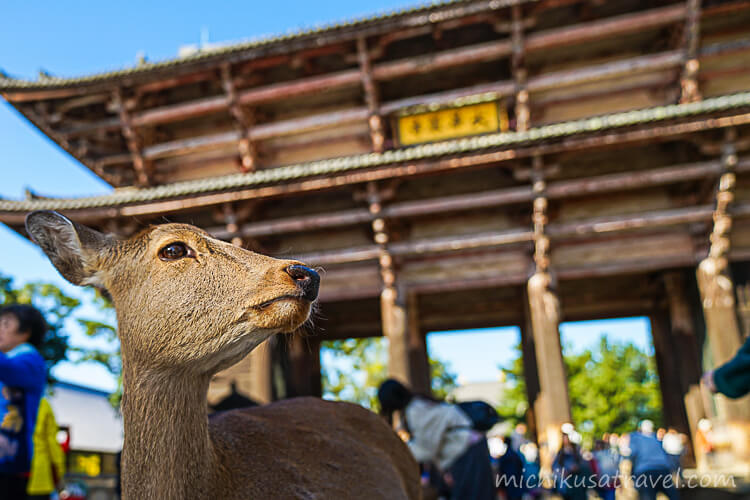
Incidentally, if you head north from the intersection with the stone monument marking Kasuga-taisha’s approach (Daibutsuden Intersection),Tōdai-ji’s Nandaimon Gateis where you will arrive.
Tōdai-ji’s temple complex and visitor information are introduced in detail in the article below.
Local bus and car
To reach the Main Sanctuary and the National Treasure Hall, take a Nara Kotsu bus bound for the Kasuga-taisha Main Sanctuary from JR Nara Station or Kintetsu Nara Station, and get off at “Kasuga-taisha Main Sanctuary,” right by the destination. On the outbound loop of the city bus, it is about a 10-minute walk from “Kasuga-taisha Omote-sando.” Parking is available for cars, but ordinary vehicles may be denied parking during busy periods or festivals.
Bus services and travel times may vary by season, so please check before traveling.
The related guide “【奈良】観光スポット・グルメ・交通・モデルコースを解説” is currently available only in Japanese.
