Highlights of Tenryū-ji
Tenryū-ji is the head temple of the Tenryū-ji school of Rinzai Zen Buddhism. Ashikaga Takauji founded it in memory of Emperor Go-Daigo, appointing Musō Soseki as its founding abbot. Despite repeated fires, the Sōgenchi Garden designed by Musō Soseki retains traces of its original appearance. In 1994, the temple was inscribed as a World Heritage Site as part of the “Historic Monuments of Ancient Kyoto.”
The Great Abbot's Quarters and Sogenchi Garden

The Daihojo, the largest building at Tenryu-ji, has a broad veranda extending around it along the Sogenchi Pond. The building, pond, and mountains behind it form a single landscape.

East of the Daihojo stretches a white-sand garden, offering a view of a refined space characteristic of a Zen temple.

Sogenchi Garden is a strolling pond garden that retains the appearance it had when it was created by Musō Soseki. The stone arrangement of Ryūmonbaku Waterfall on the opposite shore, together with the borrowed scenery of Mount Kame and Arashiyama, makes the garden and its surroundings appear visually continuous.
The Sogenchi Garden was also the first garden in Japan to be designated a Historic Site and Place of Special Scenic Beauty. After taking in the full view from the abbot's quarters, walk around the pond to appreciate how the stone arrangements and plantings change with the angle.
Kuri, the Great Hōjō, and the Cloud Dragon painting in the Hattō Hall

The kuri, with its gabled roof and white walls, is one of Tenryu-ji Temple's landmark buildings. After viewing the painting of Bodhidharma on the large screen at the entrance, visitors continue to the Daikōjō and the shoin.
The ceiling of the Dharma Hall features a Cloud Dragon measuring 9 m in diameter, painted by Japanese artist Matazō Kayama. It is known for its “eight-directional gaze,” which makes you feel as though the dragon is watching you no matter where you stand.
The Temple Grounds in Spring and the Hyakka-en Garden

In spring, you can enjoy scenery where the Zen temple buildings blend with the cherry blossoms.

The Hyakka-en Garden, extending north of the Sogenchi Garden, features flowers and plants for every season. In spring, rhododendrons and other flowers add color to the temple grounds.

In spring at Hyakkaen, red flowering quince blossoms add vivid color amid the fresh greenery.

A narrow stream flows through the moss, creating a tranquil landscape in Hyakkaen.

Sagano Arashiyama

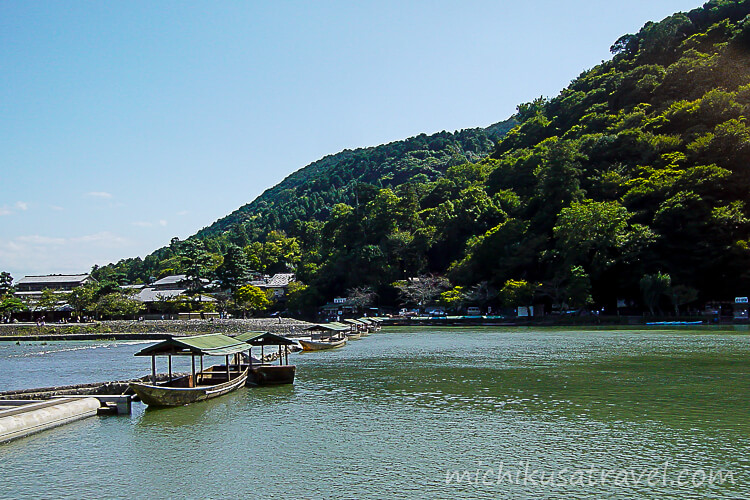
Tenryu-ji is a major temple located along the foothills of Saga-Arashiyama, an area that includes Togetsukyo Bridge and the Bamboo Grove.
Before or after visiting the garden and the temple buildings, extend your walk to Togetsukyō Bridge and the Bamboo Grove to explore the landscape of the area that developed around the temple as well. The highlights of Sagano-Arashiyama and tips for walking around are introduced in detail in the article below.
Basic Information about Tenryu-ji
The information below was checked against official sources on September 28, 2026. Please also check the latest information on the official website when planning your trip.
- 🔗 Official website
- Check visiting hours, admission fees and the dates when the Dragon Painting in the Dharma Hall is open to visitors.
参拝・交通案内:世界遺産|京都 嵯峨嵐山 臨済宗大本山 天龍寺 公式ホームページ臨済宗大本山「天龍寺」の公式ホームページです。天龍寺の参拝・交通案内、境内・山内案内、行事案内などを掲載しています。天龍寺は京都屈指の観光地、嵯峨嵐山に建つ臨済宗の禅刹。曹源池庭園は、国の史跡・特別名勝第一号に指定され、1994年...www.tenryuji.com
- 📍 Location
- Sagatenryūji Takinobabachō, Ukyo Ward, Kyoto, Kyoto Prefecture68
- 🕒 Visiting hours
-
- Garden:8:30〜17:00 (last admission 16:50)
- Main buildings:8:30〜16:45 (last admission 16:30). Visits may not be possible on some days because of events and other circumstances.
- Dragon Painting in the Dharma Hall:9:00〜16:30 (last admission 16:20). It is usually open on Saturdays, Sundays and public holidays, with periods of daily opening in spring and autumn. Check the official website before visiting, as closure days and reduced summer hours may occur.
- 💴 Admission fees
-
- Garden:high school students and older 500 yen, elementary and junior high school students 300 yen, preschool children free
- Main buildings:an additional 300 yen on top of the garden admission fee
- Dragon Painting in the Dharma Hall:500 yen per person. This is separate from admission to the garden and main buildings.
- ⏱ Recommended time
- Allow about 45 minutes if you mainly visit the garden, or about 1 hours 30 minutes if you also see the main buildings and the Dragon Painting. ⚠️ Visiting time varies depending on the areas open and visitor numbers.

Getting to Tenryū-ji
Railway
From Arashiyama Station on the Keifuku Arashiyama Line, head north along Nagatsuji Street in front of the station to reach Tenryu-ji’s main gate. It is about 13 minutes on foot from Saga-Arashiyama Station on the JR Sagano Line and about 15 minutes from Arashiyama Station on the Hankyu Railway.
Bus
Take Kyoto City Bus routes 11, 28, or 93 and get off at “Arashiyama Tenryuji-mae”; Kyoto Bus routes 61, 72, or 83 stop at “in front of Keifuku Arashiyama Station.” During periods of heavy traffic, arrival times can vary considerably, so consider combining the bus with rail travel.
By car
There is a parking lot on the grounds with no reservations, operating on a first-come, first-served basis. For passenger cars, the fee is 1,000 yen per 1, the hours are 8:30 to 17:00, and the capacity is 100 vehicles. Roads in the area are often congested during the autumn foliage season, so public transportation is convenient.
For attractions, transport and suggested itineraries, see “Kyoto: A guide to attractions, food, transportation, and suggested itineraries”.