Highlights of the Kyoto City KYOCERA Museum of Art
The Kyoto City KYOCERA Museum of Art opened in 1933 as the “Kyoto Museum of Art Commemorating the Imperial Ceremony” and was renamed the “Kyoto City Museum of Art” after World War II. Its current name, “Kyoto City KYOCERA Museum of Art,” is the commonly used name based on a naming-rights agreement with Kyocera Corporation.
The Main Building in Teikan Style

The main building, designed by Kenjirō Maeda, is an example of the architectural style known as teikanshiki, combining a monumental, symmetrical composition with a Japanese-style roof. Teikanshiki is an architectural style that incorporates Japanese design elements into modern reinforced-concrete buildings; it was used mainly in the early Shōwa period for government offices and public facilities.
Collection Room and Higashiyama Cube
The collection rooms in the main building display Japanese paintings from the Kyoto art world, along with other holdings that convey Kyoto’s artistic culture. The Higashiyama Cube, newly established during the 2020 renovation, hosts exhibitions focused on contemporary art, allowing visitors to view the works in a space distinct from the main building’s historic galleries.
The Great Torii Gate of Heian Shrine
 From the National Museum of Modern Art, Kyoto across the street, you can see Heian Shrine’s giant torii gate and the historic main building of the Kyoto City KYOCERA Museum of Art in the same view. The giant torii is a landmark of the Okazaki district, home to cultural institutions including the Kyoto City KYOCERA Museum of Art, the National Museum of Modern Art, Kyoto, and ROHM Theatre Kyoto.
Past exhibitions and events

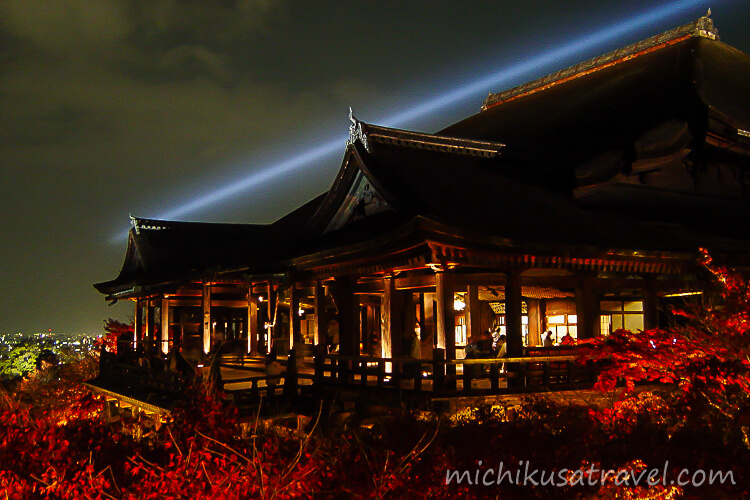
As part of the “Okazaki Tokiakari” event, projection mapping was projected onto the main building every autumn from 2011 to 2016. The event returned once in 2019 after renovation work, but that was its final edition.
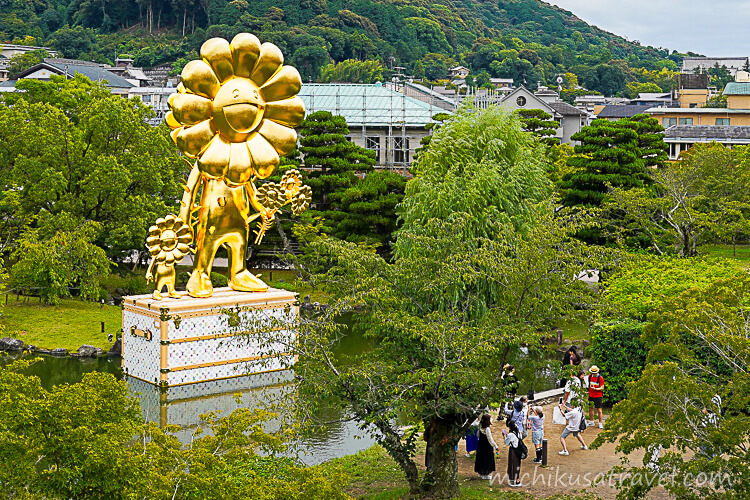
At the 2024 exhibition “Takashi Murakami Mononoke Kyoto,” the approximately 13m-tall golden sculpture “Flower Parent and Child” was displayed in the pond of the Japanese garden designed by the seventh-generation Ogawa Jihei. It stood atop a giant Louis Vuitton trunk.
Basic information about Kyoto City KYOCERA Museum of Art
The information below was checked against official sources on October 4, 2026. Please also check the latest information on the official website when planning your trip.
- 🔗 Official website
- Check current and upcoming exhibitions, opening hours, admission fees, and museum facilities.
 京都市京セラ美術館2020年3月21日「京都市京セラ美術館」としてリニューアルオープン。kyotocity-kyocera.museum
- 📍 Address
- 124 Okazaki Enshoji-cho, Sakyo-ku, Kyoto, Kyoto Prefecture
- 🕒 Opening hours
- 10:00–18:00. ⚠️ Last admission times vary by exhibition.
- 🚫 Closed
- Mondays and over the New Year period (December 28–January 2). The museum opens when Monday is a national holiday or public holiday. ⚠️ Check the official website for gallery closure days for individual exhibitions and temporary museum closures.
- 💴 Admission
-
- Special exhibitions and art association exhibitions: varies by exhibition
- Collection Room — adults: Kyoto City residents ¥520, nonresidents ¥730, groups of 20 or more ¥620
- Collection Room — elementary, junior high, and high school students: free for Kyoto City residents and students attending school in the city, nonresidents ¥300, groups of 20 or more ¥200
- Children below elementary school age: free
Proof of address is required to receive the Kyoto City resident rate. Free admission is available to eligible visitors including Kyoto City residents aged 70 or over and holders of qualifying certificates, together with 1 caregiver. ⚠️ Some exhibitions may require advance reservations or timed-entry tickets.
- ⏱ Suggested visit duration
- Allow about 1 hour 30 minutes to 2 hours to see either the Collection Room or one special exhibition, along with the architecture. ⚠️ Allow longer if you plan to see multiple exhibitions or visit the café and shop.
Access to the Kyoto City KYOCERA Museum of Art
Subway
It is approximately 8 minutes on foot from Higashiyama Station on Kyoto's Tozai Subway Line. From Exit 1, head east along Sanjo-dori, turn left onto Jingu-michi, and pass through the large torii gate of Heian-jingu Shrine; the museum's main entrance is on the right. It is approximately 16 minutes on foot from Keihan Sanjo Station and Sanjo Keihan Subway Station.
City bus
From Kyoto Station, take Kyoto City Bus route 5 and get off at the “Okazaki Park Museum・Heian Jingū-mae” stop; it is just a short walk from there. From Kyoto-Kawaramachi Station, you can take route 46 or 5, and from Sanjō Station, route 5.
By car
There is a paid parking lot on the north side of the main building, but the 19 spaces for general use cannot be reserved. During busy periods, consider using nearby parking lots or public transportation. Parking fees may vary depending on the day of the week and extended holiday periods.
Parking fees and conditions of use are available on the official access page.
For attractions, transport and suggested itineraries, see “Kyoto: A guide to attractions, food, transportation, and suggested itineraries”.