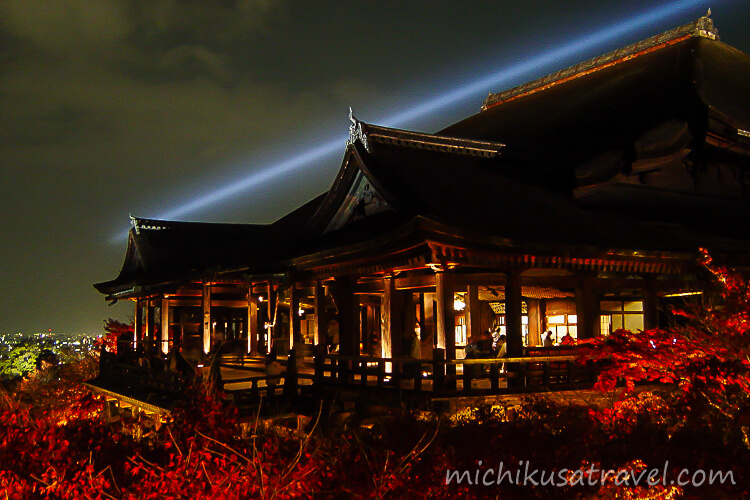
Highlights of Jishu Shrine
Jishu Shrine stands north of the main hall of Kiyomizu-dera Temple. Its principal deity is Ōkuninushi-no-Mikoto, the god of love and good relationships. Because the shrine also enshrines his divine parents and the divine parents of Kushinada-hime—deities from three generations—it attracts people praying for a good match, conception, and a safe delivery.
Main Hall, Worship Hall, and Main Gate

The present Main Hall, Worship Hall, and Main Gate were rebuilt by Tokugawa Iemitsu in 1633. The Main Hall is a cypress-bark-roofed building combining the irimoya roof style with gongen-zukuri architecture. Together with the Worship Hall and Main Gate, it is designated as an Important Cultural Property of Japan.
The main hall is built like a stage facing the cliff, and its mirrored ceiling features a dragon said to have been painted by Kanō Motonobu. Because it seems to glare at you from every direction, it is known as the “Dragon with Eyes That Follow You in Every Direction”.
Ōkuninushi no Mikoto and Harmonious Relationships

On the shrine grounds, statues depicting Ōkuninushi no Mikoto and the White Hare of Inaba welcome visitors. Ōkuninushi no Mikoto is widely revered as a deity of good relationships, and the grounds contain several prayer sites associated with finding a good match. Together with the arrangement enshrining deities from three generations, this is a place where visitors can perceive the overlapping traditions of faith in harmonious relationships.
Love Stones

In front of the main hall stand two “love fortune-telling stones”, about 10m apart. It is said that a wish for love will come true if you walk with your eyes closed from one stone and safely reach the other.
It is said that if you reach the destination on your first try, your love will be fulfilled sooner, while it will take longer if it takes several attempts. If you arrive there with advice from someone else, it is believed that your love will be fulfilled through the help of others.
Kiyomizu-dera Temple

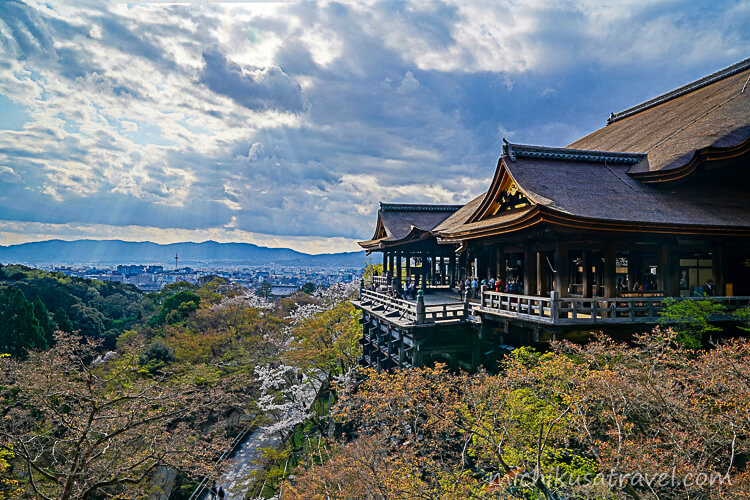
Jishu Shrine is located north of Kiyomizu-dera’s main hall. From the stage projecting from the main hall of Kiyomizu-dera, known as the “Kiyomizu Stage,” you can look out over Kyoto and the surrounding mountains.
The highlights, visiting hours, and admission fees of Kiyomizu-dera are explained in detail in the article about Kiyomizu-dera.
Basic information about Jishu Shrine
The information below was checked against official sources on September 29, 2026. Please also check the latest information on the official website when planning your trip.
- 🔗 Official website
- You can check information about the closed gates, special prayers for blessed relationships, the shrine buildings, and the love-divination stones.
縁結び祈願 恋愛成就 京都地主神社www.jishujinja.or.jp
- 📍 Location
- Shimizu, Higashiyama Ward, Kyoto1chome317
- 🕒 Visit status
- ⚠️ The grounds are closed due to construction work on the buildings and maintenance work on the grounds. The construction period and reopening date have not been decided, and the grounds cannot be visited.
- 💶 Fees
- Visits to the grounds are not possible while they are closed. Special prayers for blessed relationships are accepted by mail; check the official website for the offering amount and application method.
- ⏱ Time required
- After reopening, allow approximately 30 minutes to 1 hours to visit the main sanctuary, worship hall, and love-divination stones.⚠️ The grounds are currently closed and cannot be visited; even after reopening, the time required may vary depending on crowding and the nature of your visit.

Access to Jishu Shrine
⚠️ The site is currently closed. The route to the location is provided below.
On foot
It is about 5 minutes on foot from Ninenzaka, and about 30 minutes on foot from Maruyama Park via Ninenzaka and Sannenzaka. From Kiyomizu-Gojo Station on the Keihan Main Line, it is about 30 minutes on foot.
Route buses
From Kyoto Station, take city bus route 86, 100, or 206 to the Gojozaka bus stop. From Gion-Shijo Station on the Keihan Main Line or Kyoto-Kawaramachi Station on the Hankyu Kyoto Line, take city bus route 207 to the Kiyomizumichi bus stop. It is about 10 minutes on foot from either stop.

For attractions, transport and suggested itineraries, see “Kyoto: A guide to attractions, food, transportation, and suggested itineraries”.