Highlights of Tōdai-ji

Todai-ji is the head temple of the Kegon school in Nara andone of the Seven Great Temples of Nanto. It was established during the Nara period at the behest of Emperor Shōmu to ensure the peace and prosperity of the state and build the nation through Buddhist statues.
In the 15th year of the Tenpyō era (743), a vow was made to construct the Great Buddha, and construction progressed with the participation of many people from across the country. In the 4th year of the Tenpyō-Shōhō era (752), the Great Buddha was completed, and a grand eye-opening consecration ceremony was held.
Later, much of the temple complex was destroyed by wartime fires in the 4th year of the Jishō era (1180) and the 10th year of the Eiroku era (1567), but reconstruction progressed during the Kamakura and Edo periods.

The main highlight is the seated statue of Rushana Buddha, known as the Great Buddha of Nara. Together with the Great Buddha Hall (Kondō), where the Great Buddha is enshrined, it is designated a National Treasure.
In addition, many buildings, including the Great South Gate, Founder’s Hall, Hokkedō Hall (Sangatsudō Hall), and Nigatsudō Hall, as well as many Buddhist statues and works of art and craft, including standing statues of Kongōrikishi, Fukuūkenjaku Kannon, and the Four Heavenly Kings (Kaidandō), are designated as National Treasures.
Tōdai-ji is registered as a UNESCO World Cultural Heritage site as one of the Historic Monuments of Ancient Nara.
Namdaemun

Todai-ji is the head temple of the Kegon school. “Daikōgon-ji,” written on the plaque above the South Gate, is another name for Todai-ji. The present South Gate was rebuilt during the Kamakura period and is designated a National Treasure.
Standing Statues of the Kongō Rikishi Guardians

This is the Agyō statue, one of the pair of standing Kongō Rikishi (Niō) statues housed at the South Gate. Together with the Ungyō statue, it is designated as a National Treasure. Their left-right arrangement is the reverse of the usual order, making them one of Tōdai-ji’s Seven Mysteries.

The grounds of Tōdai-ji border Nara Park or merge seamlessly with it.

Deer can also be seen along the approach leading through the Great South Gate to the Middle Gate.

These are rice crackers for the deer. Feeding the deer anything else is prohibited.


The enormous octagonal lantern standing between the Central Gate and the Great Buddha Hall is said to date from the founding of Tōdai-ji and is designated as a National Treasure.
Great Buddha Hall (Golden Hall)
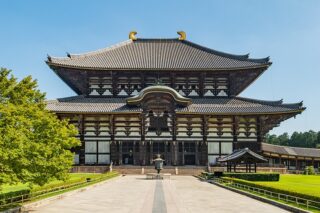
The Great Buddha Hall (Kondō) at Todai-ji is one of the largest wooden structures in the worldIt is known as one of the largest wooden structures in the world. The current Great Buddha Hall (Kondō) was rebuilt during the Edo period and is designated as a National Treasure.
Seated statue of Roshana Buddha (Vairocana Buddha)
This seated statue of Vairocana Buddha is known as the Great Buddha of Nara. Standing approximately 15 meters tall, it is Japan's largest surviving bronze Great Buddha erected before the Edo period. It is designated a National Treasure.
In the 4th year of the Tenpyō-shōhō era (752), a ceremony was held to consecrate and open the statue’s eyes. It was later damaged in two major wartime fires, but underwent extensive restoration during the Kamakura and Edo periods and has been preserved to the present day.
Seated statue of Nyoirin Kannon

Together with Kokūzō Bosatsu, they are enshrined as attendant figures to Rushana Buddha. Both are designated Important Cultural Properties of Japan.
Seated statue of the bodhisattva Ākāśagarbha

The Rushana Buddha is usually flanked by the bodhisattvas Monju and Fugen. At Todai-ji, however, Nyoirin Kannon and Kokuzo-bosatsu are enshrined as attendants. Because this differs from the usual pairing, it is considered one of Todai-ji’s seven wonders.
Statue of Tamonten

Vaiśravaṇa is one of the Four Heavenly Kings, the guardian deities of Buddhism, and protects the north. He is a warrior deity said to have heard the most of the Buddha’s teachings; he holds a trident and a pagoda in his hands and treads on an evil demon.
Statue of Kōmokuten

Komokuten is one of the Four Heavenly Kings and guards the west. His name refers to his far-reaching vision, said to see across vast distances. Of the Four Heavenly Kings, Jikokuten and Zochoten were left unfinished, and only their heads remain.
Crawling through the pillar hole

Northeast of the Great Buddha Hall is a pillar with a hole in it. It is said that crawling through the hole brings blessings such as protection from illness. One theory holds that it wards off evil spirits from the “demon gate,” but its origin is uncertain. It is considered one of Todai-ji’s seven mysteries.
Hokkedō (Sangatsudō)

Hokkedō (Sangatsudō) is one of the temple buildings in the area on the eastern side of the Tōdai-ji grounds known as “Jōin,” and isthe oldest building in Tōdai-ji. Traditionally said to have been founded during the Tenpyō period, it has been designated a National Treasure. All 10 Buddhist statues enshrined inside, including the standing statue of Fukūkensaku Kannon, have been designated National Treasures.
Nigatsudō

Nigatsudō is one of the halls in the upper section, together with Hokke-dō (Sangatsudō) and others, a stage-style building overlooking the city of Nara.

The present-day Nigatsudō was rebuilt during the Edo period and is designated as a National Treasure. The name “Nigatsudō” comes from the fact that the Shuni-e ceremony was held in the second month of the lunar calendar.
Shuni-e (Water-Sending and Torch Ceremonies)

Shuni-e is a Buddhist ceremony in which prayers are offered for peace in the nation and abundant harvests. During Shuni-e at Nigatsudō Hall of Tōdai-ji, water called “okōzui” is drawn from a well named Wakasa-i and offered to the principal image. This ceremony iscalled Omizutori. Before Omizutori, the “Omizukuri” ceremony is also held at Wakasa Jinguji Temple in Obama, Fukui Prefecture.
During Shuni-e at Tōdai-ji’s Nigatsudō, large torches are carried across the hall’s stage as sparks dance in the night sky; Otaimatsuis performed. Originally, these lights were used to illuminate the path of the monks conducting Shuni-e. Today, it is an event heralding the arrival of spring in Nara and is widely loved.
Basic information about Tōdai-ji
The information below was checked against official sources on September 16, 2026. Please also check the latest information on the official website when planning your trip.
- 🔗 Official Website
- The official website provides visiting hours and admission fees for the Great Buddha Hall, Hokke-do Hall (Sangatsu-do Hall), Kaidan-do Hall, and the Todai-ji Museum.
 拝観時間・拝観料 - 東大寺拝観時間・拝観料 Opening Hours / Admission Fees '26/9/10 重要なお知らwww.todaiji.or.jp
- 📍 Address
- 406-1 Zoshi-cho, Nara City, Nara Prefecture
- 🕒 Visiting Hours
-
- Great Buddha Hall: 7:30–17:30 from April to October; 8:00–17:00 from November to March
- Hokke-do Hall (Sangatsu-do Hall) and Kaidan-in Kaidan-do Hall:8:30〜16:00
- Todai-ji Museum: 9:30–17:30 from April to October (last admission 17:00); 9:30–17:00 from November to March (last admission 16:30)
- 🚫 Closed Days
- Open daily except during special events or emergencies.⚠️ Visiting conditions may change due to events or other circumstances, so check the official website before your visit.
- 💶 Admission Fees
-
- Great Buddha Hall, Hokke-do Hall, and Kaidan-do Hall: At each facility, adults (university students and older) ¥800, high school students ¥800, junior high school students ¥800, and elementary school students ¥400
- Combined ticket for the Great Buddha Hall and Todai-ji Museum: Junior high school students and older ¥1,200; elementary school students ¥600
- Visitors with a disability certificate: Adults (university students and older), high school students, and junior high school students ¥400; elementary school students ¥200
Separate admission fees are required for the Great Buddha Hall, Hokke-do Hall, Kaidan-do Hall, and the Todai-ji Museum.
- 🎫 Admission Tickets
- No reservation or advance application is required. Groups are also accepted at the same-day ticket counter. Admission tickets must be paid for in cash.
- ⏱️ Suggested Visit Duration
- Allow approximately 60–90 minutes for a visit focused on the Great Buddha Hall, starting from Nandai-mon Gate.⚠️ Allow around 2–3 hours if you also plan to visit Hokke-do Hall, Kaidan-do Hall, the Todai-ji Museum, and Nigatsu-do Hall.
Getting to Tōdai-ji
Kintetsu-Nara StationtoTodai-ji Temple's Nandaimon Gateis about a 20-minute walk. From Kintetsu-Nara Station, continue east along Omiya Street andNara National Museumturn left at the next intersection (Daibutsuden Intersection).Nara ParkContinue north along the park's outer edge to reach Todai-ji Temple's Nandaimon Gate.
Local bus and car
From JR Nara Station or Kintetsu Nara Station, take the city loop bus, get off at “Tōdaiji Daibutsuden・Kasuga Taisha-mae,” and walk for about 5 minutes. From Kintetsu Nara Station, you can also take the Gurutto bus and get off at the Daibutsuden-mae parking lot. There is no dedicated parking lot on the temple grounds, so if you are driving, use a nearby parking lot.
Operating details and parking conditions may change, so please check them again before setting out.
The related guide “【奈良】観光スポット・グルメ・交通・モデルコースを解説” is currently available only in Japanese.
