Highlights of the Sannai Maruyama Archaeological Site
The Sannai Maruyama Site is the remains of a large settlement from the Jōmon period in Aomori City, Aomori Prefecture.
The area was inhabited over a long period, from approximately 5900 to 4200 years ago. The remains of numerous dwellings, storage pits, burial grounds, and workshops have been discovered here. It is particularly known for its enormous raised-floor building, constructed with 6 posts, which offers a glimpse into the advanced wooden construction techniques of the time.
A wide variety of artifacts, including pottery, stone tools, wooden objects, and lacquerware, have also been excavated, showing that the Jomon people developed a rich culture involving trade and rituals.
Because of these values, the Sannai-Maruyama ruins were inscribed in 2021 as World Cultural Heritage as part of the Jomon Prehistoric Sites in Northern Japan.
Large raised-floor buildings and large pit dwellings

This reconstruction of a large raised-floor building is a landmark of the Sannai-Maruyama Archaeological Site.

What is known for certain is that the postholes were approximately 2 meters in both diameter and depth and were spaced 4.2 meters apart. There are various theories about the building’s height, number of levels, and purpose.

This is a reconstruction of a huge pit dwelling measuring 32 meters long and 10 meters wide. It is thought to have served as a meeting place, communal workshop, or shared residence.

A fairy-tale-like landscape stretches out before you.

In the foreground are the remains of a pit dwelling, while the reconstructed post-built building stands in the background. Pit dwellings are distinguished by floors below ground level, whereas post-built buildings have floors level with or raised above the ground.
Reconstructed dwellings and excavation site

This is a thatched dwelling. The entire dwelling is covered with thatch in a dome-like shape.

It is a conical dwelling with a bark roof.

A dwelling with an earth-covered roof. A natural grass roof has formed.


Excavation work is still ongoing.

Jomon Jiyukan

The Sannai Maruyama Site also includes the Jōmon Jiyūkan Museum. It displays pottery, clay figurines, everyday tools, ornaments, and other items excavated at the site.

A sewing needle finely crafted from animal bone or horn. It is said that fibers were extracted from plants such as ramie and akaso and spun into thread.
Basic Information about the Sannai Maruyama Site
The information below was checked against official sources on September 21, 2026. Please also check the latest information on the official website when planning your trip.
- 🔗 Official website
- The official website provides the opening hours, closure days, and admission fees including the permanent exhibition for the Sannai Maruyama Site and Jomon Jiyukan.
ご利用案内見学時間9:00AM~5:00PM9:00AM~6:00PM(GW、6/1~9/30のみ)※入場は閉館の30分前まで 休館日毎月第4月曜日(祝日の場合は翌日)12/30~1/1所内整理日 今...sannaimaruyama.pref.aomori.jp
- 📍 Address
- Maruyama, Sannai, Aomori City, Aomori Prefecture305
- 🕒 Opening hours
-
- Regular:9:00–17:00
- Golden Week, 6 Month1–9 Month30:9:00–18:00
Admission is allowed until 30 minutes before each closing time.
- 🚫 Closure days
- Regular:the 4 Monday of each month (the following day when it falls on a public holiday), 12 Month30–1 Month1, and facility maintenance days.
- 💶 Admission fees
-
- Adults:500 yen
- University students and others:250 yen
- High school students and younger:Free
These are the fees for the permanent exhibition, including the archaeological site. Group rates are available for groups of 20 or more; special exhibitions require a separate fee.
- ⏱️ Suggested visit time
- The official model routes include a short route covering the site and the Sannai Maruyama Museum in 40 minutes, and a route taking 70 minutes that provides a broader look at the main structures and exhibits. ⚠️ The time required varies depending on volunteer guides, special exhibitions, hands-on workshops, and the weather.

Access to the Sannai Maruyama Site
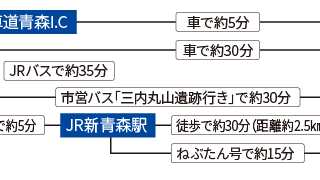
The Sannai-Maruyama ruins lie southwest of central Aomori and are conveniently accessible from Shin-Aomori Station. Travel between Aomori Station and Shin-Aomori Station on the JR Ōu Line takes 1 stops and 4 minutes.
From Shin-Aomori Station to the entrance to the Sannai-Maruyama Archaeological Site, it is approximately 10 minutes by car, 15 minutes by bus, or 38 minutes on foot. From Aomori Station, it is approximately 20 minutes by car or 30 to 40 minutes by bus.
Adjacent to the southeast of the Sannai Maruyama Site is the Aomori Museum of Art. It exhibits works by artists from Aomori Prefecture, including Shikō Munakata and Yoshitomo Nara, as well as artworks from Japan and abroad.
Local bus and car
From Aomori Station, take an Aomori City Bus departing from boarding area 6 in front of the station, or the Nebutan-go departing from boarding area 2 at the West Exit, to “Sannai Maruyama Site-mae.” From Shin-Aomori Station, the Nebutan-go departing from boarding area 3 at the East Exit is convenient. Parking is available for approximately 500 standard cars.
The related guide “【青森】観光スポット・グルメ・交通・モデルコースを解説” is currently available only in Japanese.
