
About Japan’s high-speed railways
The history of the Shinkansen began with the opening of the Tokaido Shinkansen in 1964. Following the success of the Tokaido Shinkansen, the Sanyo Shinkansen opened in 1972, followed by the Tohoku and Joetsu Shinkansen in 1982. At the time, these Shinkansen lines were operated by Japanese National Railways (JNR).
Following the breakup and privatization of Japanese National Railways in 1987, the Tokaido Shinkansen was taken over by JR Central, the Sanyo Shinkansen by JR West, and the Tohoku and Joetsu Shinkansen by JR East.
At the time of the breakup and privatization of Japanese National Railways, the Tohoku and Joetsu Shinkansen lines began and ended at Ueno, and were extended to Tokyo Station in 1991. Although there was a plan for through service between the Tohoku and Joetsu Shinkansen and the Tokaido Shinkansen at Tokyo Station, it was never realized.
Several factors are cited as reasons, including the crowded timetable of the Tokaido Shinkansen, the platform capacity at Tokyo Station, the division into separate companies following privatization, and differences in power frequency.
By the time Japanese National Railways was divided and privatized, through services were already operatingthe Tokaido and Sanyo Shinkansen operated by JR Central and JR West, and the Tohoku and Joetsu Shinkansen operated by JR East, each followed its own path of developmentand continued to develop independently.
JR East expanded its network to various parts of Tohoku: the Yamagata Shinkansen opened in 1992, followed by the Akita Shinkansen in 1997. Both were developed as mini-Shinkansen lines.
The Hokuriku Shinkansen first opened in 1997 between Takasaki and Nagano as the “Nagano Shinkansen.” In 2015, it was extended from Nagano to Kanazawa, and JR East and JR West began operating it jointly. In 2024, it was extended from Kanazawa to Tsuruga.
In the JR Hokkaido area, the section of the Hokkaido Shinkansen between Shin-Aomori and Shin-Hakodate-Hokuto opened in 2016, anddirect through service between the Tohoku Shinkansen and Hokkaido Shinkansen became possible.
In the JR Kyushu area, the Shin-Yatsushiro–Kagoshima-Chūō section of the Kyushu Shinkansen opened in 2004. In 2011, the entire line to Hakata was completed, andthrough service between the Sanyō Shinkansen and Kyushu Shinkansen began. In 2022, the Takeo-Onsen–Nagasaki section of the Nishi-Kyushu Shinkansen opened.
As a result, the Shinkansen developed into a high-speed rail network connecting different parts of Japan from Hokkaido to Kyushu.
The Blue and Green Shinkansen Trains

This is the signage at Tokyo Station.Blue and greenare colors derived from the 0 Series of the Tokaido and Sanyo Shinkansen and the 200 Series of the Tohoku and Joetsu Shinkansen, respectively. This tradition has been carried on in the N700 and E5 series.
The Tokaido and Sanyo Shinkansen use the COMTRAC operations management system, while the Tohoku, Joetsu, and Hokuriku Shinkansen use the different COSMOS system. SIRIUS on the Kyushu and Nishi-Kyushu Shinkansen is system-linked with COMTRAC, and CYGNUS on the Hokkaido Shinkansen is system-linked with COSMOS.
| Shinkansen | Train operation control system | Train operation and maintenance system | Operator |
|---|---|---|---|
| Tokaido・Sanyo Kyushu・Nishi-Kyushu |
COMTRAC SIRIUS |
ATC-NS KS-ATC |
JR Central・JR West JR Kyushu |
| Tohoku・Joetsu・Hokuriku Hokkaido |
COSMOS CYGNUS |
DS-ATC | JR East・JR West JR Hokkaido |
Rolling stock of the Tokaido, Sanyo, Kyushu and Nishi-Kyushu Shinkansen
The trains used on the Tokaido and Sanyo Shinkansen lineshave been developed jointly or independently by JR Central and JR West. With technical support from JR Central and JR West, JR Kyushu developed the 800 series.
The Nishi-Kyushu Shinkansen uses N700S trainsets developed by JR Central. The development of rolling stock for the Tokaido, Sanyo, Kyushu, and Nishi-Kyushu Shinkansen is based on cooperation among the respective companies, withJR Central playing a leading role.
| Rolling stock | Service launch | Routes served | Developer | Notes |
|---|---|---|---|---|
| 0 Series | 1964 | Tokaido–Sanyo | JNR | |
| 100 Series | 1985 | Tokaido–Sanyo | JNR | JR West newly designed the 100N Series |
| 300 Series | 1992 | Tokaido–Sanyo | JR Central | |
| 500 Series | 1997 | Tokaido–Sanyo | JR West | |
| 700 Series | 1999 | Tokaido–Sanyo | JR Central・JR West | |
| 800 Series | 2004 | Kyushu | JR Kyushu | JR Central and JR West provided technical support |
| N700 Series | 2007 | Tokaido–Sanyo–Kyushu | JR Central・JR West | |
| N700S | 2020 | Tokaido–Sanyo–Nishi-Kyushu | JR Central |
Shinkansen 0 series electric train

The Shinkansen 0 series train was introduced in 1964 with the opening of the Tokaido Shinkansen as the first commercial Shinkansen train. Its rounded nose earned it the nickname “dumpling nose,” and it is known as a railway vehicle symbolizing Japan during its period of rapid economic growth.
When it began operating, it became the world's fastest train in terms of maximum operating speed (the highest speed in commercial service)210 kilometers per hourand recorded this speed, connecting Tokyo and Shin-Osaka in about 4 hours. In 1986, its maximum operating speed was raised to 220 kilometers per hour, and until its retirement in 2008, it supported Japan's high-speed railway for no less than 44 years.
Shinkansen Class 100 electric train

The 100 Series Shinkansen train began commercial service in 1985 as the successor to the 0 Series. In addition to its sharply streamlined nose, it introduced the world's first 2-level cars for high-speed rail, greatly improving comfort with features such as private Green Car compartments and reclining swivel seats at every Standard Car seat.
The Series 100 had a maximum operating speed of 220 kilometers per hour, while the Series 100N (V formation), introduced in 1989230 kilometers per hourentered commercial service on the Sanyo Shinkansen section.
Shinkansen 300 series train

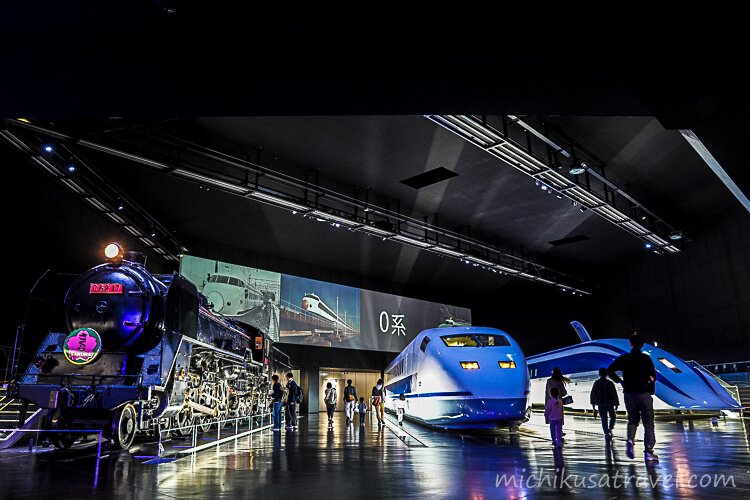
The 300 series Shinkansen train began commercial service in 1992as the first “Nozomi”and dramatically improved high-speed performance.A commercial speed of 270 kilometers per hourenabled it to connect Tokyo and Shin-Osaka in as little as 2 hours and 30 minutes. It is displayed at SCMAGLEV and Railway Park.
For information about the SCMAGLEV and Railway Park’s highlights, opening hours, and tickets, please see the article below.
Shinkansen 500 Series train

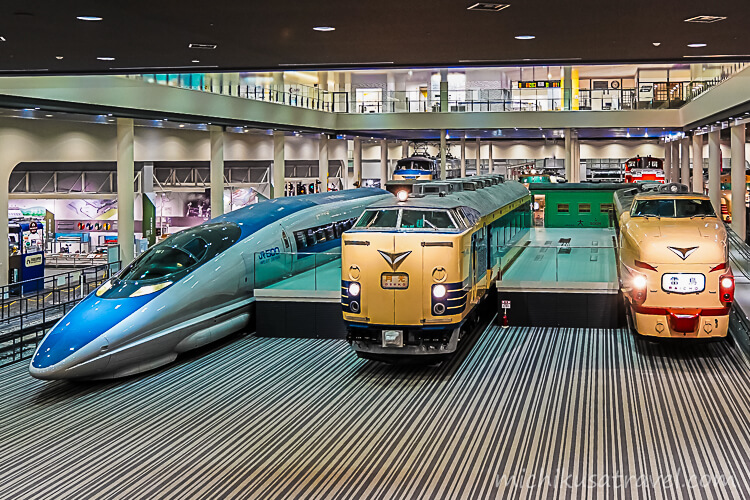
The Shinkansen 500 Series train entered commercial service in 1997 and was designed with an emphasis on high speed. At the time, it achieved the world's fastest commercial operating speed of 300 kilometers per hour.
 The 500 Series train is the only Shinkansen train developed independently by JR West. It is exhibited at the Kyoto Railway Museum.
For information about the highlights, opening hours, tickets, and more about the Kyoto Railway Museum, see the article below.
Shinkansen 700 series electric train

The Shinkansen 700 Series train began commercial service in 1999 as a new standard model following the 300 and 500 Series. It was developed to comprehensively improve not only high-speed performance but also ride comfort, quietness, and energy efficiency. Its distinctive nose, shaped like a platypus, reduces noise as the train passes through tunnels. The maximum operating speed is 270 kilometers per hour on the Tokaido Shinkansen and 285 kilometers per hour on the Sanyo Shinkansen.
800 Series Shinkansen train

The 800 Series Shinkansen train was introduced in 2004 alongside the partial opening of the Kyushu Shinkansen, becoming JR Kyushu’s first Shinkansen train.technical support from JR Central and JR West and was developed based on JR West’s 7000 subseries of the 700 Series (Hikari Rail Star).
N700 Series Shinkansen train

The N700 Series Shinkansen train began commercial service in 2007 as the successor to the 700 Series. This train further improved speed, comfort, and environmental performance,285 kilometers per hour on the Tokaido Shinkansen and 300 kilometers per hour on the Sanyo Shinkansenin commercial service.

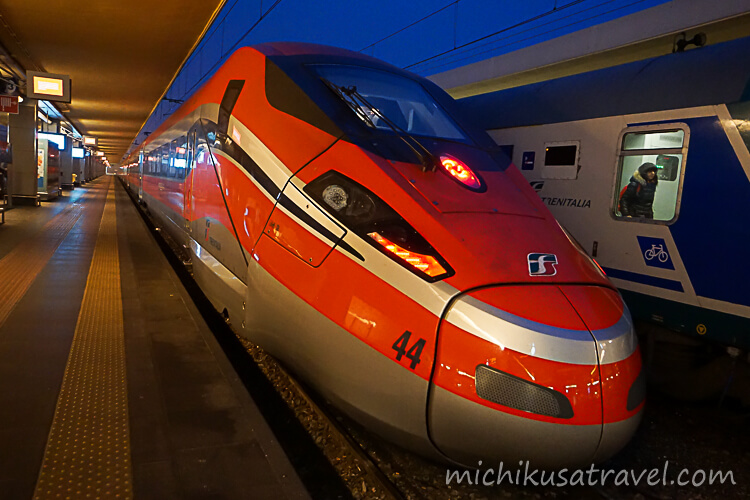
Another notable feature is that, as a Japanese Shinkansen train, it was the first to adopt atilting-body systemThis made it possible to reduce speed less even on the Tokaido Shinkansen, which has many curves, helping shorten travel times and improve ride comfort. Among trains with tilting bodies, Italy’s Pendolino is well known.
The article below provides a detailed introduction to Italy’s railways.
N700S Series Shinkansen Train
 The Shinkansen N700S Series train began commercial service in 2020 as the successor to the N700 Series. While the N700 Series was jointly developed by JR Central and JR West, the N700S Series was developed independently by JR Central, further improving safety, stability, comfort, and environmental performance. In addition to being used on services such as the Nozomi on the Tokaido and Sanyo Shinkansen lines, it has also been introduced on the Kamome service of the Nishi-Kyushu Shinkansen.
Shinkansen 923 series electric train, 0 subseries (T4 formation)

The 923 Series Shinkansen, batch 0 (T4 formation), is a comprehensive electric and track inspection train that measures the condition of electrical, track, and signaling equipment on the Tokaido and Sanyo Shinkansen while running on commercial lines. Developed as a service vehicle based on the 700 Series, it is calledDoctor Yellowbecause of its body color.
Rolling stock of the Hokkaido, Tohoku, Akita, Yamagata, Joetsu and Hokuriku Shinkansen
The rolling stock for the Hokkaido, Tohoku, Akita, Yamagata, Joetsu, and Hokuriku Shinkansen has been developed primarily by JR East_. The H5 series of the Hokkaido Shinkansen is also based on JR East’s E5 series.
By contrast, the Hokuriku Shinkansen'sE7 and W7 series trains were jointly developed by JR East and JR WestThis was a joint development project. JR West, which has been deeply involved in developing rolling stock for the Tokaido and Sanyo Shinkansen, joined forces with JR East on the Hokuriku Shinkansen and could perhaps be said to serve as a bridge in the lineage of Shinkansen trains.
The E1 series was originally planned as the 600 series, but because JR East adopted a new designation system for E series,the 600 series designation was left unused.
| Rolling stock | Entered service | Routes served | Developer | Notes |
|---|---|---|---|---|
| 200 series | 1982 | Tohoku·Joetsu·Nagano | Japanese National Railways | |
| 400 series | 1992 | Tohoku·Yamagata | JR East | Mini-Shinkansen |
| E1 series | 1994 | Tohoku·Joetsu | JR East | 2-level |
| E2 series | 1997 | Tohoku·Joetsu·Hokuriku | JR East | |
| E3 series | 1997 | Tohoku·Akita·Yamagata | JR East | Mini-Shinkansen |
| E4 series | 1997 | Tohoku·Joetsu | JR East | 2-level |
| H5·E5 series | 2011 | Tohoku·Hokkaido | JR East | |
| E6 series | 2013 | Tohoku·Akita | JR East | Mini-Shinkansen |
| E7·W7 series | 2014 | Joetsu·Hokuriku | JR East·JR West | |
| E8 series | 2024 | Tohoku·Yamagata | JR East | Mini-Shinkansen |
Shinkansen 200 Series train

The Shinkansen 200 series train was introduced in 1982 with the opening of the Tohoku and Joetsu Shinkansen lines. Its appearance closely resembles that of the 0 series, but because it runs through cold, snowy regions,resistance to cold and snowis one of its defining features.A white (ivory) base with green linesis a characteristic visual feature of the 200 series.
400 Series Shinkansen train

The Shinkansen 400 series train was introduced in 1992 with the opening of the Yamagata Shinkansen as thefirst Mini-Shinkansen train. Mini-Shinkansen is a system that enables through service with the Shinkansen, for example by converting existing conventional lines to standard gauge. The trains are built smaller than regular Shinkansen so they can also run on conventional-line sections. The Akita Shinkansen, opened in 1997, also uses this system.
E1 Series Shinkansen train

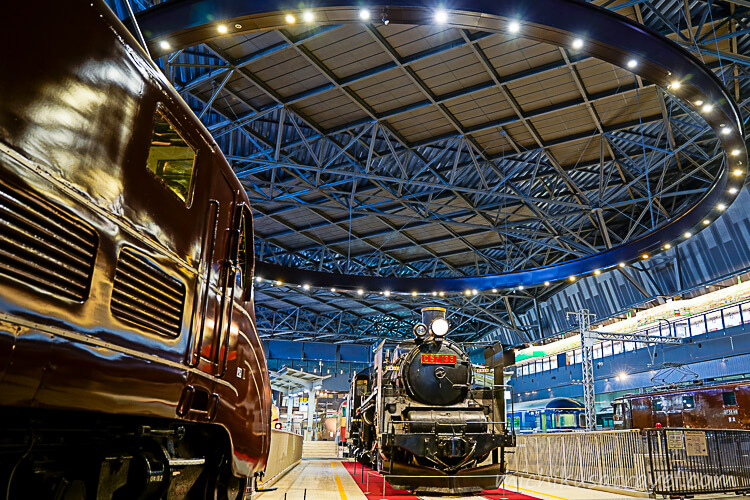
The E1 Series Shinkansen train was introduced in 1994 as thefirst entirely double-decker Shinkansen train. It operated mainly on the Tohoku and Joetsu Shinkansen lines.

“Max” is short for “Multi Amenity Express.” “Toki” is also the name of a train on the Joetsu Shinkansen. It is on display at the Railway Museum in Saitama.
For information on the Railway Museum’s highlights, opening hours, tickets, and more, please see the article below.
E2 Series Shinkansen Train

The E2 Shinkansen train was introduced in 1997. It was developed for the Yamabiko service, which runs coupled with the Akita Shinkansen Komachi, and also for the Asama service on the Hokuriku Shinkansen.
Shinkansen E3 Series train

This is the Yamagata Shinkansen E3 series, named “Tsubasa.” It entered commercial service in 1997. It is a mini-shinkansen that followed the 400 series and was also introduced on the Akita Shinkansen.

It depicts Yamagata Prefecture's specialties: safflower and cherries.
Shinkansen E4 Series train

The E4 series Shinkansen train is an all-double-decker Shinkansen train developed after the E1 series. It began commercial service in 1997. At the time, it had the largest passenger capacity in the world.
E5 Series Shinkansen train

The E5 and H5 Shinkansen trains were developed to enable commercial operation at speeds exceeding 300 kilometers per hour on the Tohoku Shinkansen. In 2013, they achieved Japan's fastest speed with commercial operation at 320 kilometers per hour. The trains owned by JR East are the E5 series, while those owned by JR Hokkaido are the H5 series. They can be distinguished by the color of the stripe, which is either pink or purple.

The E5 series features a logo inspired by a falcon.
H5 Series Shinkansen train

The H5 series features a logo inspired by Hokkaido’s landscape and the peregrine falcon.
E6 Series Shinkansen Train

This is the Akita Shinkansen E6 series “Komachi.” It began commercial operation in 2013. It is a mini-Shinkansen train that followed the E3 series. Its red body color is eye-catching.

The logo is inspired by Ono no Komachi.
Shinkansen E7 series train

The E7 and W7 series were developed for the opening of the Hokuriku Shinkansen between Nagano and Kanazawa in 2015.They were jointly developed by JR East and JR WestIn 2014, they were first introduced as the “Asama” service between Tokyo and Nagano. Trains owned by JR East are the E7 series, while those owned by JR West are the W7 series. Their designs are identical, but they can be distinguished by whether the letter on the windshield begins with “F” or “W”.

The logo is also shared by the E7 and W7 series and is modeled on the number “7.” Vehicles owned by JR West bear the inscription “JR WEST JAPAN RAILWAY COMPANY.”
E8 series Shinkansen train

The Shinkansen E8 is a high-speed train that entered commercial service in 2024 as the successor to the E3 “Tsubasa” trains of the Yamagata Shinkansen. It is a mini-Shinkansen train for the Yamagata Shinkansen, following the 400 and E3 series. With improved speed and comfort compared with the E3 series, it can operate commercially between Utsunomiya and Fukushima at300 kilometers per hour.
E926 series Shinkansen train

The E926 Shinkansen train is an inspection vehicle operated by JR East for Shinkansen lines. It serves the same role as the “Doctor Yellow” on the Tokaido and Sanyo Shinkansen lines. Based on the E3 series, it can run not only on full-standard Shinkansen lines but also on mini-Shinkansen sections such as the Yamagata Shinkansen and Akita Shinkansen.East i is what it is called.
(Bonus) Taiwan High-Speed Rail Rolling Stock
Taiwan High Speed Rail 700T train

The Taiwan High Speed Rail 700T train was introduced from Japan in 2007, when Taiwan High Speed Rail began operations. It was jointly developed by JR Central and JR West based on the Shinkansen 700 series. It was the first Shinkansen train exported overseas. In Japan, it is known by the nickname Taiwan Shinkansen.
Its maximum operating speed is 300 kilometers per hour, exceeding that of the 700 series. It connects Nangang Station (Taipei) and Zuoying Station (Kaohsiung) in approximately 1 hour and 30 minutes.