Highlights of Tokyo Station
Tokyo Station is Japan's largest shinkansen terminal, served by the Tokaido and Sanyo Shinkansen to Tokai, Kansai, Chugoku, and Kyushu, the Tohoku and Hokkaido Shinkansen to Tohoku and Hokkaido, and the Joetsu and Hokuriku Shinkansen to Shinetsu and Hokuriku,Japan's largest shinkansen terminal.
Among the conventional railway lines, Tokyo Station is served by the Yamanote Line, Keihin-Tōhoku Line, Ueno–Tokyo Line (Tōkaidō, Utsunomiya, Takasaki, and Jōban lines), Chūō Line (Rapid), Yokosuka–Sōbu Line (Rapid), and Keiyō and Musashino lines, as well as the Tokyo Metro Marunouchi Line.
History
In 1872 (the 5th year of the Meiji era),Japan's first railway opened between Shimbashi Station and Yokohama Station(the government railway). Shimbashi Station corresponds to today's Shiodome Station, while Yokohama Station corresponds to today's Sakuragichō Station. In 1889 (the 22nd year of the Meiji era), the entire section between Shimbashi and Kobe (the Tōkaidō Main Line) opened.
In 1883 (the 16th year of the Meiji era)Japan’s first private railway opened between Ueno and Kumagaya stations(the Japanese Railway). In 1891 (the 24th year of the Meiji era), the entire section between Ueno and Aomori stations (later the Tohoku Main Line) was completed.
Because the area was densely built up and difficult to construct in,the section between Shimbashi Station and Ueno Stationwas to be connected by an elevated railway, withCentral Station (Central Terminal)built along the route. Marunouchi was selected for the station because it was government-owned land where securing a site was relatively easy.
Following the First Sino-Japanese War and the nationalization of Japan’s railways, in 1914 (the 3rd year of the Taishō era), Central Station was renamedTokyo Stationand opened. The former Shimbashi Station was renamed Shiodome Station, while the former Karasumori Station was renamed Shimbashi Station.
With the opening of Tokyo Station, the starting point of the Tokaido Main Line was changed to Tokyo Station. In 1925 (the 14th year of the Taisho era), the section between Tokyo and Ueno stations opened as the Yamanote Line began operating as a loop line, and the Tohoku Main Line also had its starting point changed to Tokyo Station.
In 1964 (Showa 39), theTokaido Shinkansenopened between Tokyo Station and Shin-Osaka Station.Tohoku Shinkansenopened provisionally between Omiya Station and Morioka Station in 1982 (Showa 57), was extended to Ueno Station in 1985 (Showa 60), and then to Tokyo Station in 1991 (Heisei 3), completing the entire line.
Marunouchi Station Building

Kingō Tatsuno and Manji Kasaiwas jointly designed and completed in 1914. It has been designated an Important Cultural Property of Japan. Like the Iwate Bank Red Brick Hall in Morioka, which was completed earlier to a joint design by the same two architects, it shares design features such as red brick and domed ceilings.
For information about Morioka’s attractions, food, transportation, and more, please see the article below.

A terminal served by numerous railway lines

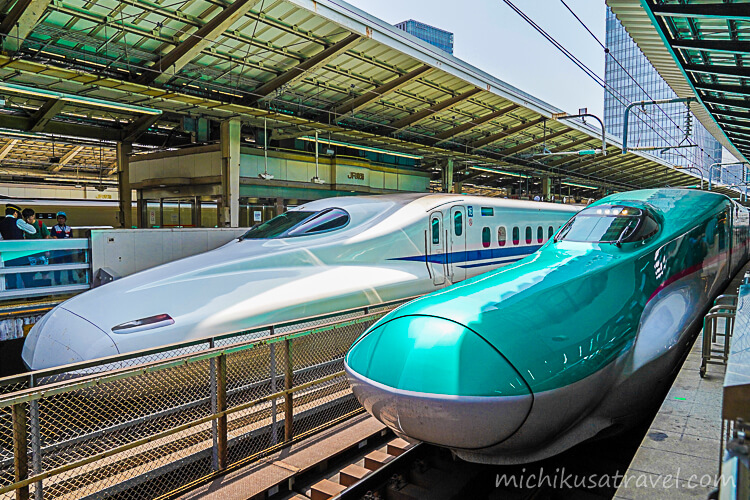
The Tokaido and Sanyo Shinkansen platforms managed by JR Central (blue) are separate from the Tohoku, Yamagata, Akita, Hokkaido, Joetsu, and Hokuriku Shinkansen platforms managed by JR East (green).
The Shinkansen platforms are concentrated on the Yaesu side. In addition to the above-ground platforms for conventional trains, there are underground platforms for the Sobu, Yokosuka, and Keiyo lines. The Keiyo Line in particular is far from the other platforms, so it is reassuring to allow plenty of time for transfers.
Shinkansen trains you can see at Tokyo Station
At Tokyo Station, you can compare JR Central and JR East Shinkansen trains at the same station. Here we introduce combinations photographed at Tokyo Station, including trains lined up on the same platform and coupled train operations.

From left: the N700 1000 series (N700A) and the 700 series.

This is a coupled operation featuring an E3-series Yamagata Shinkansen train and an E2-series Tōhoku Shinkansen train.
The Yamagata Shinkansen E3 series “Tsubasa” ended regular service in December 2025 with the start of E8 series operations.

From left: the E5 series of the Tohoku-Hokkaido Shinkansen and the E7 series of the Joetsu-Hokuriku Shinkansen.
 In the back is a coupled E2-series Tohoku Shinkansen train, while in the foreground an E6-series Akita Shinkansen is coupled with an H5-series Tohoku-Hokkaido Shinkansen.

The Yamagata Shinkansen E3 series and Tohoku–Hokkaido Shinkansen H5 series operate as a coupled train.

The E926 series Shinkansen train can carry out inspections while traveling at 275 kilometers per hour on Shinkansen sections.East i (pronounced East Eye)is what it is called.

From left, these are an N700-series train on the Tōkaidō–San’yō Shinkansen and an E5-series train on the Tōhoku–Hokkaidō Shinkansen. The two Shinkansen lines seem close, yet are far apart. Like water and oil, they never intersect.
For more details on the background to the development of both Shinkansen lines and the features of each Shinkansen model, please see the article below.
Basic Information about Tokyo Station
The information below was checked against official sources on September 16, 2026. Please also check the latest information on the official website when planning your trip.
- 🔗 Official website
- Information about ticket gates, ticket offices, and station facilities is available on JR East’s Tokyo Station page.
JR東日本 公式サイトwww.jreast.co.jp
- 📍 Location
- 1-chome Marunouchi, Chiyoda-ku, Tokyo
- 🕒 Hours
- They vary depending on the trains, ticket gates, ticket offices, and facilities inside the station.
- 💶 Admission
- Viewing the Marunouchi Station Building from outside is free. To enter the area beyond the ticket gates, you need a ticket for the section you are using or an admission ticket.
- ⏱️ Time required
- Allow 30–60 minutes if you are mainly viewing the Marunouchi Station Building, or 1–2 hours if you also plan to explore the station’s attractions and shopping facilities (editorial estimate).⚠️ The time required varies depending on crowd levels, the scope of your visit, and whether you need to transfer.

Getting to Tokyo Station
If the JR Yamanote Line is divided into an eastern side, running alongside the Keihin-Tohoku and Ueno-Tokyo lines, and a western side, running alongside the Saikyo and Shonan-Shinjuku lines, Tokyo Station is the largest hub on the eastern side. It is connected to Shinjuku Station, the largest hub on the western side, by the lines crossing the city center: the JR Chuo Line (Rapid) and the Tokyo Metro Marunouchi Line.
Transferring from the Shinkansen
When transferring from the Shinkansen to conventional lines, allow time to walk between platforms. According to JR East’s standard transfer times, transfers between the Tokaido and Sanyo Shinkansen and the Tohoku, Yamagata, Akita, Hokkaido, Joetsu, and Hokuriku Shinkansen take about 8 minutes, while a transfer to the Keiyo Line takes about 20 minutes. These times may change, for example, because of station improvement work.
