About trams in Italy
The history of trams in Europe and around the world begins in Germany. At an industrial exhibition held in Berlin in 1879, Siemens demonstrated the world’s first tram. Trial operations began in Berlin’s Lichterfelde district in 1881, followed by regular service in 1883.
About 10 years after Germany, Italy’s first tram began running in Milan in 1893. Milan still operates old vehicles manufactured in the first half of the 20th century, known as “Ventotto”, adding character to the cityscape.
As motorization advanced, a domino effect of tram closures swept through cities across Italy, including Padua, Verona, Florence, and Bologna, around the middle of the 20th century. In recent years, however, growing environmental awareness has led to trams being valued again as an eco-friendly form of transport, and some cities, such as Padua, have reinstated their services.
One distinctive feature of Padua’s trams is their use of a new French technology called “Translohr.”
Trams in Milan
Milan's trams and metro are operated by Azienda Trasporti Milanesi (ATM).
ATM 1500 series (ATM serie 1500)

The 1500 series is sometimes also known by the nickname “Ventotto.” In Italian, Ventotto means “28,” and the name comes from the year 1500, when the 1928 series began regular service.

Records indicate that many Ventotto trams were shipped across the Atlantic to San Francisco after completing their service in Milan. In San Francisco, as in Milan, you can still see Ventotto trams in active service.

During the Christmas season, trams decorated with lights run through the city. Sponsored by Coca-Cola.
ATM 4700 series (ATM series 4700)

ATM 4900 series (ATM series 4900)


The traffic signs look like the Japanese flag.
ATM 7000 series (ATM series 7000)

From the 7000 series onward, the design becomes much more modern. It is an ultra-low-floor tram manufactured by Bombardier Transportation.

ATM 7100 series (ATM series 7100)

The 7100 and 7500 series are manufactured by Hitachi Rail Italy.
ATM 7500 series (ATM series 7500)

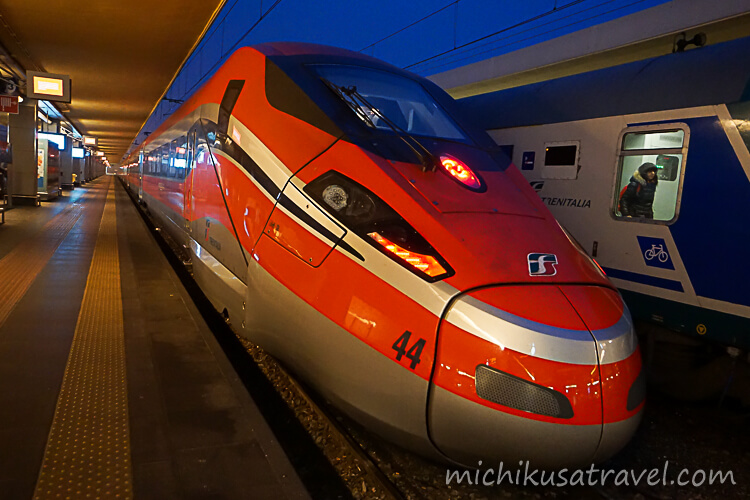
Hitachi Rail Italy also manufactures the Italian State Railways’ ETR500 trains.
The article below introduces Italian railway vehicles and the Pendolino.
Trams in Turin
Turin’s trams and metro are operated by Gruppo Torinese Trasporti (GTT).
GTT 5000 series (GTT serie 5000)

This is an early-generation ultra-low-floor tram, even by global standards. It was manufactured by Fiat’s railway division, Fiat Ferroviaria. The company is also well known for developing the Pendolino for the Italian state railway, but it has since been acquired by France’s Alstom.
In addition, retro models of the 2800 type are still in service.
Trams in Padua

The tram blends beautifully into the streetscape. It is a quintessentially European scene.

Padua’s tram service ceased operation in 1954. After lying dormant for half a century, it reopened in 2007.
It uses the Translohr system developed by the French company Lohr Industrie. If you look closely at the photograph, you will notice that it does not have 2 rails like a conventional tram. There is only 1 in the center. This is known as a guide rail and steers the tram, while the propulsion needed to move it is provided by rubber tires, just like those of a car.
Elsewhere in Italy, the system is also used in Venice, in the Mestre district.