Highlights of the Railway Museum

The Railway Museum in Omiya, Saitama, is one of Japan’s largest railway museums. It opened in 2007 as part of a project commemorating 20 years since the founding of JR East, and in 2018 the South Wing opened and the permanent exhibition in the Main Building was completely renovated.
Designated as Important Cultural Properties of Japan are the 150-class steam locomotive (locomotive No. 1), Japan’s first steam locomotive; Imperial Car No. 1, first generation, Japan’s first passenger car exclusively for the emperor; and the Nade 6110-class electric train, which became the prototype for commuter trains.
Many other valuable railway vehicles are also on display, including the EF55-series electric locomotive and the 7100-series Japanese National Railways steam locomotive “Benkei.”
There are also plenty of hands-on exhibits where visitors can have fun learning how railways work, including a miniature train that you can drive around an outdoor course.
Japanese National Railways 150-class steam locomotive (locomotive 1)

Japan’s railway service began between Shimbashi and Yokohama on 10 14, 1872 (Meiji 5). The Japanese National Railways Class 150 steam locomotive was built by the Vulcan Foundry in Britain in 1871 (Meiji 4) and imported for the opening of Japan’s railways. It was Japan’s first steam locomotive and is affectionately known as “Locomotive No. 1.” In 1997, it became the first railway vehicle to be designated a National Important Cultural Property.

The JNR 150 Class steam locomotive (locomotive No. 1) was sold to the Shimabara Railway in Nagasaki Prefecture in 1911 (Meiji 44). After supporting the company during its early years, it was returned to the Ministry of Railways for preservation in 1930 (Showa 5). On its return, Shimabara Railway founder Mototaro Ueki expressed his feelings on a plaque with the words “immeasurable sorrow at parting.”
Japanese National Railways class 7100 steam locomotive No. 2 “Benkei”

The JNR 7100 Class consists of tender steam locomotives manufactured by the American company H. K. Porter from 1880 to 1889. This is locomotive No. 2, popularly known as “Benkei.” Its front cowcatcher and distinctive diamond-stack chimney display features typical of steam locomotives from the era of the American frontier. It was introduced for the opening of the government-operated Horonai Railway, Hokkaido’s first railway.

H. K. Porter was a locomotive manufacturer based in Pittsburgh, Pennsylvania. “369” indicates the production number, while “1880” indicates the year of manufacture.
8 units of the 7100 class were built, but only 3 survive, including locomotive No. 2, “Benkei.” Another is locomotive No. 1, “Yoshitsune,” displayed at the Kyoto Railway Museum, while the remaining 1 unit is locomotive No. 6, “Shizuka,” displayed at the Otaru Museum. 1
For information about exhibits such as the Jozey locomotive at the Kyoto Railway Museum, see the article below.
Kaitakushi passenger car

The Benkei locomotive pulls the Kaitakushi passenger car. It was a first-class carriage for senior government officials, including members of the Hokkaido Development Commission, and was imported from the United States for the opening of the Horonai Railway.
Horonai is the usual Japanese reading, but the name derives from the Ainu word Poronai, meaning “large river.” The Kaitakushi car bears the inscription “PORONAI RAILWAY OF HOKKAIDO.”
JNR 1290-class steam locomotive “Zenkō”

The Japanese National Railways 1290-type steam locomotive “Zenkō” is a tank locomotive manufactured by the British company Manning Wardle in 1881 (14 year of the Meiji era). It is introduced as the first steam locomotive to run in Saitama Prefecture. The name “Zenkō” derives from the fact that the locomotive was unloaded and assembled near Zenkō-ji Temple in Kawaguchi, Saitama Prefecture.
Japanese National Railways 9850-Type Steam Locomotive (9856)

The 9850-class steam locomotive of the Japanese National Railways (9856) is a Mallet-type locomotive manufactured by Henschel & Sohn in the Kingdom of Prussia (present-day Germany) and imported in 1912. It was used to haul heavy trains along steep sections of major routes, including the Yamakita–Numazu section of the Tokaido Main Line and the Nagano–Naoetsu section of the Shin'etsu Main Line.
This locomotive is the only Mallet-type steam locomotive surviving in Japan. The boiler and other parts have been cut away and displayed to reveal the internal structure.
Japanese National Railways C57-class steam locomotive135

The JNR C57-class steam locomotives are tender locomotives manufactured from 1937 (Showa era 12) to 1947 (Showa era 22). Because of their elegant appearance, they are known as “ladies”.
Locomotive number 135 is known for hauling the last regular passenger train on the Muroran Main Line to be pulled by a JNR steam locomotive, in 1975 (Showa era 50).
0 Series Shinkansen “Hikari”

The 0 Series debuted with the opening of the Tokaido Shinkansen in 1964 as Japan’s first Shinkansen train for commercial service. The “Hikari” connected Tokyo and Shin-Osaka in approximately 4 hours. It continued to serve on the Sanyo Shinkansen after that line opened in 1972.
The original 0 Series lead cars featured a design known as the illuminated nose: the coupler cover at the tip was made of translucent acrylic resin and glowed softly in the light from the front marker lamps. This car recreates that feature.
Following the division and privatization of Japanese National Railways, the Tokaido and Sanyo Shinkansen lines fell outside JR East’s jurisdiction. This car was donated by JR West in 2009.
Shinkansen 200 Series train

The 200-series Shinkansen train is a Shinkansen railway vehicle introduced when the Tōhoku and Jōetsu Shinkansen lines opened in 1982. Its exterior closely resembles the 0 series, but because it operates in cold, snowy regions, its defining feature is resistance to cold and snow.
The color scheme of a white (ivory) base with green lines is a visual characteristic of the 200 series. Even today, for example, at Tokyo Station, the pictograms for the Tōkaidō and San’yō Shinkansen are blue, while those for the Tōhoku, Yamagata, Akita, Hokkaidō, Jōetsu, and Hokuriku Shinkansen are shown in green. Green also corresponds to JR East’s corporate color.
See the article below for more information about the Tokyo Station building and the Shinkansen.
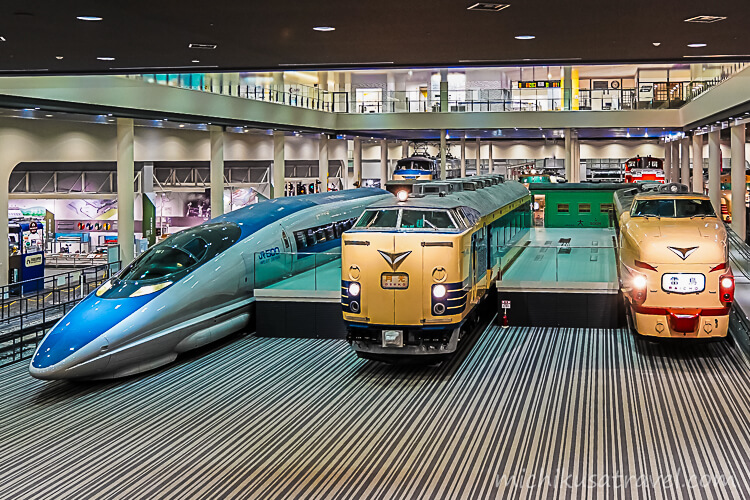
400 series Shinkansen train / E 5 series Shinkansen train

From left are an 400 Series Shinkansen and an E5 Series Shinkansen.
The 400 Series Shinkansen debuted with the opening of the Yamagata Shinkansen in 1992 as Japan’s first Mini-Shinkansen train. The Mini-Shinkansen system allows Shinkansen trains to run directly onto modified conventional lines, including lines converted to standard gauge. Its trains have smaller bodies than regular Shinkansen trains so that they can also operate over conventional-line sections. The Akita Shinkansen, which opened in 1997, uses the same system.

The E5 Series Shinkansen train was developed to enable commercial operation at speeds of at least 300 kilometers per hour on the Tohoku Shinkansen. In 2013, it achieved commercial operation at 320 kilometers per hour, then the fastest in Japan.
E 1 series Shinkansen train “Max Toki”

The E1-series Shinkansen electric train, introduced in1994, was the first Shinkansen train made entirely of2 double-decker cars. It operated mainly on the Tōhoku and Jōetsu Shinkansen lines.

“Max” is short for “Multi Amenity Express.” “Toki” is also the name of a train on the Joetsu Shinkansen.
Japanese National Railways 181 series electric train “Toki”

Series 181, the predecessor of JNR electric train sets in series 151, appeared in 1958 as the first limited-express electric train of JNR. As the limited express “Kodama,” it connected Tokyo and Osaka in 6 hours and 50 minutes. After the Tokaido Shinkansen opened in 1964, some train cars were reassigned to the Joetsu Line limited express “Toki.” Their performance was then enhanced to handle steep sections, and they were renamed series 181.
With the opening of the Tohoku and Joetsu Shinkansen lines in 1982, regular operation of series 181 also ended.
JNR Nade6110-type electric railcar (JNR Hode6110-type electric railcar)

The Japanese National Railways Class Nade 6110 electric railcar was manufactured from 1911 (the 44 year of the Meiji era) to 1914 (the 3 year of the Taishō era) for the Chūō and Yamanote lines. It is the oldest surviving bogie electric railcar. Its 2 bogies, one at the front and one at the rear, enabled it to negotiate curves smoothly and run stably. It also had features that became the prototype for later commuter electric trains, including 3 doors on each side. It is designated an Important Cultural Property of Japan.
KiHa 41300 diesel railcar

The KiHa Class 41300 diesel railcar was one of the JNR's early railcars. Introduced in the 1930s, it helped modernize regional lines. A railcar is a self-propelled railway vehicle powered by an engine, and it attracted attention as an alternative to steam locomotives on non-electrified lines.

The beautiful scenery along the Koumi Line is visible through the train window.
Maite 39-Type Passenger Car

The Maité 39-type passenger car was one of only 2 first-class observation cars of Japanese National Railways’ 1 class, built in 1930 (5 in the Shōwa era). It was coupled at the rear of the limited express “Fuji,” which ran between Tokyo and Shimonoseki.

It is characterized by its luxurious interior in a purely Japanese style known as “Momoyama.”
Japanese National Railways 20-series passenger car (Nahanehu22-type passenger car)

The JNR 20 Series passenger cars were introduced in 1958 for the “Asakaze” sleeper limited express linking Tokyo and Hakata. Their blue bodies earned them the name Blue Train. The Nahanefu 22 type, introduced in 1964, is a later 2-class sleeping car with a conductor’s compartment.
1 Imperial Carriage (First Generation)

Imperial Car No. 1, first generation, is Japan’s first imperial car (a passenger car exclusively for the emperor), manufactured in 1876 (9 year of the Meiji era). It was prepared for Emperor Meiji’s journey to mark the opening of the railway between Kyoto, Osaka, and Kobe. It has been designated an Important Cultural Property of Japan.
JNR Class ED40 Electric Locomotive

The JNR Class ED40 was a DC rack electric locomotive whose production began in 1919 (Taishō 8) for the steeply graded section between Yokokawa and Karuizawa (Usui Pass) on the Shin'etsu Main Line. Based on the German Class EC40 but incorporating further improvements, it was the first Japanese-built DC rack electric locomotive and the JNR's first domestically produced electric locomotive. It was manufactured at the Ministry of Railways' Ōmiya Works. It is designated an Important Cultural Property of Japan.
Turntable

In the center of the Vehicle Station on the 1 floor of the Main Building, there is a turntable used for exhibitions. The Turntable Rotation and Steam Whistle Demonstration, in which the turntable rotates to the sound of a steam whistle, is a popular program. The vehicles on the turntable vary by season, including C 57 steam locomotives and EF 55 electric locomotives.
JNR Class EF55 Electric Locomotive

The JNR EF 55 electric locomotive is a passenger locomotive, with only 3 units built in 1936.
Its streamlined nose reflects the global railway-design trend of the 1930, also seen in the British locomotive Mallard. The EF 55 class was based on the Pennsylvania Railroad GG 1-class electric locomotive.
For information about the exhibits at the National Railway Museum in the United Kingdom, please see the article below.
Miniature Train

This miniature train recreates JR East’s 259-series “Narita Express.” Visitors can experience driving a train on an outdoor course measuring 1 laps and 300 meters. By operating the train while paying attention to signals and speed, visitors can learn experientially about safe railway operations.
Railway Museum Line

This miniature train connects the main building’s “Museum Central Station” with the north building’s “Museum North Station.” It is modeled on a Shinkansen E2-series electric train. The blue-and-white body, reminiscent of the E2 series, and the layout connecting the two “stations” reflect an exhibition concept that turns getting around the museum into a railway experience.

Railway Museum: Essential Information
The information below was checked against official sources on September 16, 2026. Please also check the latest information on the official website when planning your trip.
- 🔗 Official website
- Visit the official website for information about The Railway Museum's exhibits and experiences, opening days, admission tickets, and use of the miniature driving train and simulators.
 鉄道博物館 - THE RAILWAY MUSEUM -埼玉県さいたま市大宮区にある鉄道博物館は、日本最大級の鉄道ミュージアムです。歴史的な車両展示や体験型シミュレータ、企画展などを通して鉄道の魅力を存分に楽しめます。www.railway-museum.jp
- 📍 Address
- 3-chome 47 Onaricho, Omiya Ward, Saitama, Saitama Prefecture
- 🕒 Opening hours
- 10:00–17:00, with last admission at 16:30.
- 🚫 Closed
- Every Tuesday and during the year-end and New Year holidays. The museum may open when Tuesday is a public holiday or during extended school vacations. ⚠️ Check the opening calendar before visiting.
- 💶 Admission
- A regular advance ticket costs 1,500 yen, while a same-day ticket costs 1,600 yen. Ticket prices by category, purchasing methods, and experience reservations are covered in detail in the next section, “Tickets for The Railway Museum.”
- ⏱️ Visit duration
- Allow about 2–3 hours to see the full-size rolling stock and major exhibits. Attractions include a railway diorama, turntable rotation and locomotive whistle demonstrations, a miniature driving train, and train-driving simulators. ⚠️ If you plan to join the experience programs, allow extra time for reservations, lotteries, and waiting.
Railway Museum Tickets
- 💶 Admission fees
-
- Advance purchase (by the day before): adults 1,500 yen, elementary and secondary school students 500 yen, preschool children (aged 3 or older) 200 yen
- Same-day purchase: adults 1,600 yen, elementary and secondary school students 600 yen, preschool children 300 yen
- Under 3: free
Discounts are available for the person holding a disability certificate or similar document and up to 1 caregivers.
- 🎫 Admission tickets and experience reservations
- Admission tickets can be purchased through the official online ticket site, convenience stores, or the museum's ticket machines. Admission tickets with reservations for the mini train, the E5 simulator, the D51 simulator, and the conductor simulator are sold through Seven Ticket.
- 🚆 Mini train and paid simulators
- The mini train and the D51, E5, and conductor simulators each cost 1 times 600 yen. Participation is by lottery through the Teppa-Ku lottery app, and each experience has age requirements. Some simulators are free and operate on a first-come, first-served basis.

Getting to the Railway Museum
The nearest station to the Railway Museum is the New Shuttle station Railway Museum. After exiting through the station ticket gates, walk north along the approach for about 1 minutes to reach the entrance to the Railway Museum.
From Omiya Station, the New Shuttle (Saitama New Urban Transit) reaches Tetsudō-Hakubutsukan Station in 1 stops and approximately 2 minutes. The Railway Museum is also about a 24-minute walk from Omiya Station.
By car
If you are traveling by car, you can use the museum’s dedicated parking lot. It may be full on holidays, so consider traveling by public transportation as well. The parking lot closes when the Railway Museum closes.