Highlights of the National Railway Museum

Proudly representing Britain, the birthplace of the railway, this is one of the world's largest railway museums.
said to have completed the basic design of the steam locomotiveRocketandMallardwhich set the world speed record for steam locomotives; the exhibits dedicated especially to steam locomotives are extensive.
From Japan,the Shinkansen Series 0was donated and has become one of the museum's signature display vehicles.
The museum has entered into sister-museum partnerships with The Railway Museum in Saitama and the Kyoto Railway Museum.

It is a characterful brick building.

Japan’s 0 Series Shinkansen stands alongside British legends.

Here too, there is a panel about the Shinkansen in the spot closest to the entrance.
To its right is Mallard, and farther to the right is a diesel locomotive nicknamed “Deltic”. We will introduce all of them later, together with photos of the actual locomotives.
Gladstone

This is the so-called royal train. Where Japan would have the Imperial Seal of the Chrysanthemum, it bears the United Kingdom’s coat of arms. The lion symbolizes England, and the unicorn symbolizes Scotland.

This is a passenger carriage hauled by Gladstone, known as “Queen Victoria's Saloon.”

You can take a tea break or have a light snack on seats inspired by train passenger seats.

The outer wall of Station Hall, where the royal train is displayed, is painted with logos of various railway-related companies. The JR Central logo is at the lower left.
Since the Class 0 Shinkansen was donated by JR West, not JR Central, the paintwork does not appear to commemorate it.
Rocket

Rocket was the first locomotive in the world to enable passenger railway travel using a steam locomotive. Because it was designed by father and son George and Robert Stephenson, Stephenson's Rocketis another name for it.
Thanks to numerous innovations, including the use of a fire-tube boiler and a mechanism that transmitted the cylinders’ power directly to the wheels, the top speed exceeded 40 km/h. It also left behind the infamous record of “the world’s first fatal accident,” but once the curtain had risen on the age of mass transportation, it never closed again.
 Mature steam locomotives like those seen in Japan have a water tank hidden beneath the coal bunker, but on Rocket a wooden barrel is placed in a conspicuous position beside the coal bunker.
British Rail Class 373 “Eurostar”

“Eurostar” is the name given to the international train linking London and Paris through the Channel Tunnel. Class 373 was developed based on the French railway SNCF’s high-speed TGV trains and entered commercial service in 1994.
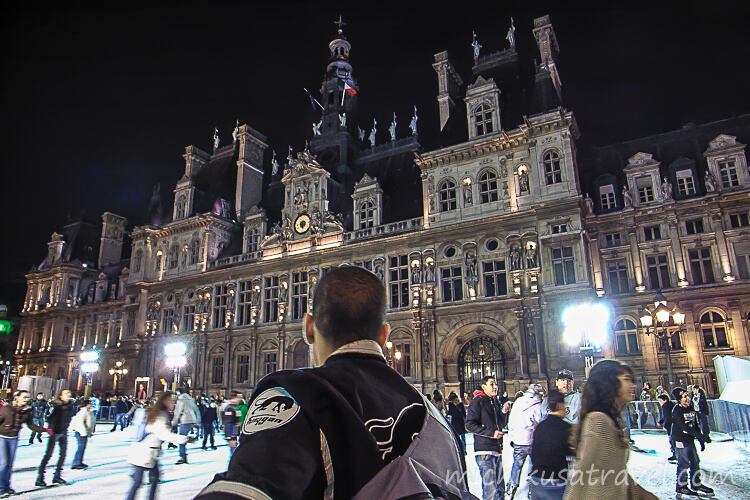
For information on Paris’s attractions, food, and transportation, please see the article below.
0 Series Shinkansen

It was donated by JR West in 2001. Materials related to the history of the Shinkansen are also on display.
Incidentally, the Series 0 Shinkansen on display at the Railway Museum in Saitama (JR East) was also donated by JR West.
LNER A4 steam locomotive No. 4468 “Mallard”

Its sleek, highly refined streamlined body hardly looks like that of a steam locomotive. It is also known as “Mallard”.

It holds the world speed record for steam locomotives at 126 mph(203 km/h). It is unlikely ever to be beaten.

From left are British Rail Class 52, Class 55, and Class 40 diesel locomotives. Class 55 is also fondly known by the nickname “Deltic”.
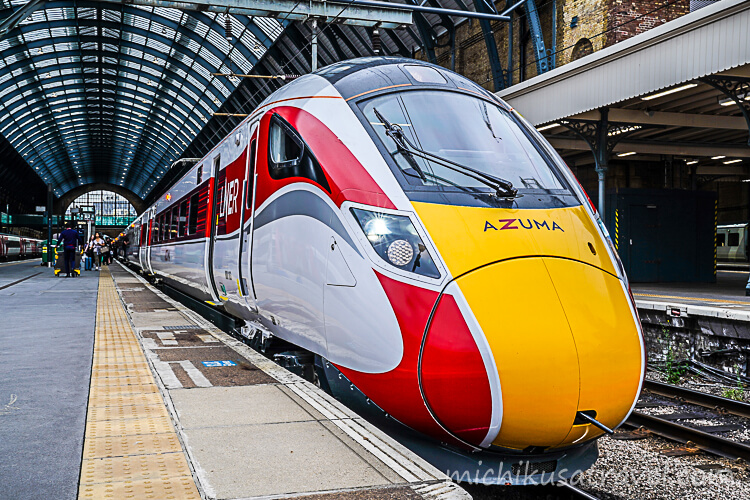
As steam locomotives were replaced by diesel locomotives, a series of collisions occurred because of the diesels’ quietness, so British Railways required the fronts of diesel locomotives to be painted yellow. The tradition has been carried on by Eurostar and Hitachi-built Class 800 trains.
The reason the Series 40 is not yellow may be that it was in a transitional period.
The article below provides an in-depth introduction to railways in the United Kingdom.
Stirling Single

The United Kingdom is a long country stretching from north to south. Its rail network has 2 main routes: the West Coast Main Line, which runs from north to south along the west coast, and the East Coast Main Line, which runs along the east coast. Both routes have competed to provide the fastest connections to northern England and Scotland.
The Stirling Single emerged in the latter half of the 19th century as the star of the East Coast line. It was notable for its large 8 ft(2.4 m)driving wheels and achieved an average speed of 50 mph(80 km/h)and a top speed of 85 mph(137 km/h).
Duchess of Hamilton

Like Mallard, it is notable for its streamlined styling.
Although it offered aerodynamic advantages, it had the major drawback of being difficult to maintain, and was ultimately operated with its streamlined cover removed. For display at the railway museum, its distinctive streamlined cover was recreated.
GWR Railcar

This one is also streamlined, but it is not a steam locomotive; it is a diesel railcar built in 1934. It is thought to be a multiple-unit railcar with distributed power rather than a locomotive. It was nicknamed the “Flying Banana.”
It was strongly influenced by the “railcar” designed by Ettore Bugatti, who was also famous for his automobile designs. Bugatti’s “railcar” is displayed at the railway museum Cité du Train in Mulhouse, France.
Like the Railway Museum in Saitama, it has a turntable inside the museum.

It would have been nice to have an observation area offering a view from above, but unfortunately I could not find one.
China Railways KF7

This steam locomotive was built in Britain in 1935 and operated commercially in China. In 1979, it was donated by the Chinese government to the National Railway Museum, bringing it back to its country of origin.
It was manufactured by Vulcan Foundry. Incidentally, the vehicle that ran between Shimbashi and Yokohama on Japan’s first railway was also made by the same company. It is on display at the Railway Museum in Saitama.

This is a passenger carriage from a horse-drawn railway used on the Port Carlisle railway. It is also known as the “Dandy Car.”
While most horse-drawn railways were replaced by steam locomotives in the early 19th century, the Port Carlisle Railway continued operating as a horse-drawn railway until 1914.

There is also an exhibition of model trains. It appears to be OO gauge (double-o). Someone is lying on the ground—what could have happened?
There is also a miniature railway that parents and children can ride for an additional fee, as well as an amusement-park-style attraction called “Mallard Experience.” It is also recommended for family visits.
Basic information about the National Railway Museum
The information below was checked against official sources on October 11, 2026. Please also check the latest information on the official website when planning your trip.
- 🔗 Official website
- Check visitor information, admission details and experience programmes here.
Home | National Railway MuseumImmerse yourself in the home of iconic locomotives and an unrivalled collection of engineering brilliance at the Na...www.railwaymuseum.org.uk
- 📍 Location
- Leeman Road, York YO26 4XJ, United Kingdom
- 🕒 Opening hours
-
- Every day 10:00–17:00 (last admission 16:30)
Station Hall has reopened.
- 🚫 Closed days
- The museum is closed from 24 to 26 December. Before visiting, check the official opening information for temporary closures or changes.
- 💶 Admission
-
- General admission free (donations welcome)
- Paid experience programmes A 1-day Wonderlab ticket starts at £8.60. Children aged 2 and under and carers enter free
- 🎫 Tickets
- Advance online booking is recommended, especially during busy periods. Same-day admission is possible, but visitors without reservations may face longer waits.
- ⏱️ Visit duration
- Allow 2–3 hours to see the main exhibitions in the Great Hall and Station Hall.⚠️ Plan your visit according to the areas you want to see and the experience programmes you choose. If you combine free admission with timed events, allow time for those as well.

Getting to the National Railway Museum
The National Railway Museum is located in York.
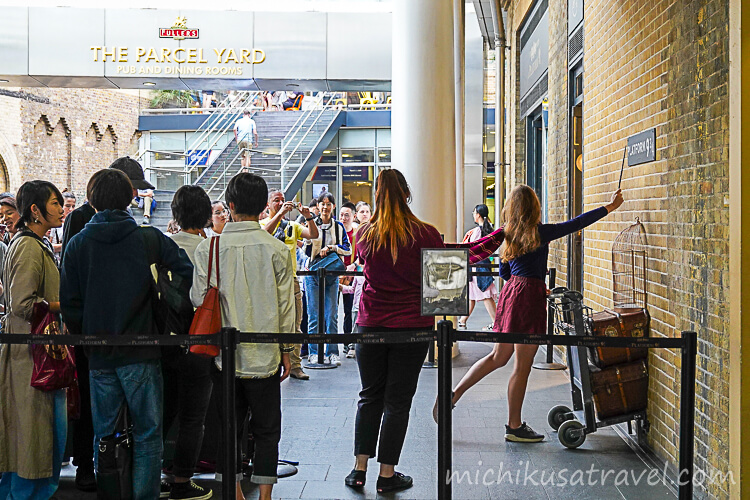
York is about 1 hour 45 minutes to 2 hours from London King's Cross by LNER or Grand Central. The sights and practical information for King's Cross Station are introduced in the article below.
If you wish to avoid steps, leave York station through the main entrance and turn left. Pass the Milner Hotel and enter Station Rise. Go through the tunnel at Marble Arch, cross the road, continue along Hudson Boulevard, and follow the signs for the miniature railway and visitor car park.
Online maps may show an incorrect route, so please use the museum’s official route map and the signs on site.

The related guide “【ヨーク】観光スポット・グルメ・交通・モデルコースを解説” is currently available only in Japanese.
