Highlights of Sforza Castle
The Castle of the Visconti and Sforza Families
When it comes to art museums in New York, the Metropolitan Museum of Art springs to mind; in Paris, it might be the Louvre or the Musée d’Orsay. But which museum represents Milan?
Art enthusiasts may suggest the Pinacoteca di Brera.Sforza Castle is one of Milan’s leading museums and art galleries. But how can a castle also be a museum?
The castle actually houses Milan’s civic museums, which preserve and exhibit world-class works including Michelangelo’s final sculpture, the Rondanini Pietà, and ceiling paintings by Leonardo da Vinci.
Here we introduce the highlights of Sforza Castle, a fascinating destination both as a castle and as a museum complex.

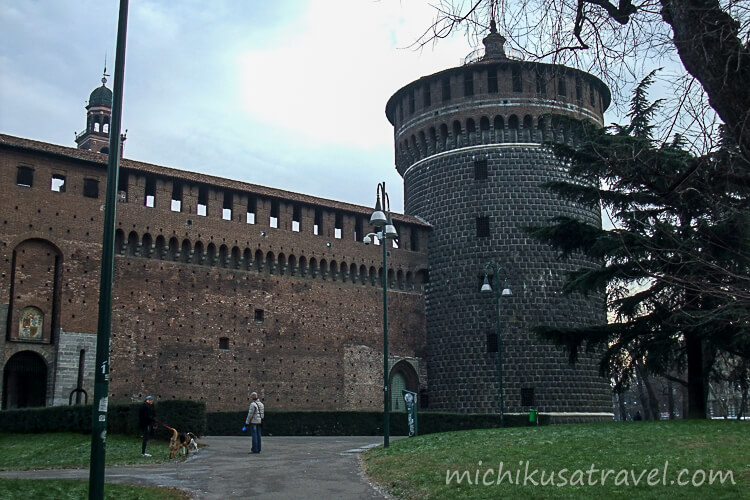
The castle was built in the mid-14th century by Galeazzo II Visconti, a ruler from the Visconti family, which controlled Milan at the time. When control of Milan passed to the Sforza family in the mid-15th century, the castle became their residence.
Francesco Sforza, who became the first Duke of Milan from the Sforza family, was originally a mercenary captain serving the Visconti family. He married a daughter of the Visconti family, and when its head died without leaving an heir, power ultimately passed to the Sforza family. At the time, he was apparently also mocked as a “former mercenary captain.”

Ludovico Sforza, Francesco’s son and the castle’s next ruler, hired Renaissance artists to decorate the castle. Among them was the renowned Leonardo da Vinci. Incidentally, it was Ludovico Sforza who commissioned the famous Last Supper at the monastery of Santa Maria delle Grazie.
It is worth noting that the Rondanini Pietà, the main highlight of Sforza Castle, was brought from Rome in 1952 after the castle had become a museum and is not directly connected to the castle’s history.
Museums and Collections Inside the Castle
We introduce Sforza Castle and the collections of the Sforza Castle Museum.


The moat of Sforza Castle is home to cats.

This is a statue of a medieval knight.

This is the equestrian statue of Bernabò Visconti. He was the younger brother of Galeazzo 2 Visconti, who built Sforza Castle, and jointly ruled Milan with Galeazzo 2. Perhaps he was also involved in the construction of Sforza Castle.

It is a saint statue with a face that looks as though it has melted.

The face is worn away here as well. I wonder if there was a custom of touching the face when praying.

In 1162, Milan was occupied and destroyed by the Holy Roman Empire, led by Frederick 1, known as “Barbarossa.” The cities of Lombardy centered around Milan formed the Lombard League and resisted it. In 1176, the Lombard League finally defeated the Holy Roman Empire at the Battle of Legnano and recaptured Milan. This sculpture depicts the citizens of Milan triumphantly returning to the city at that time.

This is a tapestry depicting Saint Ambrose, the patron saint of Milan and one of the four great Doctors of the Western Church.

This statue of Adam was created by the sculptor Stoldo Lorenzi.

This Madonna and Child statue depicts breastfeeding with striking realism.
Sala delle Asse

This is the Sala delle Asse. It features one of Sforza Castle’s major highlights: Leonardo da Vinci’s ceiling painting. It is said that he painted mulberry leaves and their red fruit spreading across the entire ceiling because Ludovico Sforza enjoyed eating mulberries.

The motif of “a large serpent trying to swallow a person” is called the biscione and is the coat of arms of the Visconti family. As shown in the photograph, combining it with an eagle created the coat of arms of the Sforza family. The biscione motif also appears in the emblem of Alfa Romeo, the automobile manufacturer that operated in Milan.
Incidentally, film director Luchino Visconti, known for works such as The Leopard and Death in Venice, was born into an aristocratic family descended from the House of Visconti.

These are statues of angels facing each other in the Sala delle colombine.

Were the bent fingers making a peace sign?

The miraculous way the hand has survived can only be explained by the power of prayer.

The artist’s intent can be felt in the surviving hands.

I don’t know what this object was used for, but it is beautifully crafted.

This is the funerary monument of Gaston de Foix. Gaston de Foix was a French general who was killed in the Battle of Ravenna in 1512. The Battle of Ravenna is considered part of the Italian Wars, which took place from the latter half of the 15th century to the middle of the 16th century.
Italy was unified in 1861; until then, it was divided into small states. While these states competed for power among themselves, they were also repeatedly invaded by neighboring great powers such as France, Germany, and Spain.
Rondanini Pietà

This is the Rondanini Pietà, the greatest highlight of Sforza Castle. Michelangelo created 4 Pietàs, but the Rondanini Pietà was made late in his life, and he is said to have continued working on it with a chisel until shortly before he fell ill.

A Pietà is a depiction of the Virgin Mary embracing her dead son, Jesus Christ, who has just been taken down from the cross. Perhaps Michelangelo identified himself with Jesus Christ?
Sempione Park
Sempione Park stretches northwest of Sforza Castle and is a green area originating from the gardens and hunting grounds that once lay behind the castle. As it was laid out along the axis from the castle to the Arch of Peace, you can continue straight on for a walk after visiting the fortress.
General information about the park is available in the City of Milan’s official guide.

Basic Information about Sforza Castle
The information below was checked against official sources on October 11, 2026. Please also check the latest information on the official website when planning your trip.
- 🔗 Official website
- Information about museum services and accessibility is available on the City of Milan’s official page.
Accessibilità - Castello Sforzesco - Comune di MilanoIl Castello si impegna a superare barriere architettoniche e sensoriali per una visita inclusiva. Scopri i progetti...www.milanocastello.it
- 📍 Address
- Piazza Castello, 20121 Milano, Italia
- 🕒 Current status
- The Sala delle Asse is currently closed for restoration.
- 🕒 Opening hours
-
- Castle museums Tue–Sun 10:00–17:30
- Last admission to each exhibition area and ticket office closing time 16:30
- Courtyards Daily 07:00–19:30
⚠️ Some museum areas may close temporarily, and admission times may change.
- 🚫 Closed days
- The museums are closed on Mondays and on January 1, May 1, and December 25. The courtyards are open daily.
- 💶 Admission
- Admission to the courtyards is free. Standard admission to the castle museums is 10 euros. Discount and exemption conditions and the separate fee for the “Merlate Panoramiche” battlement walkway are covered in the next section on tickets.
- ⏱️ Suggested visit duration
- Allow 30–45 minutes to focus on the courtyards and fortifications, 2–3 hours for the main museums and the Rondanini Pietà, or about half a day to explore several museums in detail.⚠️ Visit duration varies depending on gallery closures, admission queues, and the number of museums you visit.

Tickets for Sforza Castle
Admission prices for the castle museums are as follows.
- General admission 10 euros
- Reduced admission 5 euros
- People aged 0–17 and other eligible visitors free
Visitors eligible for free admission still need an admission ticket; when purchasing online, select the free ticket. A document verifying the eligibility requirements is required for discounted or free admission. Admission is free for everyone on the 1st Sunday of every month, and for visitors aged 25 or under on the 2nd Tuesday.
The combined museum ticket is valid on the day of issue and grants admission to all the museums within the castle, including the Ancient Egypt Gallery (Galleria Antico Egitto). Each exhibition area may be entered 1 time. Tickets can be purchased at the on-site ticket office or online and are non-refundable.
The “Merlate Panoramiche” battlement walkway requires a separate ticket, which does not include museum admission.
- General admission 10 euros
- Discounted 5 euros
- Free admission 0 euros
Admission is available from 10:00 to 17:00 from Tuesday to Sunday at 20-minute intervals, with 17:00 being the last admission time. A maximum of 25 people may enter per 1 admission.
Prices, discounts, eligibility for free admission, and purchasing methods are provided in the official ticket information.

Getting to Sforza Castle
Subway and walking
From the Piazza del Duomo area, head northwest along Via Dante to the front of the castle at Piazza Castello. From Cairoli metro station, exit toward Piazza Castello and follow the signs to the entrance through the castle gate and into the courtyard.
A detour at Sforza Castle
Geisha in the Courtyard

A gigantic geisha had appeared in the courtyard of Sforza Castle, looking as though she was about 5 meters tall.

Perhaps he is embarrassed to be exposed to curious eyes.

Or was it brought to an unfamiliar foreign land and is crying sadly?

The eyes peeking through the fingers were sharp.
⚠️ This is part of the special exhibition "That's Butterfly", themed around Madama Butterfly. It is not currently on display.
For attractions, transport and suggested itineraries, see “Milan: A guide to attractions, food, transportation, and suggested itineraries”.