Highlights of the Arc de Triomphe
The monument commissioned by Napoleon

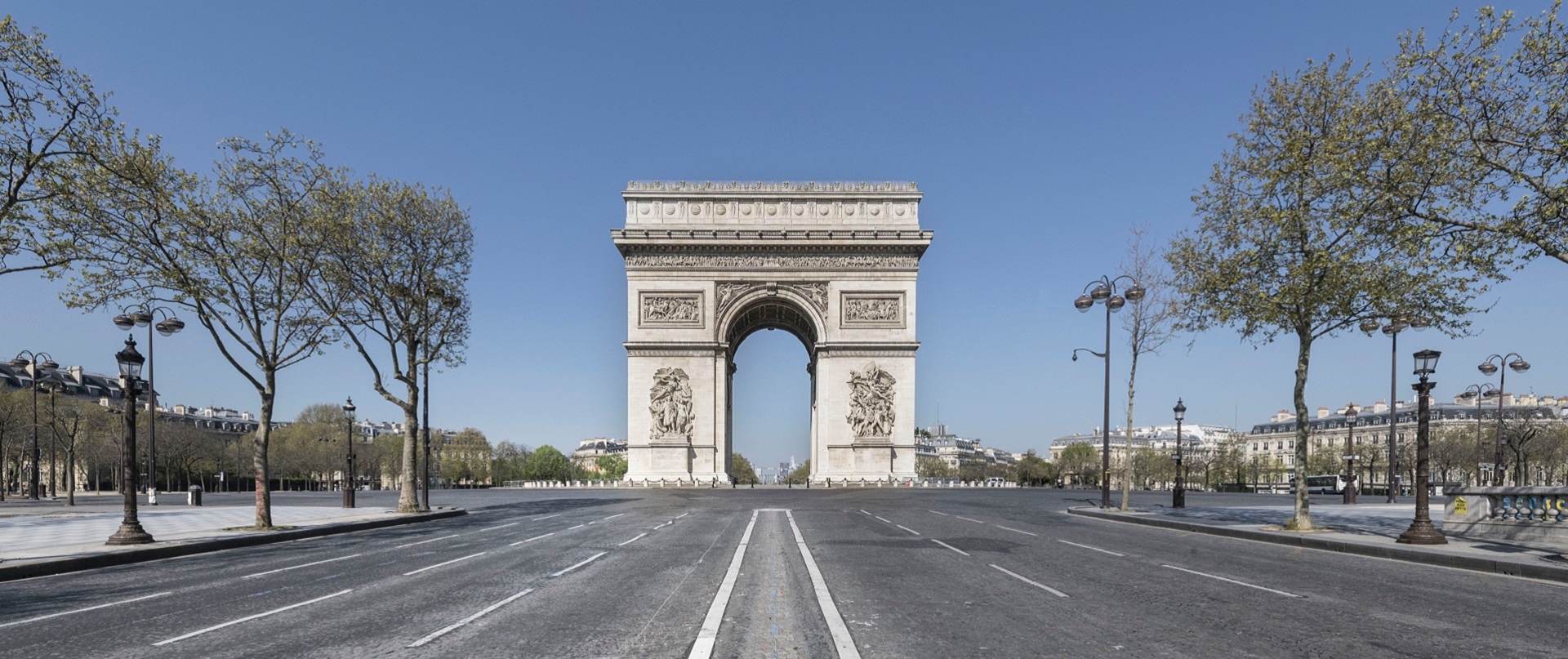
Construction of the Arc de Triomphe began in 1806 on Napoleon’s orders after his victory at the Battle of Austerlitz. After an interruption caused by political upheaval, it was completed in 1836. The exterior features large sculptures depicting French history, including Rude’s “Departure of the Volunteers of 1792,” also known as “La Marseillaise.”
The Arc de Triomphe is one of the structures that form part of the UNESCO World Heritage site “Paris, Banks of the Seine.”

The names of battles and soldiers are engraved on the inner walls. Looking up at the sculptures and inscriptions from beneath the arch, rather than only viewing it from afar, conveys its character as a national monument.
Rooftop
From the rooftop, you can see the Champs-Élysées, Place de la Concorde, the Tuileries Garden and the axis leading to the Louvre to the east, and the Grande Arche to the west. The observation deck’s greatest appeal is the chance to view old Paris and modern La Défense along a single line.
Tomb of the Unknown Soldier
Under the arch is the Tomb of the Unknown Soldier, who died in the First World War, with an eternal flame burning beside it. Inscriptions commemorating those who died in the war surround the tomb, making it a place of remembrance distinct from the viewing area. Please observe ceremonies quietly.
Arc de Triomphe: Basic Information
The information below was checked against official sources on October 11, 2026. Please also check the latest information on the official website when planning your trip.
- 🔗 Official website
-
You can check the opening hours, prices and admission requirements here.
 Informations pratiques - CMNRetrouvez ici toutes les informations pratiques pour préparer votre visite de l'Arc de triomphe.www.paris-arc-de-triomphe.fr
- 📍 Address
- Place Charles de Gaulle, 75008 Paris
- 🕒 Opening status
- ⚠️ The elevator is undergoing maintenance until further notice. The rooftop terrace can only be reached via the interior exhibition and 284 stairs.
- 🕒 Opening hours
-
- 4–9: Wednesday–Monday:10:00–23:00
- 4–9: Tuesday:11:00–23:00
- 10–3: Wednesday–Monday:10:00–22:30
- 10–3: Tuesday:11:00–22:30
Last admission is 45 minutes before closing.
- 🚫 Closed days
- The official list states that the site is closed on 5 1, 5 8, 7 14, and the morning of 11 11. It is unclear how far the “morning” note applies. On 2026 12 24 and 31, it closes at 16:00. Temporary closures may also occur for ceremonies or due to weather.
- 💶 Admission
- From 4 to 9, admission is 22 euros, or 16 euros on Wednesdays. From 10 to 3, admission is 16 euros. Admission is free for children under 18 and other eligible visitors.
- 🎫 Tickets
-
- What the ticket covers: The ticket includes access to the interior and rooftop terrace. The forecourt and the Tomb of the Unknown Soldier are freely accessible.
- Obtaining free tickets: The official family page recommends obtaining free tickets for children under 18 online. Other eligible visitors are directed to collect them on site.
- Using the disability-related free admission: For an individual visit, present valid supporting documents at the on-site ticket desk. No advance reservation is required.
- CMI and equivalent foreign documents: A CMI marked “priorité” or “invalidité,” or an equivalent foreign document, grants free admission to the holder and 1 companion.
- Parking CMI: A parking CMI provides priority admission only.
- AAH certificate: With an AAH certificate issued less than 6 months ago, the holder enters free of charge, while the companion pays.
- ⏱ Visit duration
- Allow approximately 1–1 hours 30 minutes to visit the exhibition and rooftop terrace. A guided visit with commentary takes about 45 minutes; an online-reserved specialist tour (visite-conférence) takes about 1 hours 30 minutes. ⚠️ The duration varies depending on crowds and waiting time at security.
Getting to the Arc de Triomphe
Metro and RER
The nearest station is Charles-de-Gaulle-Étoile on Metro lines 1, 2 and 6, and RER line A.
Entrance
Do not cross the roundabout on foot. Enter the Passage du Souvenir underground passage from the Avenue des Champs-Élysées or Avenue de la Grande Armée side.
For attractions, transport and suggested itineraries, see “Paris: A guide to attractions, food, transportation, and suggested itineraries”.