Highlights of Kochi Castle
Tosa Castle, built by Kazutoyo Yamauchi

Kochi Castle was built by Kazutoyo Yamauchi on Mount Otakasaka. The castle's name, “Kochi,” became the source of the names of Kochi City and Kochi Prefecture. With the Enokuchi River flowing to the north and the Kagami River to the south, it was initially named Kochiyama Castle, written with characters meaning “amid the rivers.” However, because the area suffered frequent flooding, those characters were avoided and the name Kochiyama Castle was rewritten with different characters. In time, it came to be known by its present name, Kochi Castle.
During the Edo period, a castle town developed around Kochi Castle, which remained the seat of the Yamanouchi family until it was decommissioned in 1871 (Meiji 4). The lives of Kazutoyo and his wife Chiyo, renowned for her devoted support of her husband, are also depicted in the NHK historical drama series “Kōmyō ga Tsuji.”
Castle Tower and Kaitokukan

The castle tower is in the back, with the palace in front. The palace is called Kaitokukan, and together with the castle tower it has been designated an Important Cultural Property of Japan.

This is the view from the keep. You can look out over Kochi’s urban area, which developed as a castle town.

The castle tower displays a diorama recreating whaling.

You can view whaling in Tosa in three dimensions, including the arrangement of the boats and people.

Perhaps pulleys were used to transport the meat and remove the skin.
Otemon Gate

This is the impressive Otemon Gate. The view of the Otemon Gate and main tower together is one of Kochi Castle’s signature scenes.
Statue of Kazutoyo Yamauchi
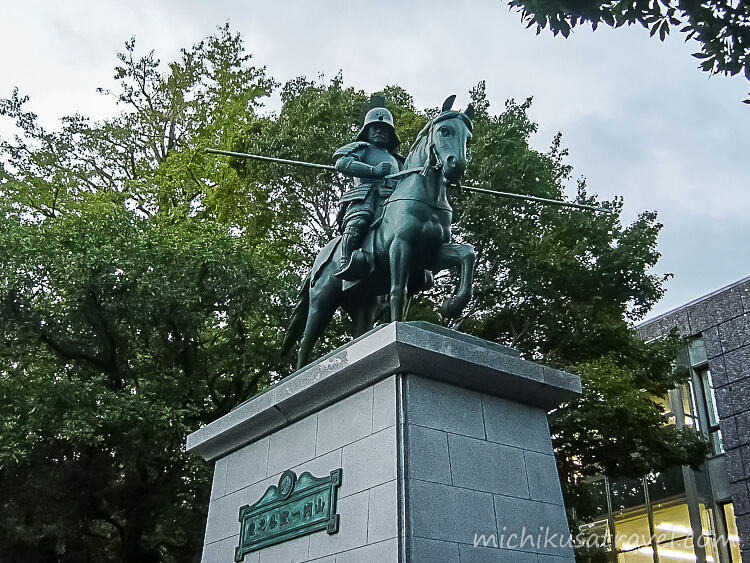
This is a bronze statue of Kazutoyo Yamauchi, the first lord of the Tosa domain, who built Kōchi Castle.
Bronze Statue of Yamauchi Chiyo

This is a statue of Chiyo, the wife of Kazutoyo Yamauchi. Chiyo’s posthumous Buddhist name was “Kenshō-in.”
According to an anecdote, shortly after Kazutoyo began serving Nobunaga, he used Chiyo’s hidden savings to purchase “the finest horse in eastern Japan,” which helped advance Kazutoyo’s career.
Statue of Taisuke Itagaki

This is a statue of Itagaki Taisuke, known as a leader of the Movement for Freedom and People's Rights.
In 1882 (Meiji 15), Itagaki Taisuke was attacked by a violent assailant while giving a speech in Gifu. It was on this occasion that the words “Even if Itagaki dies, freedom will not” were born.
Basic information about Kochi Castle
The information below was checked against official sources on September 19, 2026. Please also check the latest information on the official website when planning your trip.
- 🔗 Official website
- You can check the opening hours, admission fees, and current events at Kochi Castle’s keep and Kaitokukan here.
 利用料金・開館時間kochipark.jp
- 📍 Address
- Marunouchi 1-2-1, Kochi City, Kochi Prefecture
- 🕒 Opening hours
- The keep and Kaitokukan at Kochi Castle are open from 9:00 to 17:00, with last admission at 16:30. ⚠️ Opening hours may be extended during Golden Week and the Yosakoi Festival period.
- 🚫 Closed
- December 26–January 1
- 💶 Admission fees
-
- Aged 18 and over 500 yen
- Under 18 Free (student ID or similar proof required)
- Groups of 20 or more Aged 18 and over: 400 yen
The holder of an eligible disability certificate and 1 person required for direct assistance may enter free of charge.
- ⏱️ Recommended time
- Allow approximately 60–90 minutes to visit the keep and Kaitokukan from Otemon Gate. ⚠️ The time varies depending on whether you visit only the keep and Kaitokukan or also the Otemon Gate and statues. Please allow plenty of time before last admission.
Getting to Kochi Castle
On Foot and by Tram
You can walk from JR Kōchi Station to Kōchi Castle. If you take the tram, get off at “Kōchi-jō-mae” and walk toward the Ōtemon Gate.
By car
It takes about 15 minutes from the Kōchi Interchange on the Kōchi Expressway. The paid Kōchi Park car park is located on the northeastern side of the castle.
Detailed information on transportation and parking is available on Kochi Castle's official access page.
The related guide “【高知】観光スポット・グルメ・交通・モデルコースを解説” is currently available only in Japanese.