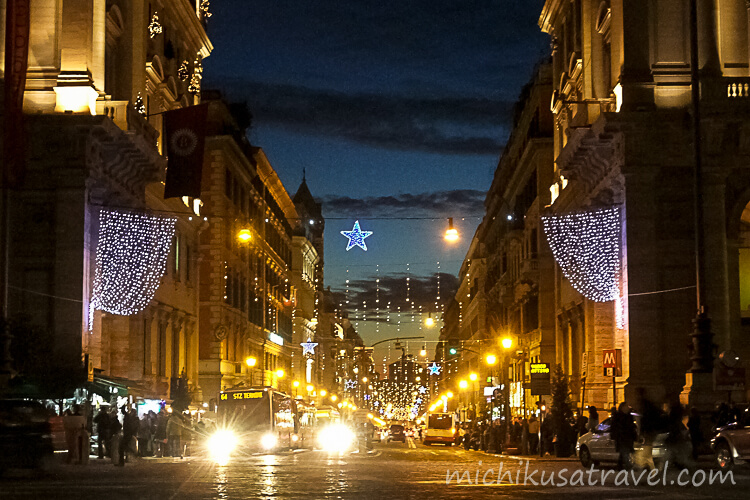
Highlights of the Roman Forum

The Roman Forum was the political and economic center of ancient Rome. This is where the famous saying “All roads lead to Rome” originated.
Forum refers to a public square in an ancient Roman city. Europe has a square-centered urban culture dating back to ancient Rome, with squares designed as the centers of cities.
The word “forum” is used for public debates, discussion venues, and conference halls, as in the World Economic Forum and Tokyo International Forum, and it derives from the Roman forum.
The Colosseum adjoins it to the east, providing a grand backdrop that adds greatly to its appeal.
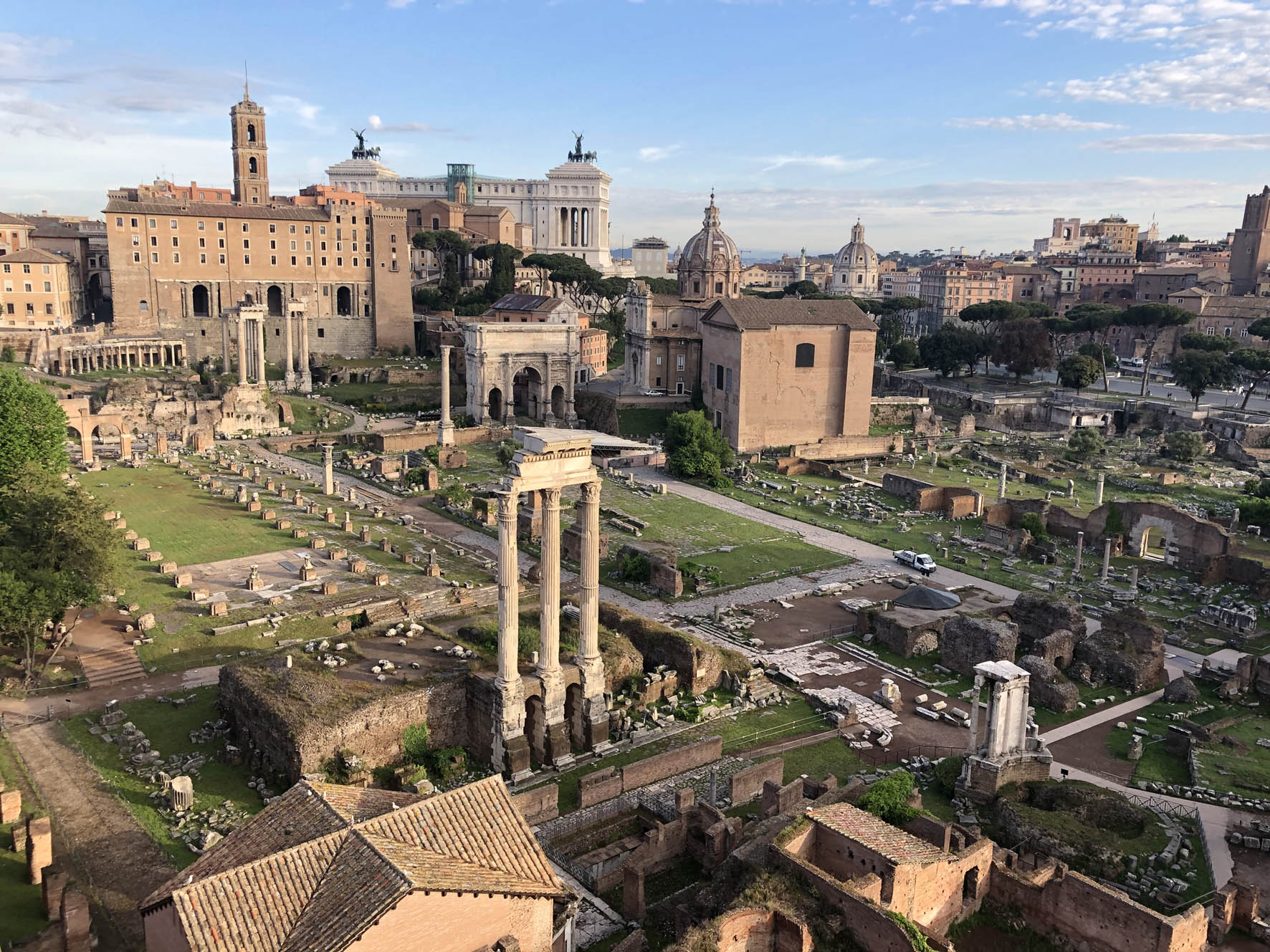
Main Ruins of the Roman Forum
The main ruins are concentrated along the east–west street known as the Via Sacra (Sacred Way).
Temple of Saturn

This temple was dedicated to Saturn, a god in Roman mythology. When Saturn is mentioned, many people may recognize the name from Goya’s painting Saturn Devouring His Son.
Arch of Septimius Severus

This triumphal arch is named after Septimius Severus, the 20th Roman emperor and the first emperor of the Severan dynasty. It was built to commemorate his victory in the 6th Parthian War.
His son, who later became Roman emperor, was Caracalla, famous for the Baths of Caracalla. The Baths of Caracalla are about 15 minutes on foot south of the Colosseum.
Basilica Aemilia

It was the first basilica built in the Roman Forum. Today, “basilica” is often used to mean a church, but at the time it referred to a public building where trials and important meetings were held.
Temple of Antoninus Pius and Faustina

This temple was built by Antoninus Pius, the 15th Roman emperor and the 4th emperor of the Nerva–Antonine dynasty, to honor his wife Faustina. Antoninus Pius also appears in Thermae Romae, where he was played by Kai Shishido in the film.
Temple of Romulus (Basilica of Santi Cosma e Damiano)

It is a temple that Emperor Maxentius commissioned during the Tetrarchy for his son Valerius Romulus, who died young at the age of 14. It is also called the Temple of Romulus or the Mausoleum of Romulus. In the 6 century, it was converted into the Christian church Basilica of Santi Cosma e Damiano.
Basilica of Maxentius (Basilica of Constantine)

This is the basilica (public meeting hall) that Maxentius, whom we just introduced, also ordered to be built. He did not live to see either the temple or the basilica completed. It is said that Constantine1. took over the project and completed it after defeating Maxentius at the Battle of the Milvian Bridge and reunifying the empire. Incidentally, the Arch of Constantine, located east of the Roman Forum, was built to commemorate this victory.
Emperor Constantine 1 is famous for officially recognizing Christianity, but because the basilica’s architectural style was adapted for Christian churches, the word is now also used to refer to the church building itself.
Arch of Titus

Domitian, the brother of Titus and the 10 emperor of the Roman Empire, who later became its 11 emperor, built it to commemorate Titus’s achievements. If the Arch of Septimius Severus at the western end of the Roman Forum is the western triumphal arch, then the Arch of Titus is the eastern one.
Temple of Venus and Roma (Basilica of Santa Francesca Romana)

This is a temple dedicated to Venus, the goddess of love and beauty in Roman mythology, and the goddess Roma. It is now a Christian church, but ancient Roman remains can be seen by walking around to the back of the building.
Roma reads as “amor,” the Latin word for “love,” when reversed, creating the wordplay behind the temple’s name. In Italian, “love” is amore.

A view looking directly toward the Colosseum from the south side of the Temple of Venus and Roma.
Palatine Hill

Palatine Hill adjoins the south side of the Roman Forum, with the remains of imperial palaces and gardens spread across the high ground overlooking the heart of ancient Rome. The two sites are part of the same archaeological area and can be visited with a shared ticket, but the highlights and walking experience differ from those of the Roman Forum, where the remains of public spaces are concentrated.
The view of the Roman Forum from the hill and the palace ruins are introduced in our article about Palatine Hill. Please take a look there as well.
Basic Information about the Roman Forum
The information below was checked against official sources on October 11, 2026. Please also check the latest information on the official website when planning your trip.
- 🔗 Official website
- Provides an overview of the Roman Forum and the site's services.
 Foro Romano - Parco archeologico del ColosseoIl Foro Romano è oggi parte del Parco archeologico del Colosseo. A èartiore dal VII sec. a.C. è stato il centro del...colosseo.it
- 📍 Location
- Largo della Salara Vecchia 5/6
- 🕒 Opening hours and access
- The regular visitor area of the Roman Forum is open. Only the House of Livia in the area covered by the combined ticket is closed for restoration, with no reopening date yet set.
- 💴 Admission
- Prices vary by ticket type. Typical ticket types and purchase conditions are explained in the following ticket section.
- ⏱ Time required
- Allow about 2 hours to visit the main ruins, or about 3 hours if you read the explanations as well. ⚠️ Visit duration varies depending on crowds and the area open to visitors.
Tickets for the Roman Forum
The Roman Forum and Palatine Hill are operated as one archaeological area and visited with a combined ticket. Depending on the ticket type, the included areas—such as the Colosseum, Imperial Fora and facilities covered by SUPER—and the validity period vary. Although the two places are introduced in separate articles, do not look for separate admission tickets when buying; choose a combined ticket that matches the areas you plan to visit that day.
| Ticket type | Indicative price | Colosseum | Eligible sites and validity conditions around the Roman Forum |
|---|---|---|---|
| 24h – Colosseum, Roman Forum and Palatine | Adults 18 euros EU citizens aged 18 or older and under 25 2 euros |
Admitted 1 time(s) at the reserved time | 1 admission to the Roman Forum–Palatine archaeological area. Within 24 hours before or after the reserved Colosseum time |
| Forum Pass SUPER | Adults 18 euros EU citizens aged 18 or older and under 25 2 euros |
No admission | 1 admission to the Roman Forum, Palatine Hill, Imperial Forums and SUPER sites. Valid only on the day of use |
For both ticket types, the reduced price is 2 euros and, according to the official wording, applies to EU citizens from the age of 18 until the day before their 25th birthday.
Colosseum, Roman Forum, Palatine Hill
Select your entry time for the Colosseum. Your time inside the Colosseum is limited to 75 minutes. Based on your reservation time and the locations of the entrances, decide whether to visit the Roman Forum before or after.

Forum Pass SUPER
No time reservation is required. After purchasing online, it can be used within 30 days, and once use has begun, it is valid only on that day. SUPER facilities have limited capacity. The House of Augustus is closed on Mondays. This pass cannot be used on free-admission days, which fall on the 1. Sunday of each month.
The Roma Pass may provide free admission or a discount for the Forum Pass SUPER in some cases. The conditions vary depending on the card’s validity period and the number of participating sites used by then, so check the official information when purchasing.
Getting to the Roman Forum
Subway and walking
From Colosseo station on Metro Line B, walk to the entrance open that day on either the Roman Forum or Palatine Hill side. Follow the signs at the entrance and along the visitor route.
For attractions, transport and suggested itineraries, see “Rome: A Guide to Attractions, Food, Transportation, and Suggested Itineraries”.