Highlights of Palatine Hill
Palatine Hill is a low hill adjoining the south side of the Roman Forum.“Seven Hills of Rome”It is considered one of them.
In Roman mythology, this is the historic site where Romulus began founding Rome. The city’s name, Rome, is also said to derive from Romulus.
Augustus, the first emperor of the Roman Empire, also established his residence here, and the remains of his palace can still be seen.
Later, successive Roman emperors developed palaces and gardens here. It may be easier to picture the place by its English name, Palatine Hill.
The word Palatine also became the origin of the English word palace.
Main ruins on the Palatine Hill

From the hilltop, where palace ruins and gardens stretch out, you can enjoy views of ancient Roman remains and the city at the same time.
The sightseeing route through the Roman Forum was linear, whereas Palatine Hill is a broad area. The crowds thin out, there is more greenery, and the place begins to feel like a park. Ideally, you should have enough time and peace of mind to enjoy a leisurely picnic. Otherwise, you will need to manage your time and focus your visit on the places that interest you.
Farnese Gardens

These gardens were created by Cardinal Farnese in the 16th century. They are popular as a viewpoint offering a panoramic view of the Roman Forum.

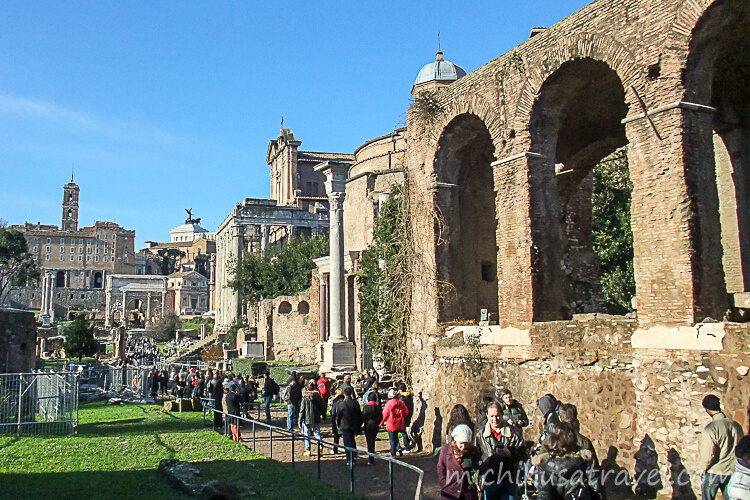
In the center is the Basilica of Maxentius (Basilica of Constantine), on the left is the Temple of Romulus (Basilica of Santi Cosma e Damiano), and on the right is the Temple of Venus and Roma (Basilica of Santa Francesca Romana).

The Colosseum and the Arch of Titus in front of it are visible.

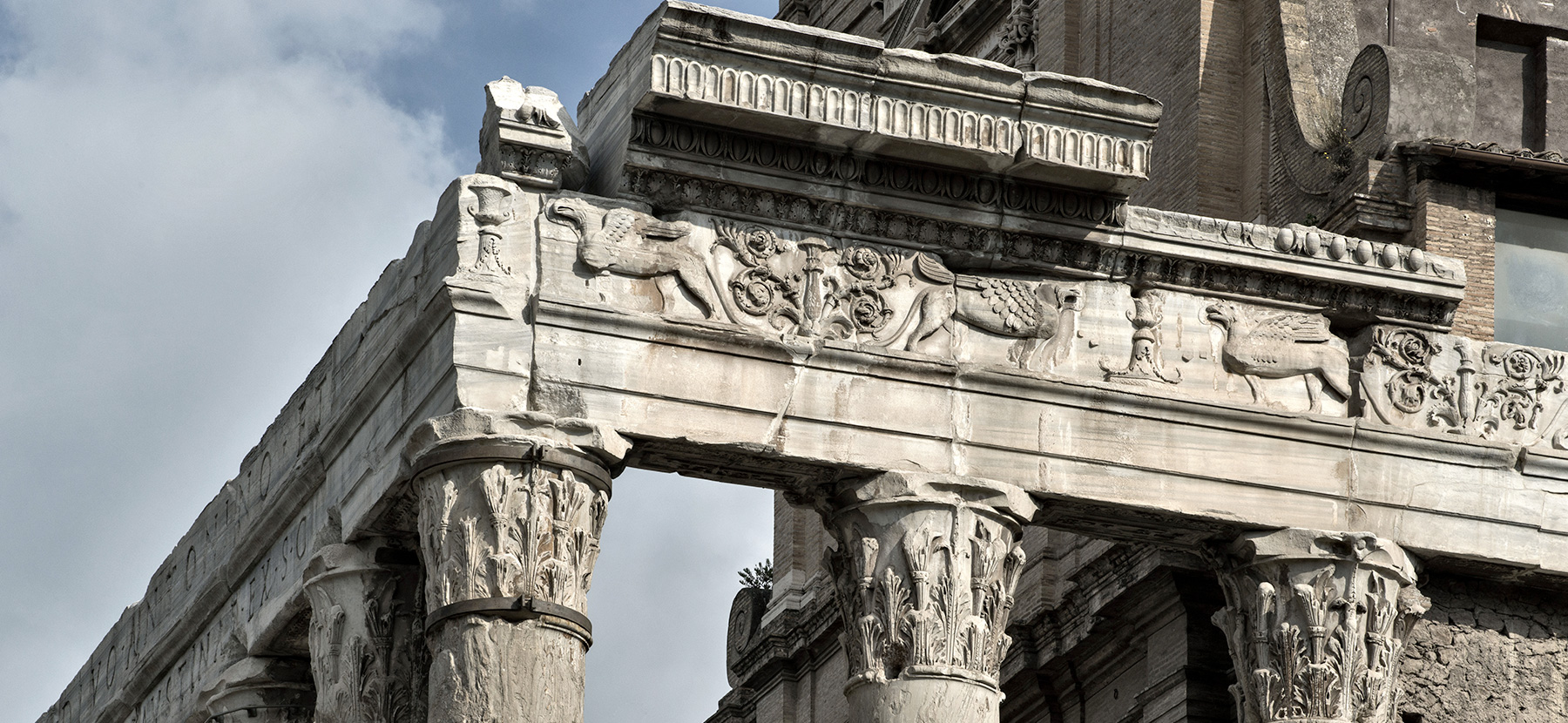
From the right, you can see the Temple of Antoninus Pius and Faustina, the Curia Julia (the Roman Senate building), and the Arch of Septimius Severus. Farther west is the Capitoline Hill, one of the “Seven Hills of Rome,” and the huge white building is the Victor Emmanuel 2 Monument.
Stadium

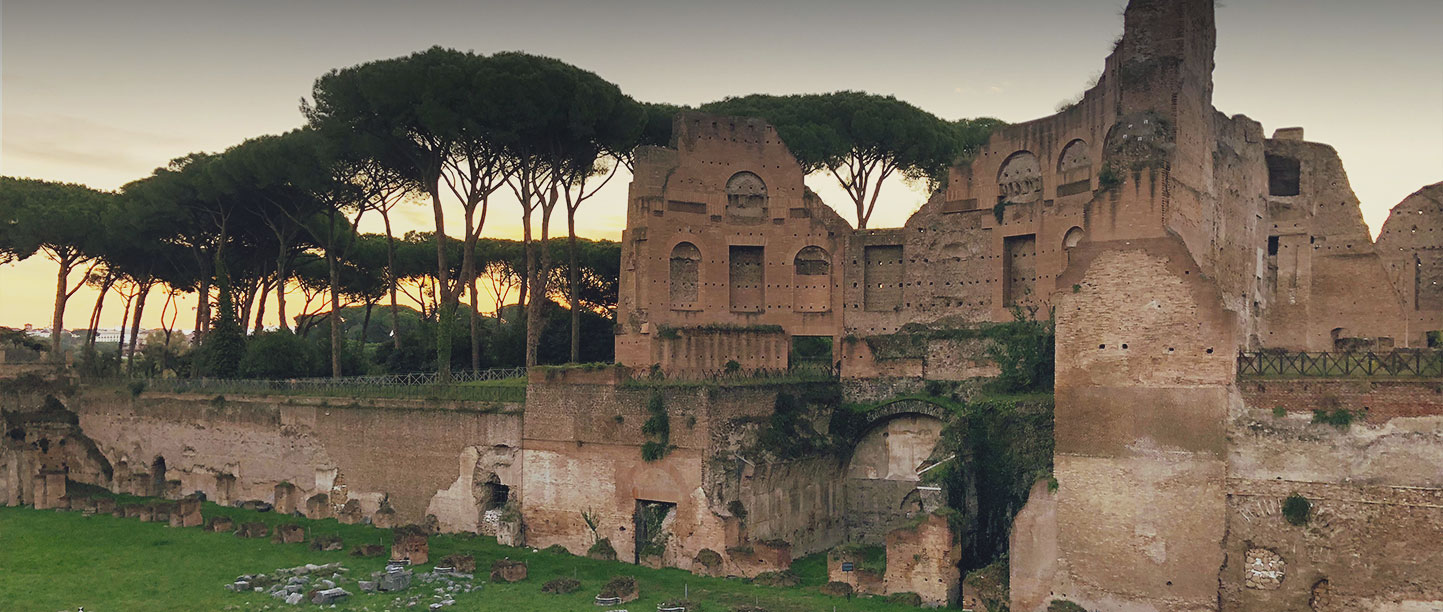
It was built by Domitian, the 11th emperor of the Roman Empire, who also built the Arch of Titus. The Domus Flavia and Domus Augustana mentioned later were also built by him.
At first glance, it looks like a stadium, and the name “Stadion” is also thought to be based on that perception, but there is also a theory that it was the emperor’s private garden.
Domus Flavia

Domus Flavia was the official palace (workplace), while Domus Augustana was the official residence (home). Japan’s Prime Minister’s Office also has an adjoining residence, and the two functions are strictly distinguished.
After being built by Emperor Domitian, it served as the residence of the Roman emperors for 300 years.

This is the courtyard of Domus Flavia, known as a “peristyle.” It is difficult to make out in the photograph, but there is an octagonal pool.
Domus Augustana

This is the imperial residence. A fountain is said to have stood at the spot shown in the photograph.
This is easy to misunderstand: Augustana simply means “emperor,” while the House of Augustus is a separate site. Augustana may also have come to mean “emperor” under the influence of Augustus, so the two may not be entirely unrelated linguistically. As tourist attractions, however, they are at least separate places.
House of Augustus

This is the actual house of Augustus, the first emperor of the Roman Empire. In Latin, it is written as "Domus Augusti", or in Italian as "Casa di Augusto". Be careful not to confuse it with the Domus Augustana.

He is said to have lived a relatively modest life for an emperor of the Roman Empire.


This is an underground passageway called "Criptoportico" in Italian.


Roman Forum

The Roman Forum lies beside the northern side of Palatine Hill and developed as the political, religious, and commercial center of ancient Rome. The same archaeological area can be explored with a combination ticket, allowing you to trace the temples and triumphal arches along the Via Sacra up close from the hilltop.
Our article about the Roman Forum introduces its ruins and visitor information.
Basic Information about Palatine Hill
The information below was checked against official sources on October 11, 2026. Please also check the latest information on the official website when planning your trip.
- 🔗 Official website
- Provides opening hours and visitor information.
 Orari e Biglietti - Parco archeologico del ColosseoScopri e acquista i biglietti ufficiali per visitare il Parco archeologico del Colosseo e i suoi monumenti – Coloss...colosseo.it
- 📍 Location
- Roma, Via di San Gregorio 30
- 🕒 Access status
- Palatine Hill is included in the visitor area. The House of Livia (Casa di Livia) is reported to be closed for restoration, and no reopening date is listed. Access to every facility in the area may not be available.
- 🕐 Opening hours
- The Roman Forum–Palatine area opens at 09:00. From October 1 to 24, 2026, last admission is at 17:30 and closing time is 18:30. From October 25, 2026 to February 28, 2027, last admission is at 15:30 and closing time is 16:30. It is closed on December 25, 2026 and January 1, 2027.
- 💴 Admission fees
- Prices vary by ticket type. The main ticket types are explained in the next section.
- ⏱ Visit duration
- Allow approximately 1 hour 30 minutes to 2 hours to visit the palace ruins, gardens, and viewpoints.⚠️ Visit duration varies depending on crowds and the area visited.
Tickets for Palatine Hill
The Roman Forum and Palatine Hill are visited with a combined ticket. We introduce the two sites in separate articles, but when purchasing your ticket, choose the combined ticket that covers the areas open for visitation that day.
Forum Pass SUPER
- Price:The standard price is 18 euros. The discounted price of 2 euros applies to European citizens from the age of 18 until the day before their 25th birthday.
- Areas included:The Roman Forum, Imperial Fora, Palatine Hill, and SUPER sites. The area may be entered 1 time, and SUPER sites may be visited within their capacity limits. The Colosseum is not included. The House of Augustus is closed on Mondays, and temporarily closed sites cannot be visited either.
- Reservation and validity:No time reservation is required. It can be used within 30 days after online purchase and, once use has begun, is valid only on that day. It cannot be used on the free admission day held on the 1st Sunday of each month.
24-hour ticket including the Colosseum
- Admission fee:The standard price for the Colosseo, Foro Romano, Palatino ticket is 18 euros. The reduced price of 2 euros applies to European citizens from age 18 until the day before their 25th birthday.
- Admission conditions:You may enter the Colosseum 1 time at the reserved time, and the Foro Romano–Palatino area 1 time on the same day or within 24 hours before or after the reserved Colosseum time.
The conditions for using ticket types that include the Colosseum are provided in the official information.

Getting to Palatine Hill
Subway and walking
The official site for the attraction lists Colosseo metro station on Line B. From the station, walk to the entrance available that day on either the Roman Forum side or the Palatine Hill side, and follow the signs on site.
For attractions, transport and suggested itineraries, see “Rome: A Guide to Attractions, Food, Transportation, and Suggested Itineraries”.