Highlights of the Sacré-Cœur Basilica
Architectural Style and White Exterior Walls

Standing on the hill of Montmartre, Sacré-Cœur Basilica is defined by its silhouette of a large central dome surrounded by several smaller domes. Its exterior combines elements of Romanesque and Byzantine architecture, making it markedly different from Paris’s Gothic churches, including Notre-Dame Cathedral.
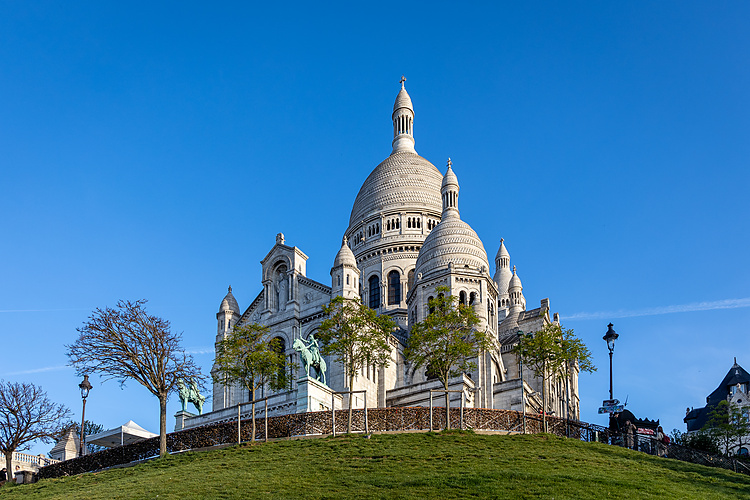 Image: Superbass / Wikimedia Commons (CC BY-SA 4.0, cropped, resized, and sharpened)The exterior walls are made of limestone, which retains its whiteness when exposed to rainwater. The basilica stands out as a landmark on the hill even from a distance, and when you turn around on the steps or in the forecourt, Paris stretches out before you. Combining the visit with a walk toward Place du Tertre lets you experience the difference in elevation between the basilica and Montmartre.
The Large Mosaic at the Rear and Eucharistic Adoration
Inside the basilica, the most striking feature is the large mosaic covering the entire apse. At its center, Christ is depicted with outstretched arms, surrounded by numerous figures and decorative motifs. This richly ornamented space offers a vivid contrast to the predominantly white exterior.
The Sacré-Cœur Basilica is also a site of perpetual Eucharistic adoration, which has continued since 1885. Although it attracts many tourists, it remains an active place of prayer, so visitors are expected to remain quiet inside.
View from the Dome
Climbing to the dome through a separate entrance offers a view over Paris from higher up than the forecourt. The white basilica seen from ground level, the large mosaic decorating the interior, and the panorama from the dome give Sacré-Cœur a distinctly different character depending on where you view it from.
Background to the Construction and Its Completion
The impetus for building the Sacré-Cœur Basilica came from the great upheavals France experienced in the latter half of the 19th century. France was defeated in the Franco-Prussian War, which began in 1870, and the Paris Commune was established the following year, 1871, causing profound social unrest.
During this period, a movement spread to build a sanctuary where people could pray for France’s renewal and peace. Montmartre Hill, long closely associated with faith, was chosen as the building site. In 1873, the construction was recognized as a national undertaking, and in 1875, the foundation stone was laid.
The design was created by the architect Paul Abadie. The Romanesque-Byzantine style, unusual in Paris at the time, was adopted, and the basilica’s distinctive appearance took shape with small domes arranged around the large central dome.
However, constructing the enormous basilica took many years. Work progressed gradually from the end of the 19th century into the beginning of the 20th century and was also affected by the First World War. The building was nearly complete around the period before and after the war, but its official consecration was not held until 1919. Further work on the details continued, and the entire structure was completed in 1923.
Montmartre
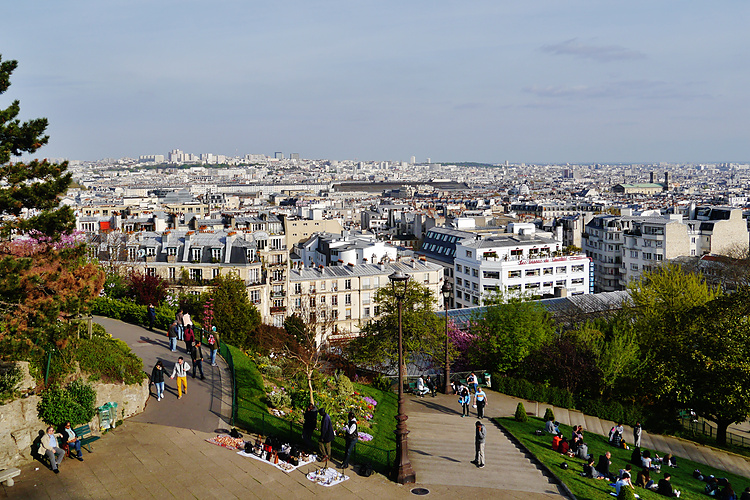 Image: Zairon / Wikimedia Commons (CC BY-SA 4.0, cropped, resized, and sharpened)Montmartre hill offers sweeping views over Paris. Standing at its summit, the Sacré-Cœur Basilica and the surrounding streets once frequented by artists together form the neighborhood’s iconic landscape.
Walks around Montmartre, including Place du Tertre, are introduced in the article “Montmartre”.
Basic information about the Sacré-Cœur Basilica
The information below was checked against official sources on October 11, 2026. Please also check the latest information on the official website when planning your trip.
- 🔗 Official website
-
Check visiting hours, admission fees, and entry conditions.
 Horaires et accès - Basilique du Sacré-Cœur de MontmartreOuverture La basilique est ouverte tous les jours de l'année, sans exception, de 6h30 à 22h30. L'entrée est gratuit...www.sacre-coeur-montmartre.com
- 📍 Address
- 35, rue du Chevalier de La Barre, 75018 Paris
- 🕒 Visiting hours
-
- Basilica: Daily, 6:30–22:30. Closing may be delayed due to liturgical services.
- Dome: 10:15–17:30, with last admission at 17:00. It closes temporarily at midday, and hours vary by season.
⚠️ Photography is prohibited in the nave. Video recording inside the basilica is also generally not permitted.
- 🚫 Closed days
- The basilica is open year-round. The dome may close due to weather or maintenance work.
- 💶 Admission
-
- Basilica interior: Free.
- Dome: €8 for visitors aged 16 and over; €5 for those aged 15 and under.
- ⏱ Suggested visit duration
- Allow about 45 minutes to 1 hour for the basilica interior and forecourt, or about 1 hour 30 minutes if you also climb the dome. ⚠️ Visit duration varies depending on crowds and whether you visit the dome.
Getting to the Sacré-Cœur Basilica
Metro
From Anvers station on Line 2, you climb uphill and up stairs. You can also walk through the Montmartre neighborhood from Abbesses station on Line 12.
Funicular
You can take the Montmartre funicular from the foot of the hill. It accepts Paris public transport tickets and is convenient if you want to avoid the steep stairs.
For attractions, transport and suggested itineraries, see “Paris: A guide to attractions, food, transportation, and suggested itineraries”.