Highlights of Shioyazaki Lighthouse
At Shioyasaki Lighthouse, you can enjoy the view from the white tower and trace its history from its first lighting to its restoration after the earthquake, as well as its connections with films and songs.
The White Lighthouse and Views of the Pacific Ocean
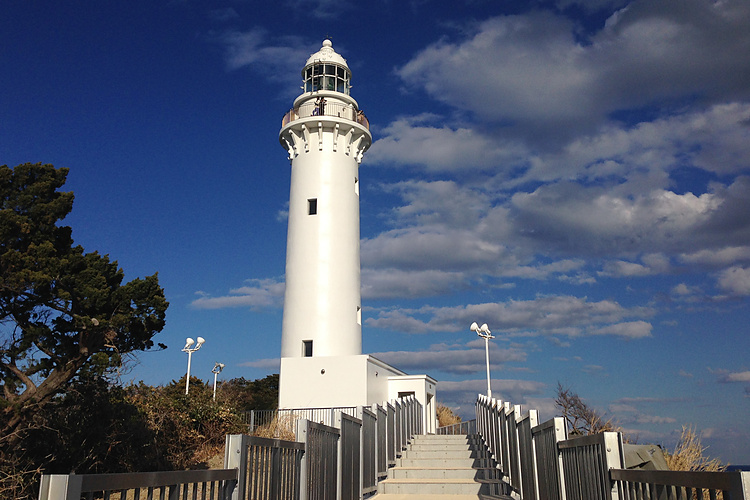 Image: hiroaki / Wikimedia Commons (CC BY 2.0, cropped, resized, and sharpened)Shioyasaki Lighthouse was selected as one of Japan’s 50 Best Lighthouses. This concrete lighthouse stands 27 m tall. Its light is located approximately 73 m above average sea level and has a range of about 41 km. From the landing at the top of the interior staircase, you can look out over the Pacific Ocean and the coastline of Iwaki’s seven beaches.
History from the First Lighting to Post-Earthquake Restoration
Shioyasaki Lighthouse was first lit on December 15, 1899. The original brick-and-stone lighthouse was severely damaged in the 1938 earthquake off the coast of Fukushima Prefecture and was rebuilt as the reinforced-concrete structure seen today. It was also damaged and its light went out during the 2011 Great East Japan Earthquake, but the light was restored about 9 months later. After the access road and other areas were restored, tours resumed in February 2014. The lighthouse exhibition room also introduces the lighthouse’s role and history.
Connection to the film “Times of Joy and Sorrow”
The memoir of the Shioyasaki Lighthouse keeper’s wife, published in a magazine in 1956, inspired the film “Times of Joy and Sorrow,” which portrays the lives of lighthouse keepers and their families. Hibarinoen Park at the foot of the lighthouse also contains a monument to the film, offering visitors both views of the lighthouse and a glimpse into the lives of its keepers.
Hibari no Sono and Misora Hibari’s “Midare-gami”
Hibari no Sono at the foot of the lighthouse tells the story of the connection between “Midare-gami,” the song Misora Hibari released as her first work after returning from a serious illness, and Shioyazaki Cape. The site features a song monument, a memorial stele with her posthumous portrait, and a bronze statue. When you stand in front of the portrait stele, a sensor plays “Midare-gami.” The “Eternal Hibari Statue” plays the melody of “Sad Whistle,” and in 2024, a bronze statue that had been exhibited at the Misora Hibari Museum in Uzumasa, Kyoto, was also relocated here.
Basic Information about Shioyazaki Lighthouse
The information below was checked against official sources on September 20, 2026. Please also check the latest information on the official website when planning your trip.
- 🔗 Official website
- Check the visiting hours, the required admission donation, and possible closures due to bad weather.
塩屋埼灯台(しおやさき) | 「灯台のことなら」 公益社団法人 燈光会www.tokokai.org
- 📍 Address
- 〒970-0223 34 Shukuzaki, Taira Usuiso, Iwaki, Fukushima
- 🕒 Opening hours
-
- Morning (year-round) 9:00–12:00
- Weekends and designated days from March to September 13:00–16:30
- Weekdays from March to September 13:00–16:00
- October to February 13:00–16:00
⚠️ There is a midday break from 12:00 to 13:00. Last admission is 30 minutes before closing in both the morning and afternoon. “Weekends and designated days” includes Saturdays, Sundays, public holidays, other holidays, Golden Week, August 10–19, and December 29–January 3.
- 🚫 Closed days
- No regular closing days are listed. ⚠️ Visits may be suspended during strong winds or other bad weather.
- 💶 Admission
-
- Junior high school students and older 300 yen (required admission donation)
- Elementary school students and younger Free
- Disability certificate holders and 1 companion Free
- 🎫 Tickets
- Pay the required admission donation on site to enter. No advance reservation or choice of ticket types is indicated. ⚠️ Visits may not be possible because of crowds or weather, so check the latest information on the day.
- ⏱️ Recommended time
- Allow approximately 45–60 minutes to see the lighthouse interior, the view, the exhibition room, and Hibari no Sono. Allow extra time for the stairs and your preferred sightseeing pace. ⚠️ The areas available for viewing and the length of your stay may change because of crowds, bad weather, or suspended visits.

Access to Shioyazaki Lighthouse
Local bus
From JR Iwaki Station, take a local bus toward Toyoma to “Lighthouse Entrance,” then walk for approximately 15 minutes. Since the number of services and operating days may vary, check the latest timetable and service information before traveling.
By car
It takes approximately 30 minutes from the Iwaki-Chuo Interchange on the Joban Expressway. At the foot of the lighthouse, there is parking for 50 regular cars and parking space for large vehicles.
Information on getting there by public transportation or car, as well as parking, is available in the official tourism guide.

The related guide “【いわき】観光スポット・グルメ・交通・モデルコースを解説” is currently available only in Japanese.