Highlights of Kennin-ji Temple
Kennin-ji is the head temple of the Kennin-ji school of Rinzai Buddhism and is considered Kyoto’s oldest Zen temple. It was founded in 1202, when shogun Minamoto no Yoriie donated the temple grounds and the Zen master Eisai was appointed its founder. Visitors can see the hōjō garden, the twin dragons in the Dharma Hall, and a high-resolution reproduction of Tawaraya Sōtatsu’s folding screen depicting the Wind and Thunder Gods.
The Abbot’s Quarters and Gardens
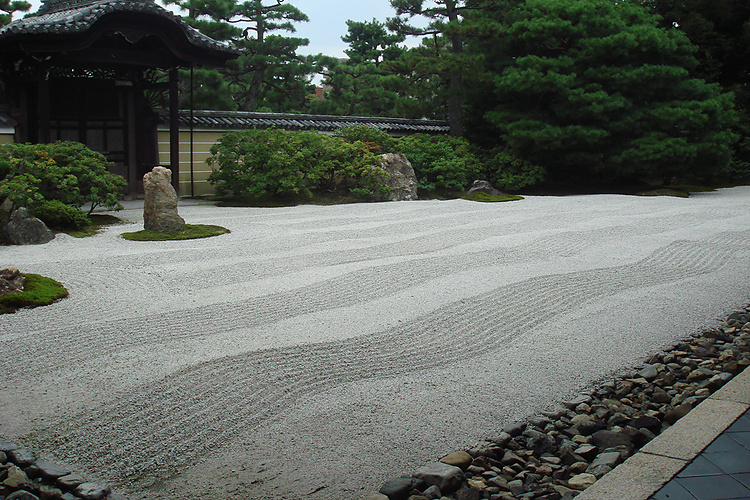 Image: Olivier Lejade (France) / Wikimedia Commons (CC BY-SA 2.0, cropped, resized, and sharpened)
The hōjō is a building that Ankokuji Ekei relocated from Ankokuji Temple in the former province of Aki in 1599. In front of the hōjō stretches Daiyū-en, a dry landscape garden covered in white sand, which can be viewed in its entirety from inside the building. Chōon Garden in the inner courtyard of the main temple complex is designed to be viewed from all four sides, with stones representing the three buddhas and stones for zazen. As you walk around it, the way the stones, moss, and autumn leaves overlap changes with your viewpoint.
Twin Dragons Painting in the Hattō Hall


The Twin Dragons painting covering the ceiling of the Dharma Hall was created by Koizumi Junsaku to commemorate the 800th anniversary of Kennin-ji’s founding. Two dragons, one with its mouth open and the other closed, are rendered in ink across a surface measuring 11.4 m high and 15.7 m wide. Dragons have traditionally been painted in the Dharma halls of Zen temples as guardians of Buddhist teachings and beings that bring down the rain of the Dharma. Looking up, you can experience the scale of this ink painting, which covers an area equivalent to 108 tatami mats.
Wind God and Thunder God Screens and Kaihō Yūshō’s fusuma paintings
The National Treasure “Wind and Thunder Gods Screens” by Tawaraya Sōtatsu is a pair of two-panel folding screens with the wind god depicted on the right-hand gold ground and the thunder god on the left. The original is entrusted to the Kyoto National Museum, while a high-resolution reproduction can be viewed at Kenninji Temple. The abbot's quarters also preserve paintings on fusuma sliding doors by Kaihō Yūshō, an artist of the Momoyama period, including “Dragon in the Clouds” and “Seven Sages of the Bamboo Grove.” Visitors can therefore appreciate both the architecture of a Zen temple and its wall and door paintings.
Basic Information about Kennin-ji Temple
The information below was checked against official sources on October 4, 2026. Please also check the latest information on the official website when planning your trip.
- 🔗 Official Website
- Check visiting hours, admission fees, temporary closures, and visitor guidelines.
建仁寺 The Oldest Zen Temple Kenninji建仁寺は臨済宗建仁寺派の大本山で、建仁2年に開創しました。開山は栄西禅師、開基は源頼家です。坐禅体験、写経体験受け付けております。www.kenninji.jp
- 📍 Address
- Komatsu-cho 584, Yamato-oji-dori Shijo-sagaru, Higashiyama Ward, Kyoto
- 🕒 Visiting Hours
- 10:00–17:00 (last admission at 16:30). The site may be closed to visitors during events or Buddhist services.
- 💴 Admission
-
- Adults: 800 yen. The fee is scheduled to change to 1,000 yen from January 1, 2027.
- Elementary, junior high, and high school students: 500 yen
- Children below elementary school age: Free
- ⏱ Suggested Visit Duration
- Allow approximately 45 minutes to 1 hour to see the Hojo garden, Dharma Hall, and sliding-door paintings. ⚠️ The time required varies depending on crowd levels and which areas are open.

Getting to Kennin-ji Temple
Railway
It is about a 7-minute walk from Gion-shijo Station on the Keihan Main Line and about a 10-minute walk from Kyoto-kawaramachi Station on the Hankyu Kyoto Line. If approaching from Hanamikoji Street, use the North Gate as a landmark; from Yasaka Street, look for the area around the Chokushimon Gate. Its location makes it an easy stop while strolling through Gion's historic streets.
Local buses
It is about 5 minutes on foot from the Kyoto City Bus Higashiyama Yasui stop, and about 7 minutes from the Shijo Keihan-mae or Minamiza-mae stops. From the Gion or Kiyomizu-michi stops, it is about 10 minutes on foot. Traffic may cause delays, so allow plenty of time for the journey.
By car
The parking lot for passenger cars is near the North Gate. On weekdays, the fee from 8:00 to 20:00 is 300 yen per 20 minutes; on holidays, the fee during the same hours is 300 yen per 15 minutes. At night, the fee is 300 yen per 30 minutes on both weekdays and holidays. Motorcycles and buses cannot use this parking lot, so please use public transportation or a nearby parking lot that accommodates them.
For attractions, transport and suggested itineraries, see “Kyoto: A guide to attractions, food, transportation, and suggested itineraries”.